President Trump Proposes New National AI Initiative to Accelerate Tech Growth
Washington, Sunday, 20 September 2026.
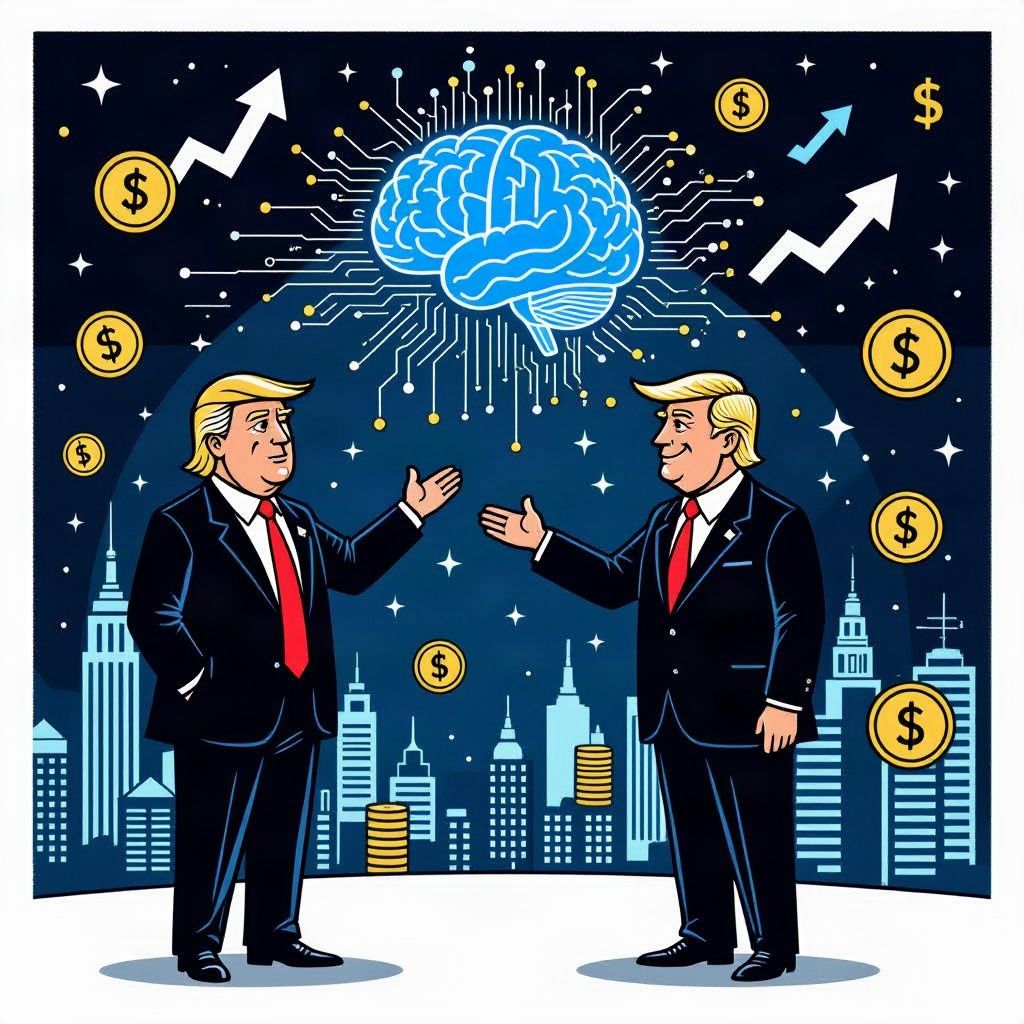
President Trump announced plans for a new “AI Force” and dedicated czar to foster industry growth, projecting artificial intelligence could eventually account for 25% of U.S. economic output.
Strategic Pivot on Federal Oversight
In a notable shift from his administration’s stance earlier in the month, President Donald Trump announced on Saturday, 19 September 2026, the creation of a federal ‘AI Force’ and the appointment of a dedicated artificial intelligence czar [1][2]. This development comes just 5 days after the President previously rejected federal artificial intelligence guardrails to prioritize economic growth [6]. The new initiative aims to consolidate federal oversight while streamlining regulatory frameworks to secure American competitiveness in emerging technologies [1]. While the White House has yet to provide specific details regarding the structure of the AI Force, the announcement signals a potential consolidation of federal AI oversight that could impact policy timelines and compliance standards [1][3].
Structure and Enforcement Mechanisms
President Trump modeled the proposed AI Force after the Space Force established during his first term, emphasizing a focus on monitoring rather than hindering industry growth [3][5]. In a Truth Social post, the President stated that the administration would not ‘hinder or stifle’ the industry but would look for ‘BAD’ actors using the existing Criminal and Civil Justice System [3][4]. This approach contrasts with calls from researchers and industry leaders for a slowdown in technology development, which Trump has dismissed as a ‘hoax’ perpetuated by political opponents [1][3]. The appointment of a new AI Czar is intended to lead this national strategy, following the conclusion of David Sacks’s tenure as White House A.I. & Crypto Czar in March 2026 [2].
Economic Projections and State-Level Responses
The administration projects that artificial intelligence could drive a new industrial revolution, eventually accounting for as much as 25% of U.S. gross domestic product (GDP) [4][5]. This economic optimism persists despite warnings from figures like Nobel laureate Geoffrey Hinton, who cautioned Congress that there may be only a year left to regulate AI before it becomes uncontrollable [1]. Concurrently, state-level actions are diverging, with California Governor Gavin Newsom signing an executive order on 18 September 2026, to increase AI industry oversight and propose a ‘kill switch’ for AI systems [1]. Governors in Virginia and Pennsylvania have also established task forces or advocated for federal regulation, highlighting a growing bipartisan concern over the risks posed by rapid artificial intelligence development [1].