Why Recent College Graduates Are Swapping Office Desks for Service Work
New York, Friday, 18 September 2026.
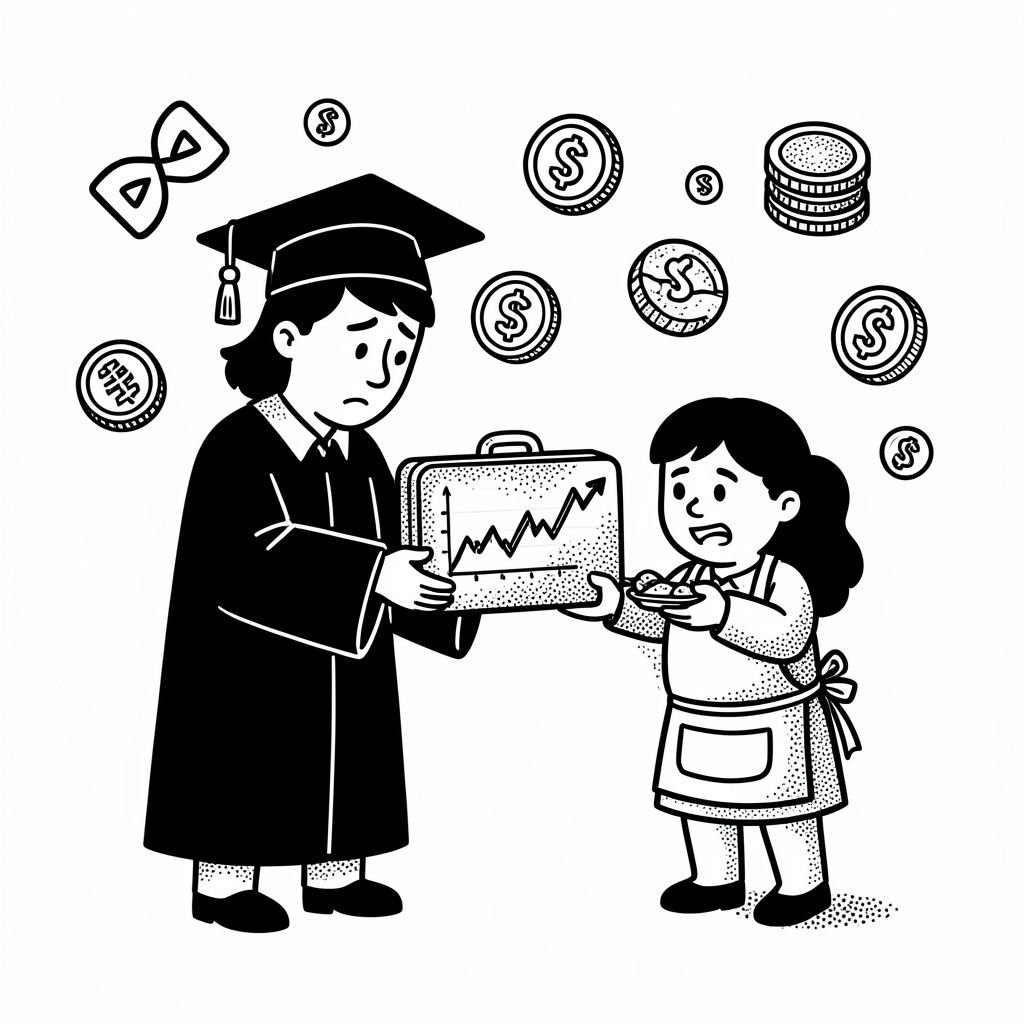
Entry-level hiring in fields exposed to artificial intelligence has contracted sharply, driving college graduates into lower-paying retail and food service jobs with initial earnings dropping 13 percent.
The Shift to Service Work and Hiring Contraction
Recent data indicates a significant contraction in entry-level hiring within fields heavily exposed to artificial intelligence, driving college graduates toward retail and food service roles [1]. According to a Census Bureau paper released on September 10, 2026, graduates of the most AI-exposed majors saw their probability of holding a job one quarter post-graduation drop by 5 percentage points [1]. Initial earnings for these graduates have fallen by 13 percent, a decline comparable to the effects of a severe recession [1]. This trend is particularly acute in technology hubs; NYC entry-level tech postings have fallen 49 percent since 2022 [5]. Similarly, a nearly 49 percent drop in entry-level tech jobs and a 34 percent drop in Art, Design, and Media roles have been observed since the launch of ChatGPT in 2022 [7]. The labor market for workers aged 22 to 34 shows a divergence, where non-degree holders experience unemployment near the low end of their two-decade range, while college graduates face levels comparable to the 2007–2009 recession [6].
Conflicting Data on Unemployment and Remote Work
While some data suggests a sharp decline, other research indicates no statistically significant spike in unemployment for recent graduates in summer 2026 relative to previous years [3]. An SSRN paper posted on September 16, 2026, found no evidence of a significant increase in relative unemployment rates using difference-in-differences models [3]. [alert! ‘Conflicting data between Census Bureau earnings drop and SSRN unemployment stability’] However, the Federal Reserve Bank of New York identified remote work as a primary driver for increased unemployment among young graduates, noting that the four-fold increase in remote work since the pandemic hinders the ability of employers to train inexperienced workers [2]. A March 2026 Handshake report shows that over 10 percent of active internship postings mentioned AI-related keywords, while full-time job postings mentioning AI nearly doubled year-over-year to 4.2 percent [2]. Employers remain 2.7 times more likely to expect AI to increase entry-level hiring rather than decrease it, according to a May 2026 Strada Institute report [2].
Economic Implications and Wage Pressure
The composition of recent job growth highlights a concentration in service sectors rather than knowledge work. According to the U.S. Bureau of Labor Statistics report released September 4, 2026, the economy added 162,000 jobs in August, with food services and drinking places accounting for 59,000 of those positions [6]. This represents 36.42 percent of total job growth, underscoring the demand for in-person labor [6]. AI implementation is causing a pullback in job openings for knowledge work roles, particularly affecting younger workers [4]. Research analyzing 321 occupations found that AI-exposed jobs experienced slower wage growth over the past three years, while net employment levels remained steady [4]. This suggests companies are capturing productivity gains by suppressing wages rather than reducing headcount [4]. Wage pressure is currently strongest in skilled trades and on-site service roles where tasks are difficult to automate [6].
Future Outlook and Enrollment Changes
Student behavior is beginning to reflect these labor market shifts, with computer science enrollment declining 8.4 percent by August 6, 2026 [1]. A Goldman Sachs analysis from June 2026 reported that computer science and programming enrollment fell over 10 percent during the 2025-26 academic year [1]. In May 2025, Dario Amodei, CEO of Anthropic, predicted AI could eliminate 50 percent of entry-level white-collar jobs within five years [4]. On September 12, 2026, Amodei issued a warning regarding catastrophic consequences if AI development continues unchecked [4]. The current data cannot separate an AI effect from an ordinary hiring slowdown in professional roles, as both would look the same in the unemployment numbers [6]. Future labor market trajectories depend on whether entry-level professional hiring will recover or if companies have permanently reduced starting class sizes [6].
Sources
- fortune.com
- journalistsresource.org
- papers.ssrn.com
- www.nytimes.com
- www.facebook.com
- www.ivorywealthmgmt.com
- www.facebook.com