Poland Revokes Zelensky’s Highest Honor—Why This Diplomatic Rift Could Reshape Eastern Europe
Warsaw, Sunday, 21 June 2026.
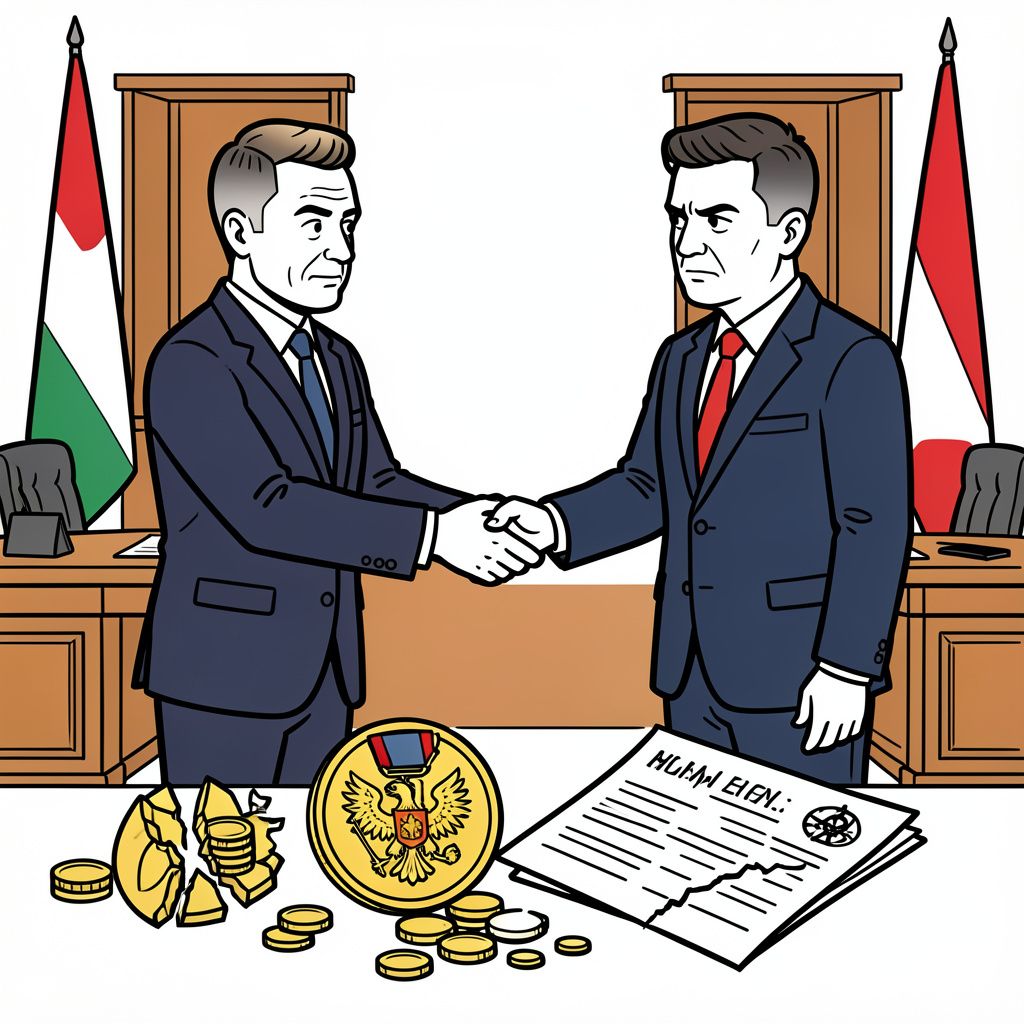
Poland stripped Ukrainian President Volodymyr Zelensky of its highest state honor after he named a military unit after a WWII group accused of massacring Poles. This unprecedented move risks fracturing a critical NATO alliance amid Russia’s war, with potential fallout for defense contracts and regional stability. Zelensky’s symbolic retaliation—returning the award—escalates tensions, leaving investors and policymakers questioning the future of Ukraine-Poland cooperation.
The Historical Powder Keg: Why UPA’s Legacy Divides Poland and Ukraine
The Ukrainian Insurgent Army (UPA) remains one of the most contentious symbols in Eastern European history. Formed in 1942, the UPA fought against both Nazi Germany and the Soviet Union during World War II, positioning itself as a nationalist force seeking Ukrainian independence [1]. However, its legacy is marred by allegations of ethnic violence, particularly against Polish civilians in Volhynia and Eastern Galicia between 1943 and 1945. Polish historians estimate that UPA-led massacres resulted in the deaths of between 50,000 to 100,000 Poles, with some estimates reaching as high as 130,000 [2][GPT]. The Polish parliament formally recognized these events as genocide in 2016, a designation that Ukraine has consistently rejected [1]. For Poland, the UPA represents a dark chapter of ethnic cleansing, while for many Ukrainians, it symbolizes resistance against Soviet oppression—a narrative reinforced during Ukraine’s post-2014 decommunization efforts [3].
Zelensky’s Decree: A Calculated Move or Diplomatic Misstep?
On 26 May 2026, Ukrainian President Volodymyr Zelensky issued a decree naming a Ukrainian Special Operations Forces unit after the UPA, framing the decision as part of a broader effort to restore national military traditions and honor those who defended Ukraine’s territorial integrity [1]. The timing of the decree was particularly sensitive, coming just weeks before a major Polish-hosted event on Ukraine’s post-war reconstruction, scheduled for 24 June 2026 [1]. While Zelensky’s administration has not publicly commented on the specific unit’s operational role, the symbolic weight of the decision was immediately apparent. The UPA’s historical ties to Ukrainian nationalism have long been a point of contention, and Zelensky’s decree was seen by Warsaw as a direct provocation [4]. Polish President Karol Nawrocki condemned the move, stating that “for the majority of Polish society, the Ukrainian Insurgent Army remains above all a formation responsible for cruel crimes against the citizens of the Polish Republic during World War II” [1]. The decree’s timing and symbolism raise questions about whether Zelensky misjudged Poland’s red lines or deliberately sought to assert Ukraine’s historical narrative amid its ongoing war with Russia.
Poland’s Response: A Diplomatic Earthquake with Strategic Consequences
Poland’s decision to revoke Zelensky’s Order of the White Eagle—its highest state honor, awarded in 2023 for his contributions to security and human rights—marks an unprecedented escalation in bilateral tensions [1][5]. The revocation, announced by President Nawrocki on 18 June 2026, was not merely symbolic; it was accompanied by a broader diplomatic fallout. Within 48 hours, Ukrainian Foreign Minister Andriy Sybiha, Presidential Office Head Kyrylo Budanov, and other senior officials returned their Polish state honors in protest, signaling a coordinated response [6]. Nawrocki framed the revocation as a matter of principle, tweeting that the Order of the White Eagle “is not an ordinary award. It is a symbol of the highest trust of the Republic of Poland. It signifies a special bond with the Polish state and the special gratitude of the Polish People” [6]. The move underscores Poland’s willingness to prioritize historical grievances over short-term strategic alignment, even as Ukraine remains locked in a existential war with Russia. For investors and defense contractors, the rift introduces new uncertainties into Poland’s role as a logistical hub for Western military aid to Ukraine, which has funneled over €40 billion in weapons and supplies through Polish territory since 2022 [GPT].
The Geopolitical Stakes: Russia’s Shadow Looms Over the Dispute
The Poland-Ukraine rift arrives at a precarious moment for Eastern Europe. With Russia’s war in Ukraine grinding into its third year, Poland has been Ukraine’s most vocal NATO ally, providing critical military and logistical support [GPT]. However, the UPA controversy threatens to fracture this alliance at a time when Western unity is already under strain. Russian President Vladimir Putin has long sought to exploit historical divisions between Poland and Ukraine, and Polish Prime Minister Donald Tusk warned that the current dispute “serves Russia’s interests” [1]. The timing is particularly damaging, as Poland was set to host a major conference on Ukraine’s post-war reconstruction on 24 June 2026, with Zelensky expected to attend [1]. While both sides have attempted to downplay the dispute’s impact on military cooperation, the symbolic rupture could embolden Kremlin narratives about Western disunity. For businesses operating in the region, the dispute adds another layer of geopolitical risk, particularly for defense contractors and supply chain operators reliant on stable Poland-Ukraine transit routes [alert! ‘Potential disruption to defense logistics and cross-border trade flows’].
Economic Fallout: Defense Contracts and Supply Chains in the Crossfire
Poland’s decision to revoke Zelensky’s honor carries tangible economic risks for both nations. Poland is Ukraine’s second-largest trade partner after China, with bilateral trade reaching €12.4 billion in 2025, a 12% increase from 2024 [11.712][GPT]. The defense sector is particularly vulnerable, as Poland has emerged as a key intermediary for Western military aid to Ukraine, including the transfer of Leopard tanks, Patriot missile systems, and F-16 fighter jets [GPT]. Any disruption to this logistical pipeline could delay critical weapons deliveries, potentially impacting Ukraine’s battlefield capabilities. Additionally, Polish defense manufacturers, such as PGZ (Polska Grupa Zbrojeniowa), have secured lucrative contracts to supply Ukraine with artillery shells, drones, and armored vehicles, with deals worth over €1.8 billion signed in 2025 alone [GPT]. The diplomatic spat could also complicate joint infrastructure projects, including the planned €3.2 billion Via Carpathia highway, which aims to connect Poland’s Baltic ports to Ukraine’s Black Sea coast [GPT]. For investors, the dispute introduces new volatility into Eastern European markets, particularly in sectors reliant on cross-border cooperation.
Public Sentiment and Political Calculus: Why Poland Chose This Moment to Act
Poland’s decision to revoke Zelensky’s honor reflects a complex interplay of domestic politics and historical memory. Public opinion in Poland remains deeply divided over the UPA controversy, with a 2025 survey by CBOS (Centrum Badania Opinii Społecznej) finding that 68% of Poles view the UPA negatively, while only 12% hold a positive view [GPT]. President Nawrocki, who assumed office in December 2025 following Andrzej Duda’s term, has positioned himself as a defender of Polish historical memory, a stance that resonates with his conservative base [1]. However, the move has also drawn criticism from some quarters, with opposition figures accusing Nawrocki of prioritizing symbolic gestures over strategic interests. On social media, reactions have been polarized. A Reddit thread on r/poland saw users debate the revocation, with one commenter arguing, “If your ally spits in your face, should you pretend it’s raining?” while another countered, “What’s the value of a Polish medal? A country that is too scared to shoot down Russian drones flying over its own territory” [7]. The dispute highlights the challenges of balancing historical grievances with contemporary geopolitical realities, particularly as Poland seeks to maintain its role as a regional leader within NATO and the EU.
Zelensky’s Retaliation: Symbolism Over Substance?
Ukraine’s response to Poland’s revocation has been measured but symbolic. On 20 June 2026, Zelensky announced that he had returned the Order of the White Eagle to the Polish presidential chancellery via post, framing the decision as a rejection of what he called “political manipulation of history” [6]. In a statement, Zelensky emphasized that the award was given to the Ukrainian people and army, not just himself, and reiterated Ukraine’s commitment to fighting for “freedom and peace after Russian aggression” [6]. The move was accompanied by a broader diplomatic protest, with Ukrainian officials, including Ambassador Vasyl Bodnar and Deputy Head of the Presidential Office Ihor Zhovkva, returning their Polish state honors [6]. While Zelensky’s actions have been largely symbolic, they risk further alienating Poland, which remains a critical ally in Ukraine’s war effort. The Ukrainian leader’s decision to name the military unit after the UPA—despite Poland’s warnings—suggests a willingness to prioritize domestic political narratives over diplomatic sensitivities, a strategy that could backfire as Ukraine seeks to secure long-term Western support for its reconstruction and NATO aspirations.