Asia-Pacific Markets Surge as US-Iran Deal Ends 107-Day War and Unlocks Oil Supply
Tokyo, Monday, 15 June 2026.
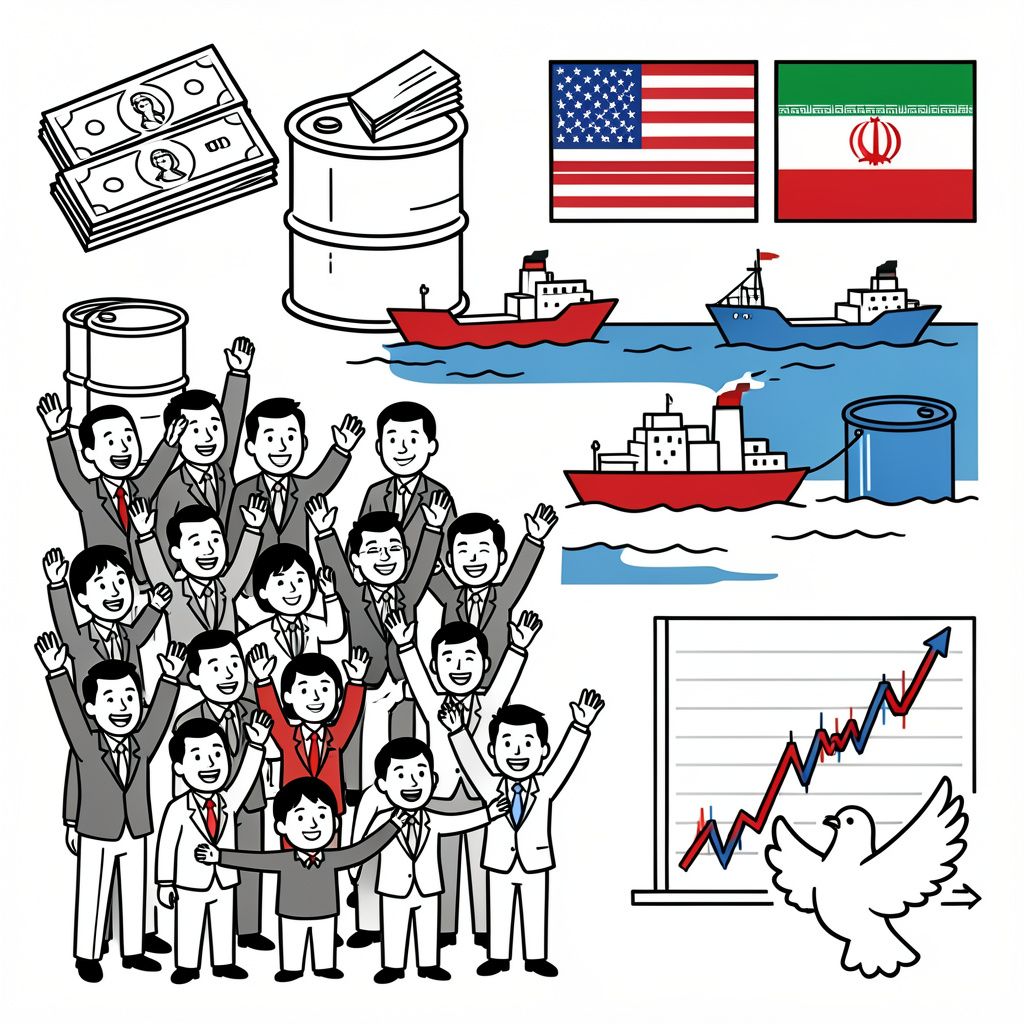
Stock markets across Asia soared by up to 5.7% on Monday after the US and Iran announced a historic deal to end their 107-day war, lifting sanctions and reopening the Strait of Hormuz—a critical chokepoint for 20% of global oil. The breakthrough sent oil prices plunging 4.5%, easing inflation fears just days before the US Federal Reserve’s rate decision. But the deal’s fine print reveals tensions: Iran will manage the strait under its sovereignty, while the US insists on toll-free access. With $24 billion in frozen assets at stake and nuclear talks looming, investors are betting on stability—even as Israel’s strikes in Lebanon and lingering infrastructure damage threaten a fragile peace.
From War to Markets: The Immediate Economic Shockwave
The Asia-Pacific region’s financial markets responded with unprecedented vigor to the announcement of a US-Iran peace deal, signaling a dramatic shift in investor sentiment after 107 days of conflict. Japan’s Nikkei 225 surged 5.5% in morning trading on Monday, 15 June 2026, while South Korea’s KOSPI climbed 5.7%, and Taiwan’s Taiex rose 2.7%. Australia’s ASX200 followed with a 1.5% gain, though Hong Kong’s Hang Seng saw more modest growth of 1% before paring some gains [1]. These movements reflect a broader regional rally, with US stock futures also indicating strong openings—1% for the S&P 500 and 1.8% for the Nasdaq Composite [1]. The surge underscores the market’s sensitivity to geopolitical stability, particularly in a region heavily reliant on Middle Eastern energy supplies. Khoon Goh, ANZ’s head of Asia research, noted that while markets had already reacted to earlier signals of a deal, ‘actual confirmation spurred a further rally’ [1].
Oil Prices Plunge as Strait of Hormuz Reopening Looms
The most immediate economic impact of the US-Iran agreement was felt in global oil markets, where Brent crude prices fell 4.5% to below $83.40 per barrel on 15 June 2026 [1]. This sharp decline reflects expectations of a rapid increase in oil supply as Iran prepares to reopen the Strait of Hormuz, a chokepoint that handles approximately 20% of global oil and liquefied natural gas (LNG) traffic [4][7]. The strait’s closure since late February 2026 had caused a daily shortfall of around 14 million barrels of oil, according to the International Energy Agency [2]. However, experts warn that the reopening process may not be instantaneous. Svein Ringbakken, managing director of the Norwegian Shipowners’ Mutual War Risks Insurance Association, cautioned that ‘even at full capacity, this would take months to restore to normal’ due to damaged infrastructure, mine-clearing operations, and logistical bottlenecks [2].
Economic Relief and Frozen Assets: A $24 Billion Question
The agreement includes provisions for the release of $24 billion in frozen Iranian assets, a critical lifeline for Tehran’s sanctions-strangled economy [2][7]. However, the timing and conditions of this release remain contentious. Iran initially proposed releasing half of the frozen assets early, with the remainder tied to the final agreement, but the US rejected this approach [5]. Instead, Qatar proposed a $12 billion package, comprising $6 billion in Iranian assets held in Qatar for humanitarian use and a $6 billion credit line [5]. The funds are expected to provide immediate economic relief, though Iran’s broader demands—including reconstruction funds and comprehensive sanctions relief—will be addressed in subsequent negotiations [5]. The phased approach reflects the deal’s delicate balance between immediate economic incentives and long-term nuclear non-proliferation goals.
Nuclear Negotiations: The 60-Day Ceasefire Clock
The current agreement represents only the first stage of a broader diplomatic effort. The MoU establishes a 60-day ceasefire, during which the US and Iran will negotiate the second stage of the deal, focusing on Iran’s nuclear program and ‘one or two other [unspecified] issues’ [5]. The nuclear negotiations will be particularly fraught, with Iran accepting a 5-year enrichment moratorium while the US pushes for a 20-year commitment [5]. A key sticking point is the disposition of Iran’s highly enriched uranium (HEU) stockpile, which has grown to over 400 kg (approximately 900 lbs) since Iran’s withdrawal from the 2015 nuclear deal [7]. Iran demands that the HEU be down-blended within its borders, while the US seeks to down-blend or destroy the material either in Iran or the US [5]. The urgency of these talks is underscored by Iran’s recent efforts to safeguard its HEU stockpile, including collapsing tunnels and booby-trapping entrances with explosive mines [5].
Regional Fallout: Lebanon and Israel’s Shadow Over the Deal
The agreement’s success is further complicated by ongoing hostilities between Israel and Iran-backed Hezbollah in Lebanon. The MoU includes an immediate and permanent cessation of military operations on all fronts, including Lebanon [3][7]. However, Israel’s exclusion from the negotiations and its continued strikes in Beirut have cast doubt on the deal’s ability to deliver lasting peace. On 14 June 2026, hours before the expected signing, Israel conducted airstrikes on Hezbollah targets in Beirut, prompting Iranian threats to walk away from the deal [4]. Trump publicly criticized Israeli Prime Minister Benjamin Netanyahu, calling him ‘fucking crazy’ and lacking ‘fucking judgment’ in a New York Times interview, while also warning both sides not to escalate the conflict [3][7]. The inclusion of Lebanon in the ceasefire remains a contentious issue, with Iran’s deputy foreign minister Kazem Gharibabadi declaring a ‘permanent and immediate end to the war’ on all fronts, a claim not echoed by Trump in his initial announcements [3].
Inflation and Central Banks: The Fed’s Dilemma
The timing of the US-Iran deal could not be more critical for central banks grappling with inflationary pressures. The European Central Bank (ECB) raised its key interest rate by 0.25 percentage points on 11 June 2026, its first hike since 2023, citing the energy shock from the Iran war as a key driver [8]. With US inflation reaching 4.2% in May 2026—the highest in three years—the Federal Reserve’s upcoming rate decision on 17 June 2026 has taken on added significance [8]. Khoon Goh of ANZ noted that the fall in oil prices ‘will provide some relief for central banks around the world who were worried about the inflation outlook’ [1]. However, the long-term impact on inflation remains uncertain, given the potential for delays in fully restoring oil supply chains and the risk of renewed geopolitical tensions. US Vice President JD Vance described the deal as ‘a great thing for the American people,’ adding that it would help drive down energy costs in the long term [8].
The Road Ahead: Signing Ceremony and Beyond
The official signing ceremony for the US-Iran MoU is scheduled for 19 June 2026 in Switzerland, following an electronic agreement reached on 12 June 2026 [4][7]. The ceremony will formalize the terms of the ceasefire, the reopening of the Strait of Hormuz, and the phased release of frozen Iranian assets. However, the deal’s implementation faces significant hurdles, including the need for mine-clearing operations in the strait, the repair of damaged infrastructure, and the establishment of security guarantees for commercial vessels [2]. Trump stated that the strait would be open ‘upon the signing of the Deal on Friday, for purposes of mine removal,’ suggesting a gradual reopening process [4]. Meanwhile, global leaders have welcomed the agreement, with the E4 (UK, France, Germany, and Italy) emphasizing the need for ‘unconditional and unrestricted freedom of navigation’ in the Strait of Hormuz [3]. The coming weeks will be critical in determining whether the deal can deliver on its promise of stability or whether lingering tensions will undermine its fragile foundations.
Sources
- www.aljazeera.com
- www.theguardian.com
- understandingwar.org
- www.axios.com
- www.reuters.com
- www.aljazeera.com
- www.cnbc.com
- www.pbs.org