Saudi Airspace Denial Forces U.S. to Halt Strait of Hormuz Military Escorts
Washington, D.C., Thursday, 7 May 2026.
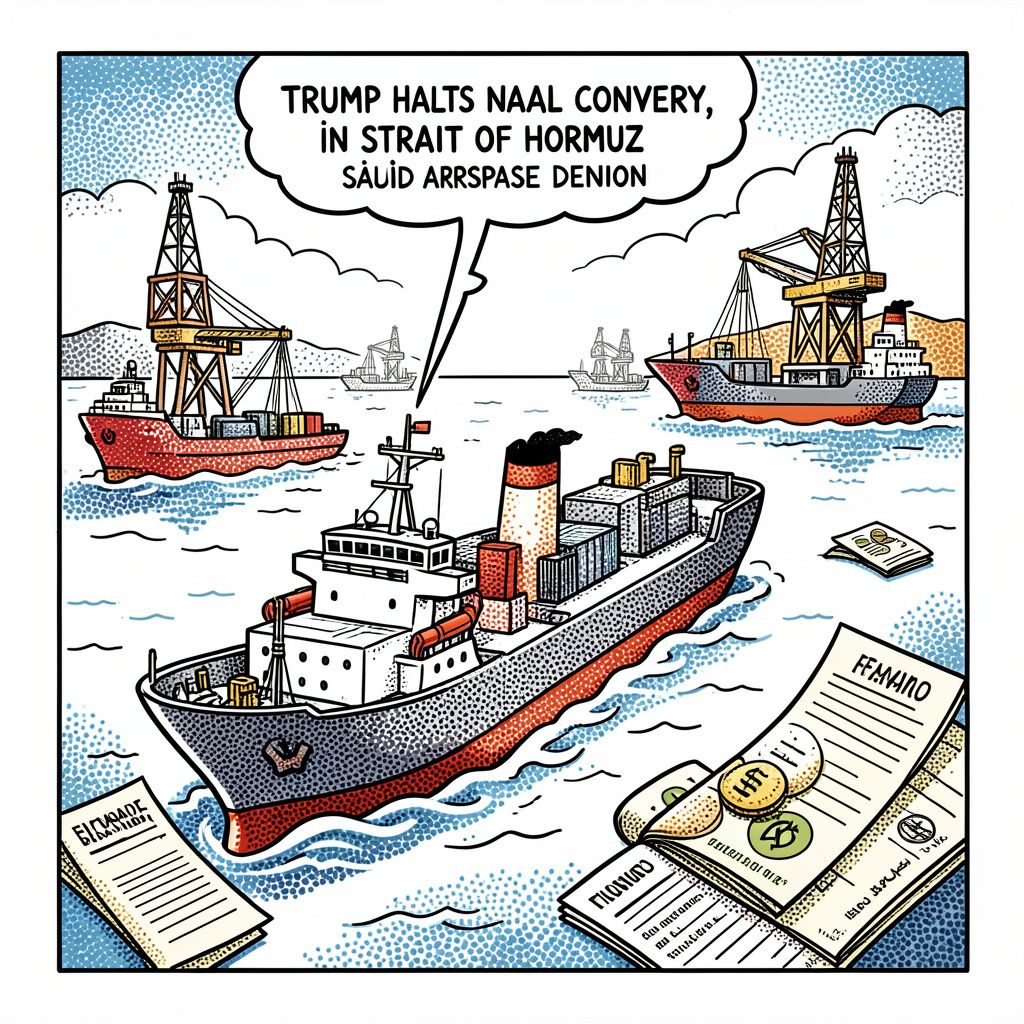
Saudi Arabia’s sudden denial of U.S. airspace access forced President Trump to halt operations in the Strait of Hormuz, leaving 22,500 mariners stranded and energy markets highly volatile.
A Diplomatic Misstep and Saudi Pushback
While earlier coverage highlighted that global oil prices briefly plummeted below $100 a barrel amid hopes of a 14-point peace agreement, the suspension of the U.S. military’s “Project Freedom” was fundamentally driven by immediate tactical roadblocks [GPT]. Announced by President Trump on Sunday, May 3, 2026, the ambitious initiative intended to utilize 15,000 U.S. military personnel and over 100 aircraft to escort stranded commercial vessels [1][4]. However, the administration launched the plan without prior coordination with key regional allies [1]. This unilateral move angered Saudi Arabia, prompting the kingdom to abruptly suspend U.S. military access to its airspace and critical facilities, including the Prince Sultan Airbase [1].
Chaos in the Strait and Persistent Blockades
The operational pause has left merchant ships highly vulnerable. On Tuesday, May 5, the French container ship San Antonio, operated by CMA CGM, suffered an attack in the strait that injured eight crew members [6][7]. A public dispute immediately ensued; while CMA CGM claimed the vessel was transiting under the umbrella of Project Freedom, a U.S. military official countered that the ship had not followed coordination guidelines and had instead requested assistance from Oman [6].
Iran’s Power Play and Economic Bleeding
The economic toll of closing the 34-kilometer-wide maritime chokepoint is severe [8]. With the strait acting as a conduit for approximately one-fifth of global oil consumption [5], Goldman Sachs estimates that Gulf Cooperation Council states are bleeding roughly $700 million daily [7]. Simultaneously, over 1,550 commercial vessels carrying 22,500 mariners remain stranded in the Persian Gulf [3][5].
The Long Road to Normalization
For the global shipping industry, political rhetoric has yet to translate into navigable waters. Lloyd’s List Intelligence reported that transit volumes in the strait decreased from 44 to 36 passages in a single week, representing a drop of -18.182% [3]. Major operators, including Hapag-Lloyd, have stated that transits are currently impossible for their fleets [8]. Maritime security experts caution that even if a diplomatic resolution is reached, the resumption of prewar traffic levels will be a gradual process requiring demonstrable security guarantees and extensive mine-clearing operations [3].
Sources
- www.nbcnews.com
- www.npr.org
- www.nbcnews.com
- www.bbc.com
- www.war.gov
- www.nytimes.com
- www.aljazeera.com
- www.npr.org