United States Enters High-Stakes Beijing Summit With Diminished Bargaining Power
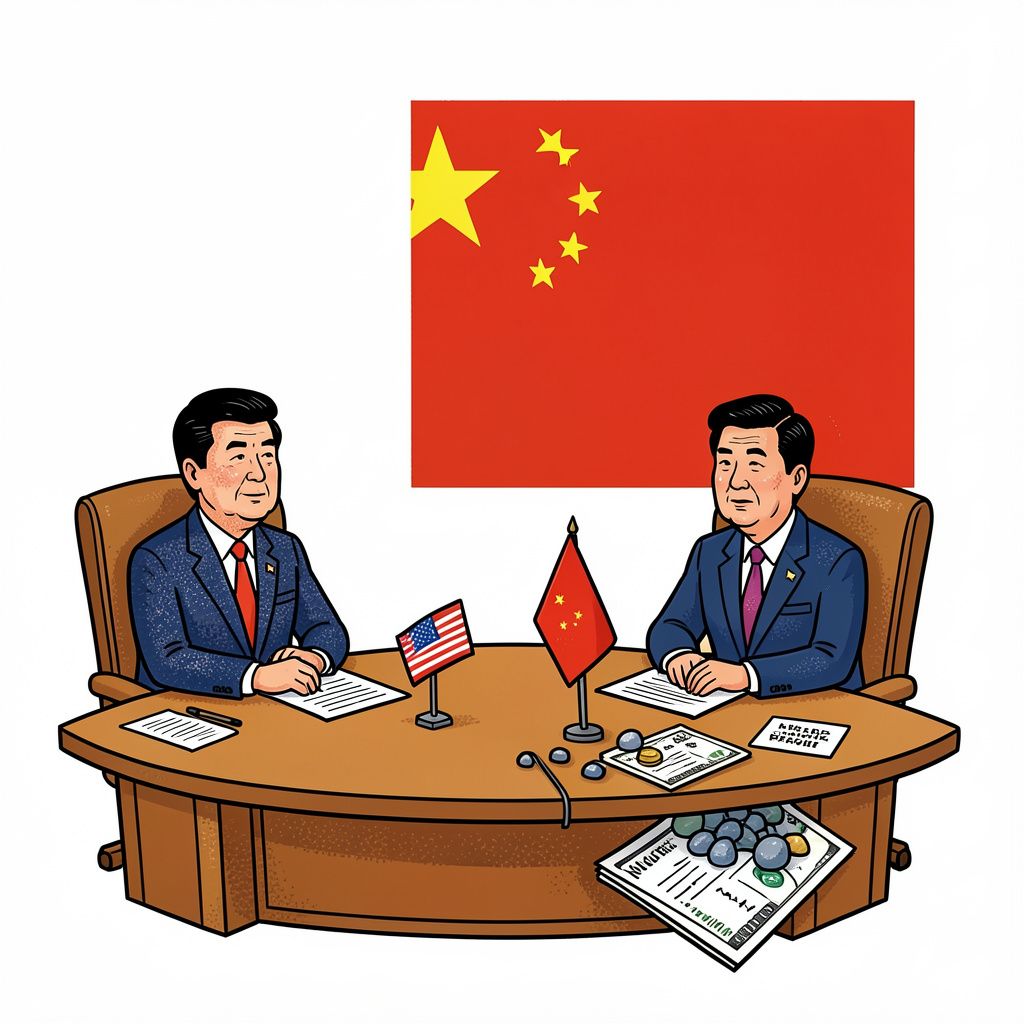
Beijing, Sunday, 10 May 2026.
Ahead of the May 14 Beijing summit, the United States faces diminished negotiating power as China leverages its fortified dominance over critical rare earth minerals and global supply chains.
Sanctions and the Struggle for Gulf Stability
As President Donald Trump prepares to depart for Beijing alongside a delegation of American chief executives, the geopolitical backdrop is dominated by the ongoing United States-led war against Iran and the resulting closure of the Strait of Hormuz [2][5][6]. The blockade has severely disrupted global shipping routes, forcing international tankers to reroute around the Cape of Good Hope and rattling global markets [4]. In a bid to restore maritime order, U.S. Treasury Secretary Scott Bessent formally requested Beijing’s assistance on May 4, 2026, to help reopen the vital waterway [1]. However, Washington’s diplomatic leverage has been undermined by the collapse of “Project Freedom,” a U.S. maritime security initiative that failed to secure the passage of vessels, prompting Gulf leaders—including the United Arab Emirates’ Mohammed bin Zayed—to seek security guarantees directly from China [4].
The Energy and Minerals Chokehold
While Washington relies heavily on punitive sanctions, Beijing has spent the last six years meticulously insulating its economy and cementing its dominance over critical global supply chains [1]. China now controls the supply of essential rare earth oxides—including neodymium, praseodymium, samarium, europium, gadolinium, and yttrium—to such an absolute extent that the U.S. Department of Defense requires Beijing’s tacit permission simply to restock its own weapons systems [1]. This near-monopoly extends deeply into the green energy sector, where China currently dominates the global production of solar panels, wind turbines, lithium-ion batteries, and electric vehicles [6].
The Artificial Intelligence Race and Taiwan
Beyond energy and trade, artificial intelligence and territorial disputes remain highly volatile items on the summit’s agenda [6]. Currently, the United States holds an estimated eight-month technological lead over China in AI development [6]. Foreign policy experts suggest that extending this lead to a margin of 18 to 24 months could force Beijing into substantive compliance with international AI safety frameworks [6]. For the upcoming May 14 meeting, analysts advise that President Trump’s primary objective should be establishing the groundwork for a future safety agreement rather than attempting to finalize a binding treaty immediately [6]. However, Chinese officials, as noted by Council on Foreign Relations senior fellow Chris McGuire, view existing U.S. export controls on AI chips as the single biggest constraint to their technological advancement—a grievance they previously prioritized during bilateral dialogues in 2024 [6].
Shifting Global Perceptions and Business Realities
As American executives travel to Beijing hoping to secure cross-border deals, they must navigate a global landscape where U.S. soft power appears to be steadily waning [5]. On May 8, 2026, the Alliance of Democracies published its latest Democracy Perception Index, revealing a stark contrast in international standing: China currently holds a net global perception rating of +7 percent, while the United States sits at -16 percent [1]. This represents a significant perception gap of 23 points in Beijing’s favor [1].