Wall Street Watches Closely as Trump Heads to Beijing for Critical Summit
New York, Sunday, 10 May 2026.
With US stocks up 16% since March despite the Iran war, investors are closely watching this week’s high-stakes Trump-Xi summit in Beijing to determine future global economic stability.
Economic Indicators and the Iran War’s Ripple Effects
The U.S. stock market has shown remarkable resilience, with the S&P 500 climbing over 16% from its late March 2026 low [1]. As of early May 2026, the S&P 500 had gained 8% for the year, while the Nasdaq Composite was up nearly 13% [1]. This represents a performance gap of 5 percentage points between the tech-heavy index and the broader market [1]. However, investors are bracing for a barrage of economic data this week that could test this optimism [1]. The April consumer price index (CPI), expected to show a 0.6% rise, is slated for release on Tuesday, May 12, 2026, followed by producer prices on Wednesday and monthly retail sales data on Thursday [1].
The Geopolitical Chessboard: Trump and Xi in Beijing
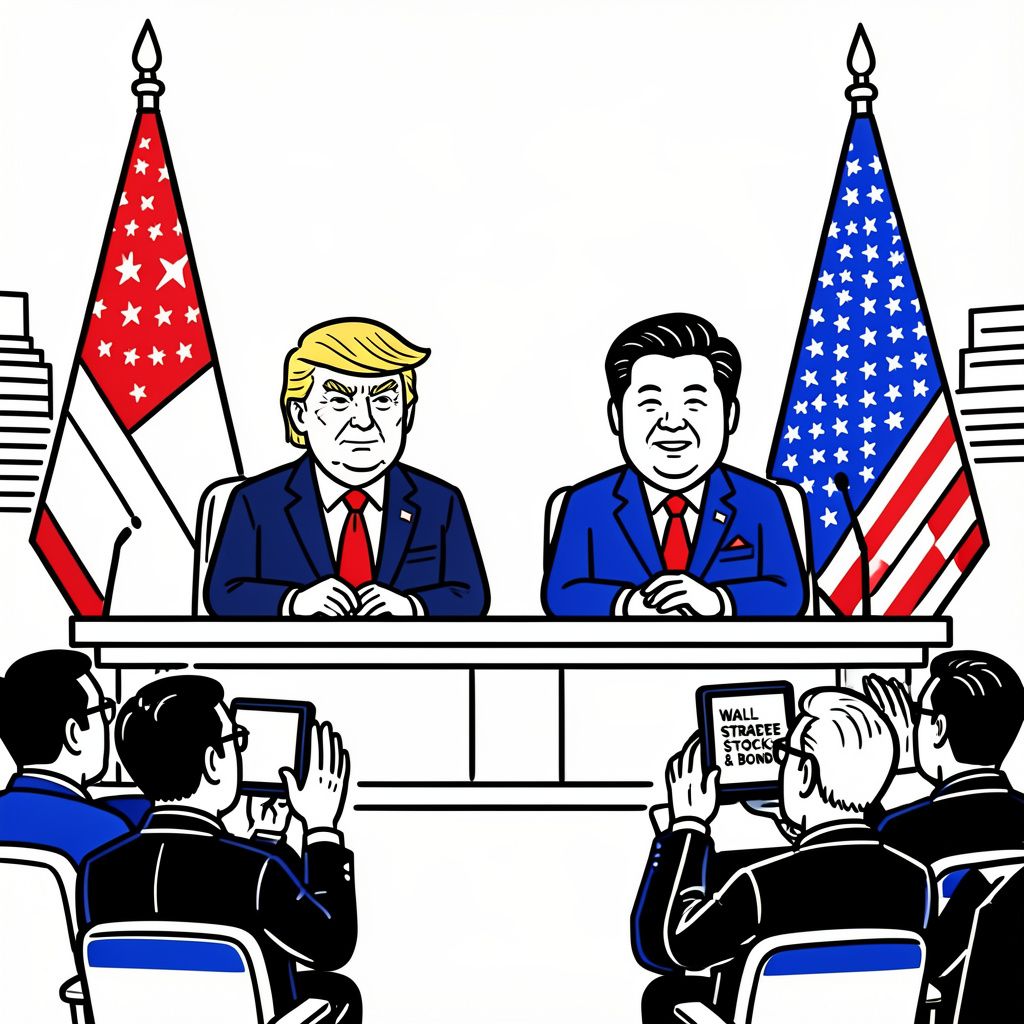
Against this backdrop of domestic economic pressure, U.S. President Donald Trump is scheduled to arrive in Beijing on Wednesday, May 13, 2026, for a highly anticipated two-day summit with Chinese President Xi Jinping spanning May 14 and 15 [3][4][5]. This marks Trump’s first visit to China since 2017, a nine-year period during which the bilateral relationship has been severely tested by trade wars, a global pandemic, and escalating military concerns [4][5]. The dynamics of this meeting are complex; Trump approaches the negotiating table politically weakened, facing a 62% domestic disapproval rating as of May 3, 2026, and grappling with the strategic fallout of the Iran conflict [5][6].
Navigating Technology, Taiwan, and Energy Security
Beyond traditional trade, technology and critical minerals are expected to dominate the discussions [3][7]. The U.S. currently maintains an estimated eight-month lead over China in artificial intelligence, an advantage Washington aims to expand to 18 to 24 months through stringent export controls [7]. The establishment of an AI safety dialogue is under consideration, though experts like Chris McGuire of the Council on Foreign Relations advise that the U.S. should focus narrowly on safety rather than compromising on export restrictions [7]. Concurrently, Washington is seeking a stable, long-term commercial arrangement for access to Chinese rare earth elements, provided these materials are not diverted for military applications [5]. Previous negotiations in Busan in 2025 led to a temporary one-year pause on Chinese rare earth controls and a reduction of U.S. tariffs on Chinese imports from 57% to 47%, a decrease of 10 percentage points [4][8].
Market Trajectory Hinges on Tangible Resolutions
As corporate earnings continue to impress—with S&P 500 earnings on track to jump 28.6% for the quarter according to early May 2026 data—markets have largely chosen to focus on positive economic indicators [1]. Kristina Hooper, chief market strategist at Man Group, observed that the market’s tremendous rebound is a result of investors willing themselves to focus on the upside [1]. Yet, this macroeconomic optimism remains inherently fragile [GPT].
Sources
- www.reuters.com
- www.cfr.org
- www.csis.org
- www.weforum.org
- www.theguardian.com
- www.scmp.com
- www.cfr.org
- www.politico.com