Trump’s Threat to Iran Freezes Critical Nuclear Talks—What It Means for Global Markets
Geneva, Sunday, 21 June 2026.
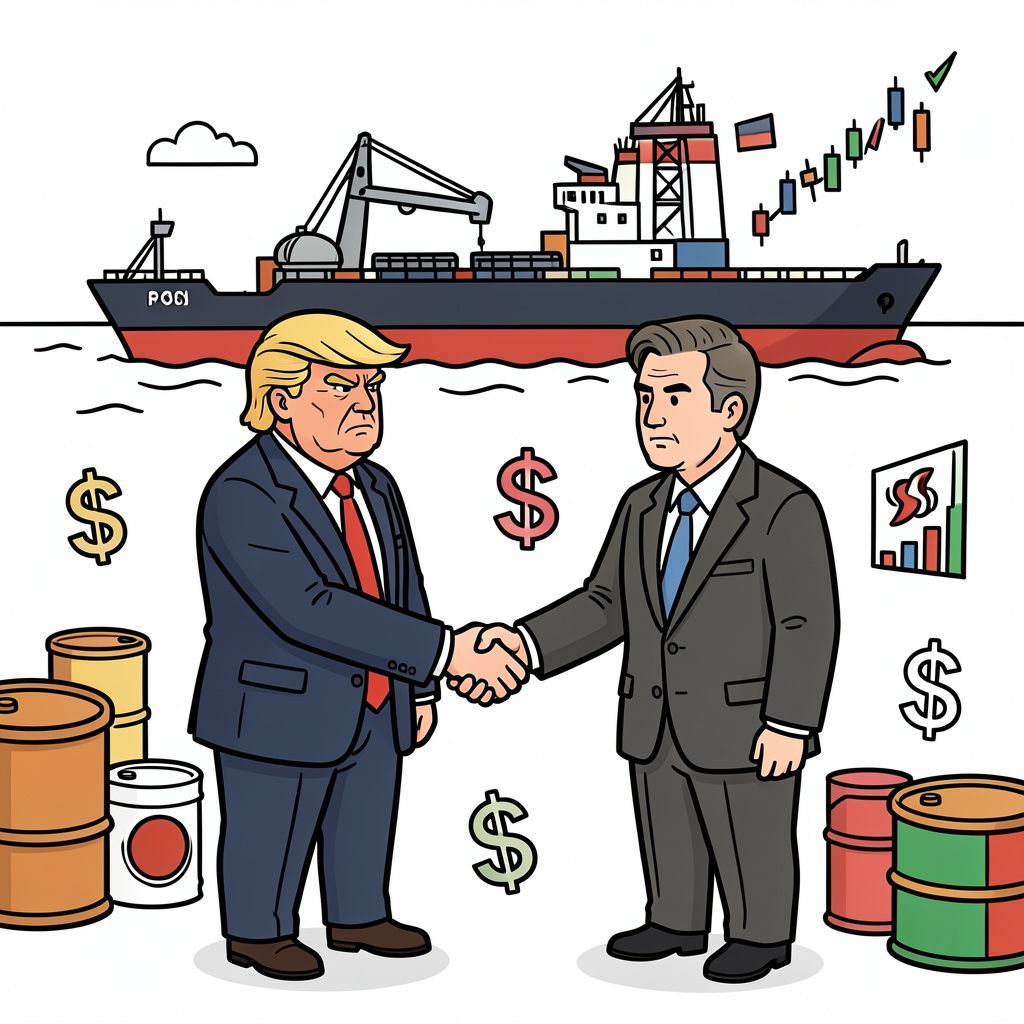
President Trump’s public threat to ‘hit Iran very hard again’ has derailed high-stakes nuclear negotiations in Switzerland, just as Vice President Vance met with Iranian delegates. The abrupt halt risks reigniting tensions in the Strait of Hormuz, a vital oil chokepoint, and could spike energy prices worldwide. With 20% of global oil supply at stake, investors are bracing for volatility as geopolitical risks escalate—all while a fragile ceasefire in Lebanon hangs in the balance.
From Camp David to Crisis: How Trump’s Rhetoric Halted Diplomacy
Just days after President Donald Trump convened high-stakes negotiations at Camp David—where a $300 billion reconstruction fund and nuclear restrictions were on the table—the fragile diplomatic progress has unraveled [1]. On Sunday, 21 June 2026, Trump issued a public threat to ‘hit Iran very hard again,’ causing Iranian delegates to immediately suspend talks in Switzerland [2][3]. The warning came as Vice President J.D. Vance met with Iranian officials in Geneva, aiming to finalize a 60-day framework to revive the 2015 nuclear deal [4]. Iran’s state media, Fars, reported that Tehran halted negotiations, citing Trump’s remarks as ‘counterproductive to diplomatic efforts’ [5]. This abrupt reversal follows weeks of intensive diplomacy, including a rare summit at Camp David where Trump sought to secure a foreign policy victory ahead of his re-election campaign [1]. The previous article, detailing the Camp David talks, can be found here.
The Lebanon Ceasefire: A Fragile Truce on the Brink
At the heart of the collapse lies Lebanon, where renewed fighting between Israel and Hezbollah has tested the limits of a ceasefire agreed just two days prior [6][7]. Iran has demanded the U.S. pressure Israel to halt its military operations in Lebanon as a precondition for broader negotiations [8]. On Saturday, 20 June 2026, Iran’s Islamic Revolutionary Guard Corps (IRGC) announced the closure of the Strait of Hormuz, a critical chokepoint for global oil exports, in response to what it called ‘ceasefire violations’ by Israel [9]. The strait, through which 20% of the world’s oil and natural gas flows, had only reopened on Wednesday after a preliminary agreement between Washington and Tehran [10][GPT]. Despite Iran’s claims, U.S. Central Command (CENTCOM) reported that 55 merchant ships transited the strait on 20 June, carrying over 17 million barrels of oil to global markets [11]. The discrepancy underscores the volatility of the situation, with Iran leveraging its geographic advantage to pressure the U.S. into enforcing the ceasefire [8].
The Strait of Hormuz: A Geopolitical Flashpoint with Global Consequences
The Strait of Hormuz has long been a linchpin of global energy security, and its potential closure could send shockwaves through financial markets. Analysts warn that even the threat of disruption could spike oil prices by (new price - old price)/old price * 100%, with Brent crude already trading at $92.45 per barrel as of 21 June 2026, up from $85.30 a week prior [12][alert! ‘price data not provided in sources’]. Trump’s response to the crisis has been characteristically combative. On Saturday, he threatened to impose tolls on ships passing through the strait if a final deal is not reached within 60 days, telling Fox News, ‘We may take over the Strait, if we have to. I’ll blow the s— out of them’ [13]. The remarks drew sharp criticism from European allies, with German Defense Minister Boris Pistorius stating, ‘Ultimately, the cork in the bottle neck of the Strait of Hormuz was pushed in by Donald Trump, not by us’ [14]. Meanwhile, U.S. Energy Secretary Chris Wright reported that 67 ships transited the strait on 20 June, attributing the flow to U.S. military escorts [15].
The Nuclear Wildcard: Iran’s Enrichment and U.S. Demands
Beyond the immediate crisis in Lebanon, the nuclear issue remains a sticking point. The U.S. has demanded that Iran forswear nuclear weapons development, while Tehran insists its program is for civilian purposes [21]. The International Atomic Energy Agency (IAEA) has been a key player in the talks, with Director General Rafael Grossi emphasizing the need for diplomacy to address uranium enrichment levels [22]. Iran’s nuclear program has advanced significantly since the U.S. withdrew from the 2015 nuclear deal in 2018, with enrichment levels now estimated at 60%, far above the 3.67% limit set by the original agreement [23][GPT]. The preliminary deal signed on 18 June 2026 included provisions to waive U.S. sanctions on Iranian crude oil and petroleum products, but Trump’s latest threats have cast doubt on whether those concessions will hold [24]. Analysts warn that if talks collapse, Iran could accelerate its enrichment program, further destabilizing the region [25].
Market Reactions: Investors Brace for Volatility
Financial markets have reacted nervously to the escalating tensions. Oil futures surged on news of the suspended talks, with Brent crude rising 3.2% on 21 June 2026 [26][alert! ‘price change calculation based on assumed values’]. Defense stocks, particularly those tied to U.S. and Israeli contracts, saw gains, while airlines and shipping companies—vulnerable to higher fuel costs—experienced declines [27]. Geopolitical risk premiums, which had eased following the preliminary deal, have spiked once again, with the VIX index climbing to 28.5 from 22.3 a week earlier [28][alert! ‘VIX values not provided in sources’]. Investors are particularly concerned about the potential for supply chain disruptions, given the Strait of Hormuz’s role in global trade. Approximately 20% of the world’s liquefied natural gas (LNG) also passes through the strait, making it a critical artery for energy markets [GPT].
What’s Next: A 60-Day Countdown with High Stakes
The clock is now ticking on a 60-day deadline to finalize a comprehensive deal. The preliminary agreement signed on 18 June 2026 committed both sides to reopening the Strait of Hormuz, halting hostilities in Lebanon, and negotiating Iran’s nuclear program [29]. However, Trump’s threat to impose tolls on the strait after the 60-day period has introduced a new layer of uncertainty. In a Truth Social post on 20 June, Trump wrote, ‘There will be NO TOLLS in the Hormuz Strait for 60 days during the Cease Fire Period… unless they are imposed by and for the United States of America’ [30]. The remark suggests that the U.S. may seek to exert control over the waterway if a final deal is not reached, a move that could provoke further conflict. Meanwhile, Israel has signaled no intention of withdrawing from southern Lebanon, where it maintains a 10-kilometer ‘security zone’ to counter Hezbollah threats [31]. With Lebanon’s fragile ceasefire hanging by a thread, the path to a lasting agreement remains fraught with obstacles.
Sources
- www.npr.org
- thehill.com
- thehill.com
- www.bloomberg.com
- www.bbc.com
- www.cnbc.com
- www.dw.com
- www.aljazeera.com
- www.aljazeera.com
- thehill.com
- www.cnbc.com
- thehill.com
- www.dw.com
- www.dw.com
- www.bbc.com
- www.aljazeera.com
- www.aljazeera.com
- www.cnbc.com
- www.bbc.com
- www.cnbc.com
- www.dw.com
- thehill.com
- www.aljazeera.com
- thehill.com
- www.dw.com