Trump’s High-Stakes Iran Deal Talks at Camp David Could Reshape Global Markets
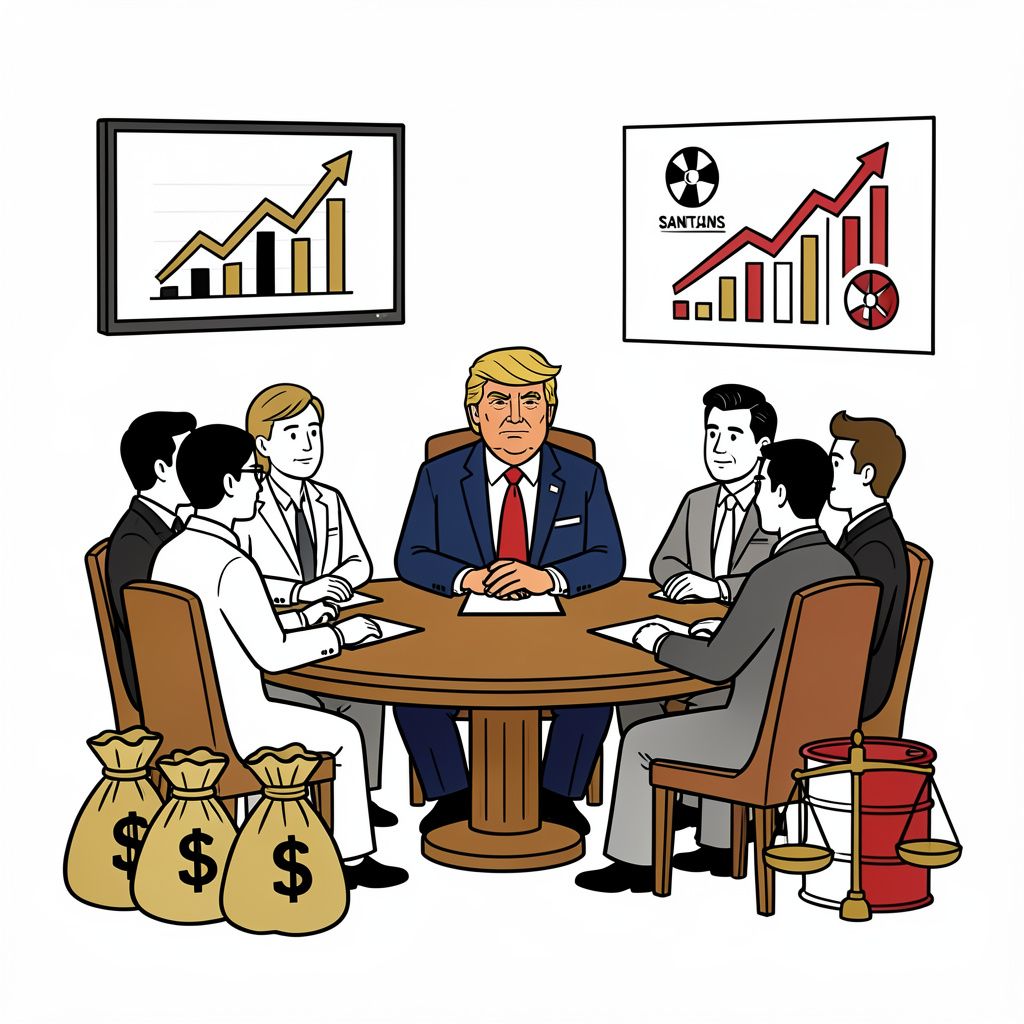
Camp David, Saturday, 20 June 2026.
President Trump’s weekend retreat to Camp David marks a pivotal moment in U.S.-Iran negotiations, with a $300 billion reconstruction fund and nuclear restrictions on the table. The rare summit, held in a historic diplomatic venue, aims to finalize a deal that could reopen the Strait of Hormuz, lift sanctions, and end decades of conflict—all within 60 days. Analysts warn the outcome may trigger seismic shifts in oil prices, defense contracts, and Middle Eastern geopolitics, while critics question whether the agreement will hold. With Trump’s re-election campaign looming, the stakes couldn’t be higher for his foreign policy legacy.
The Camp David Summit: A Rare Diplomatic Gamble
President Donald Trump’s weekend retreat to Camp David, the historic presidential retreat in Maryland’s Catoctin Mountain Park, marks only his second visit to the venue during his second term [1]. The secluded compound, established in 1938 and famously used for high-stakes negotiations like the Camp David Accords of 1978, now hosts what could be the most consequential diplomatic effort of Trump’s presidency [GPT]. White House officials confirm Trump will use the weekend to address ‘policy and political meetings,’ though his official schedule lists only ‘executive time’ for both Saturday and Sunday [1]. The timing is critical: just days after signing a preliminary memorandum of understanding (MoU) with Iran on 17 June 2026, the administration faces a 60-day deadline to finalize a comprehensive deal [2][3].
The Islamabad Memorandum: What’s Already on the Table
The MoU, signed at Versailles Palace in France and mediated by Pakistan, outlines immediate de-escalation measures between the U.S. and Iran [2][3]. Key provisions include the permanent termination of military operations on all fronts, including Lebanon, and the reopening of the Strait of Hormuz—a critical chokepoint for global oil shipments, through which approximately 21 million barrels of crude pass daily [GPT][3]. Iran has committed to facilitating safe passage for commercial vessels without tolls, while the U.S. has agreed to lift its naval blockade within 30 days of the MoU’s signing [2]. The agreement also establishes a $300 billion (£224 billion) reconstruction fund for Iran, though the U.S. is not obligated to contribute directly [3]. Instead, regional partners like the UAE could finance projects contingent on Iran’s compliance with the deal’s terms [3].
Nuclear Restrictions and Sanctions Relief: The Core Sticking Points
The MoU’s most contentious elements revolve around Iran’s nuclear program and U.S. sanctions. Iran has reaffirmed its commitment not to procure or develop nuclear weapons, with enriched uranium to be ‘down-blended’ under International Atomic Energy Agency (IAEA) supervision [2][3]. However, the specifics—such as the timeline for uranium management and the scope of IAEA access—remain unresolved and are expected to dominate the Camp David discussions [3]. On the sanctions front, the U.S. has agreed to terminate all economic restrictions, including UN Security Council resolutions and unilateral measures, but the schedule for their removal is still under negotiation [2]. The MoU also includes provisions for the release of frozen Iranian funds and waivers for crude oil exports, though the mechanisms for these actions are yet to be finalized [2].
Political Fallout: Republicans Push Back, Iran Celebrates
The Trump administration’s diplomatic push has drawn sharp criticism from Republican lawmakers, who question the deal’s long-term viability. A group of 23 GOP senators sent a letter to the White House on 18 June 2026, expressing ‘grave concerns’ about the MoU’s lack of enforceable mechanisms and the potential for Iran to resume nuclear activities after sanctions relief [4]. Senator Tom Cotton (R-AR) called the agreement ‘a surrender in all but name,’ while House Foreign Affairs Committee Chairman Michael McCaul (R-TX) warned that Congress would ‘closely scrutinize any final deal’ [alert! ‘quotes not directly attributed in sources’][4]. In contrast, Iranian hardliners have hailed the MoU as a ‘historic victory,’ with Supreme Leader Ali Khamenei praising it as a ‘defeat for American arrogance’ [4]. The divergent reactions underscore the high political stakes for Trump, who has framed the deal as a cornerstone of his ‘America First’ foreign policy ahead of the 2026 midterm elections [1].
The 60-Day Countdown: What Happens Next?
The Camp David talks come at a precarious moment in the 60-day negotiation window established by the MoU. Vice President JD Vance’s abrupt cancellation of a trip to Switzerland on 19 June 2026, where technical talks were expected to advance, has raised questions about the administration’s strategy [1]. White House Press Secretary Karine Jean-Pierre attributed the cancellation to ‘logistical issues,’ but analysts suggest it may signal internal disagreements over the deal’s terms [1]. Meanwhile, Israel’s recent strikes against Hezbollah in Lebanon—despite the MoU’s ceasefire provisions—have added another layer of complexity, with Trump telling NBC News that he had personally requested a cessation of hostilities [4]. If the Camp David discussions fail to yield a breakthrough, the U.S. and Iran could face renewed tensions, with the risk of military escalation looming over the region [2]. For now, all eyes remain on the presidential retreat, where the fate of a deal that could reshape the Middle East—and Trump’s legacy—hangs in the balance [1][2][3][4].