Trump Waives Tax Rules on Off-Road Fuel to Lower Highway Diesel Costs
Washington, Tuesday, 6 October 2026.
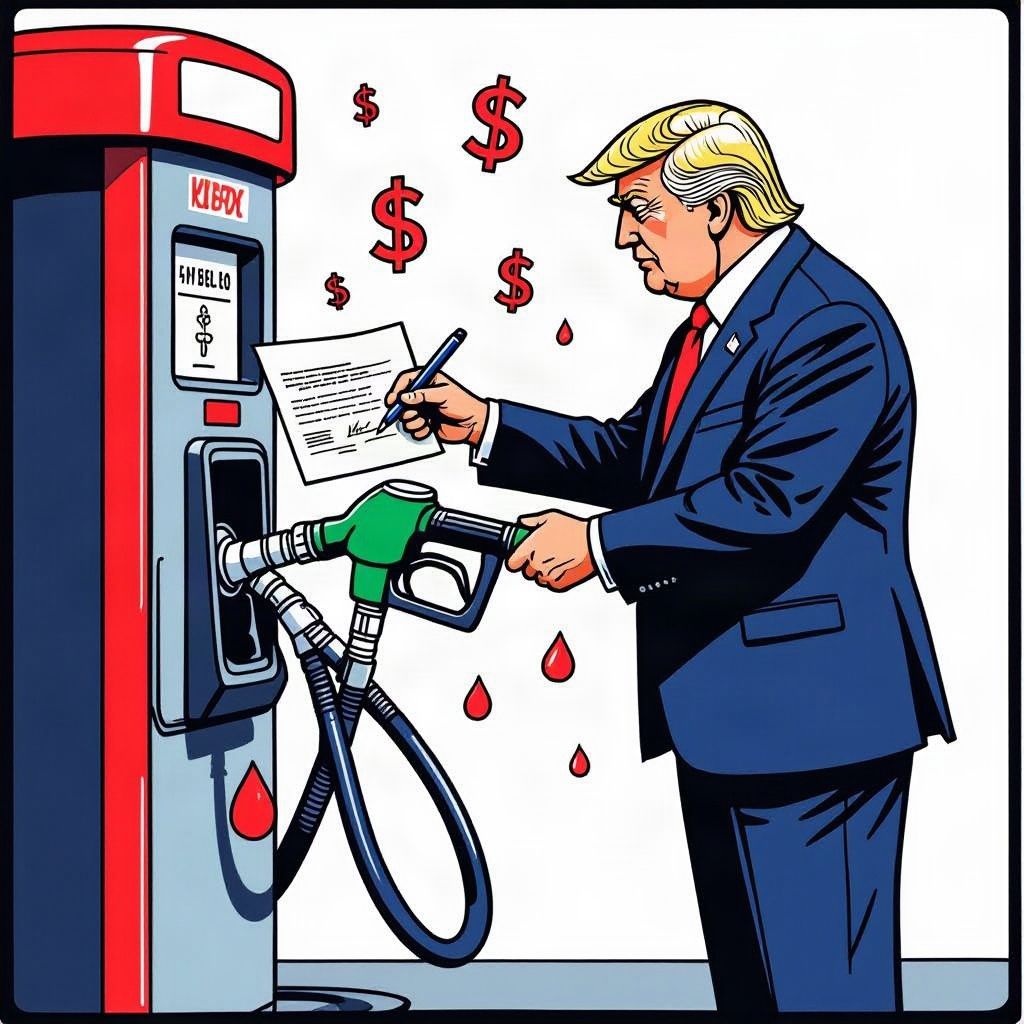
President Trump signed an executive order allowing highway drivers to use tax-free off-road diesel, a policy aimed at curbing record fuel inflation by saving truckers over $100 per refill.
Executive Order Signed to Waive Diesel Restrictions
On October 4, 2026, President Donald J. Trump signed an Executive Order temporarily allowing the use of off-road “dyed” diesel for highway vehicles, a move designed to address rising fuel inflation [1]. The announcement was formally made during a campaign stop in Nebraska on October 5, 2026, where the President emphasized the urgency of alleviating costs for truckers and farmers [2]. This policy shift waives the federal requirement that restricts tax-exempt red-dyed diesel to off-road use, such as in agriculture and construction equipment [5]. The Administration attributes the surge in diesel costs to restricted global supply chains, citing the ongoing Russia-Ukraine war and insufficient global refining capacity [1].
The Executive Order directs the Secretary of the Treasury, in consultation with the Secretary of War, to evaluate methods for permanently eliminating the obligation to pay deferred taxes on this fuel [1]. Additionally, the Secretary of Transportation is mandated to coordinate with state governments to facilitate access to dyed diesel, while the Secretary of Agriculture must ensure farmers in high-demand regions maintain supply [1]. As of October 6, 2026, the status of state compliance remains unknown, as the Order directs the White House Office of Intergovernmental Affairs to encourage states to adopt corresponding policies [1]. This timeline indicates the policy is in the immediate implementation phase, with full effect dependent on state-level cooperation [3].
Economic Impact and Tax Calculations
Under standard regulations, on-road diesel is subject to federal excise taxes, whereas off-road diesel is tax-exempt and dyed red for identification [1]. The federal diesel tax rate is established at 24.4 cents per gallon [2]. For a standard truck refill of 250 gallons, the federal tax portion alone amounts to 61 dollars, totaling $61.00 [2]. The Administration projects that where states match this federal action by waiving their own fuel taxes, savings will exceed $100 per refill for truck operators [2].
This financial relief is part of a broader affordability agenda, with the Administration claiming this action will put money directly back in the pockets of American workers [2]. Since January 2025, the Trump Administration notes it has provided over $40 billion in direct aid to farmers and ranchers [1]. Furthermore, the Department of Transportation has waived hours-of-service rules for drivers transporting gasoline and diesel to improve supply logistics [1]. However, analysts suggest that while the tax waiver provides immediate cash flow relief, it may not significantly lower the overall market price of diesel if supply constraints persist [4].
Political Context and Midterm Implications
The announcement was strategically timed during a rally in Nebraska supporting Senator Pete Ricketts and Governor Jim Pillen, both Republicans facing competitive reelection bids [4]. President Trump remarked to the officials, “So Pete and Jim, this should absolutely assure your election,” highlighting the political stakes involved [4]. The move comes as surging fuel prices have contributed to persistent inflation that threatens Republicans’ hold on Congress in the November midterm elections [3].
Prior to this announcement, there was chaotic messaging regarding potential diesel export bans, which the President ruled out after Europe agreed to tap stockpiles [3]. The Executive Order also follows an agreement negotiated with Europe in October 2026 to release 100 million barrels of refined diesel from strategic reserves over four months [1]. This sequence of events underscores the Administration’s focus on energy affordability as a central campaign issue leading into the midterms [3]. The policy aims to stabilize sentiment among farmers and ranchers who have been riled by high diesel costs and foreign beef import decisions [3].
Market Reaction and Supply Constraints
As of October 6, 2026, diesel prices averaged approximately $6.32 per gallon, according to AAA data cited during the announcement period [4]. Despite the Executive Order, some market analysts remain skeptical about the long-term impact on pump prices. Tom Kloza, chief oil analyst at Gulf Oil, described the move as “really a cosmetic gesture” and a “Band-Aid where a tourniquet would be more appropriate” [4]. Kloza emphasized that the quantity of diesel released or tax savings would not supplant the barrels lost due to geopolitical conflicts targeting refineries [4].
The Administration has reclaimed the position of the U.S. as the world’s leading energy producer following the rescinding of previous energy regulations [1]. In August 2026, President Trump announced an oil deal with Venezuela to secure 65 billion barrels of oil, intended to double U.S. reserves [1]. Nevertheless, the immediate relief for consumers depends heavily on the pass-through of tax savings by retailers and coordination with state-level tax authorities [3]. The effectiveness of this measure will be closely monitored through the end of the 2026 calendar year, as the tax deferral is temporary [1].
Sources
- www.whitehouse.gov
- www.whitehouse.gov
- www.politico.com
- thehill.com
- www.nytimes.com
- www.ft.com
- www.facebook.com
- www.facebook.com