Artificial Intelligence Investment Drives Growth as Real Wages Fall Behind Inflation
Washington, Tuesday, 6 October 2026.
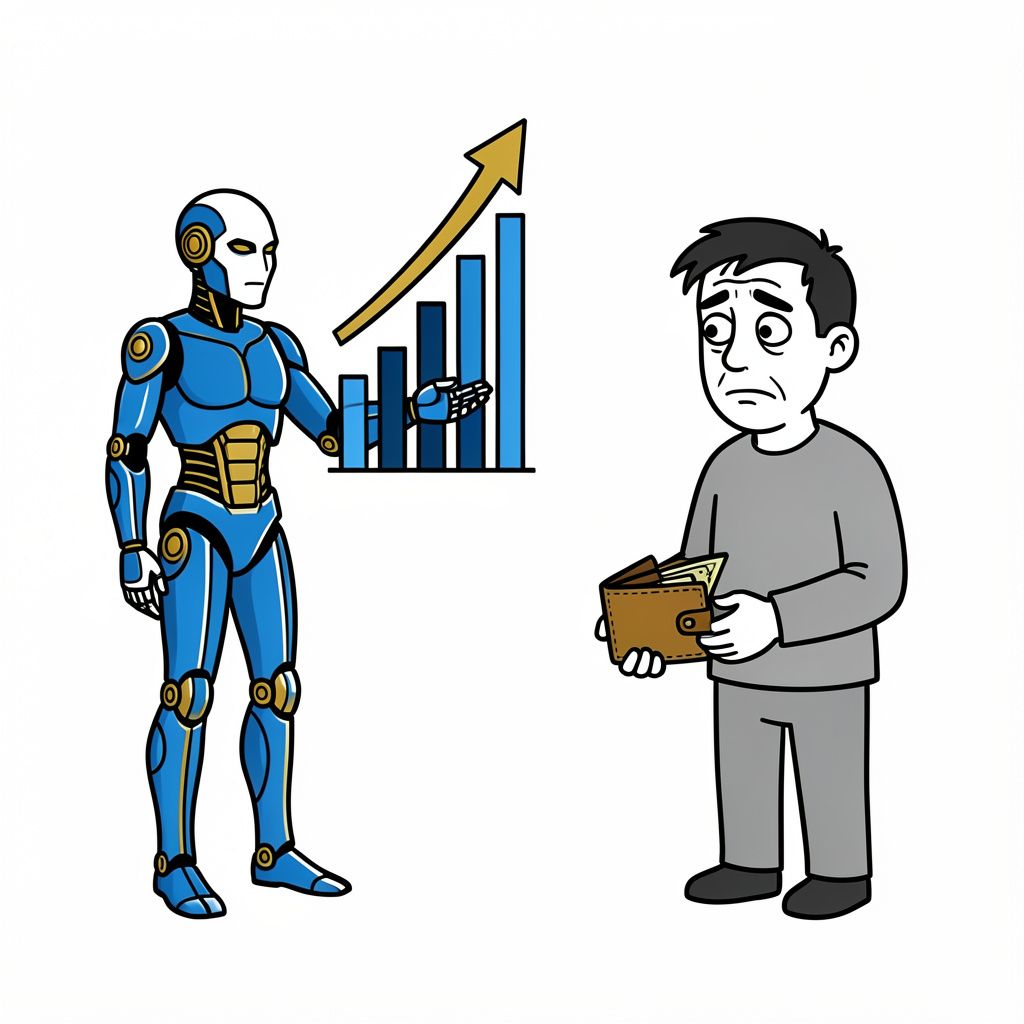
Massive corporate investment in artificial intelligence currently fuels over half of U.S. economic growth, even as persistent inflation forces consumers to drain savings to cover declining real wages.
The AI Growth Engine
As of October 2026, the United States economy displays a surprising resilience, driven predominantly by corporate expenditure in artificial intelligence infrastructure. Ira Kalish, chief global economist for Deloitte, stated on 2026-10-01 that over 50% of current U.S. economic growth is derived from investments in artificial intelligence, specifically regarding data center infrastructure [1][2]. This concentration of growth creates a unique economic environment where enterprise technology investment bolsters broader performance even as other sectors face headwinds [1]. The phenomenon represents a significant shift in economic drivers, with investment in information processing equipment and software accounting for 4% of GDP but responsible for 92% of GDP growth in the first half of 2025 [5].
The AI Growth Engine
Despite the robust aggregate numbers, the composition of this growth raises questions about sustainability and breadth. Kalish noted that while the U.S. economy is surprisingly strong, it is an odd growth structure because more than half comes from investment in AI and data centers [1][2]. Historical parallels suggest caution, as over-investment cycles in railroads or the internet previously led to asset price falls and recessions when investors became nervous [1]. Current data indicates that while AI is expected to provide a net economic benefit and increase worker production, the disruption has not yet fully materialized in labor markets [1].
Inflationary Pressures and Wage Stagnation
While corporate investment surges, household purchasing power faces significant strain from persistent inflationary pressures. Following the U.S. and Israel attack on Iran on 2026-02-28, Iran restricted access to the Strait of Hormuz, causing price increases for oil, aluminum, fertilizer, and helium [1][2]. Kalish identifies this conflict as a primary driver of inflation that is currently outpacing wage growth, resulting in declining real wages since the onset of the conflict [1]. Consumers have maintained spending levels not through income growth but by depleting savings, a trend that cannot sustain indefinitely [1][2].
Inflationary Pressures and Wage Stagnation
Energy markets remain a critical factor in the inflationary landscape, with tighter inventories supporting a long-term outlook for elevated energy costs [8]. Although China has played a major role in stabilizing the price of oil through strategic reserve releases, prices for gasoline and refined products have risen disproportionately higher than crude oil [1][2]. Kalish warned that unless the conflict ends, the economy could face a rough time, though the timeline for resolution remains uncertain [1][2]. Inflation is currently recorded at 3.4%, complicating the Federal Reserve’s mandate to stabilize prices while supporting employment [4].
Interest Rates and Investment Risks
The surge in AI spending has contributed to rising borrowing costs, with the 10-year Treasury yield increasing from 4.15% to approximately 5.3% in 2026 [4]. This shift marks the highest yield levels since 2002 and represents a percentage increase of 27.711 in borrowing costs for long-term debt [4]. High interest rates are taking a toll on households and businesses, yet they are doing little to dampen enthusiasm for investments in AI infrastructure, which are contributing to inflation [3]. Being super bullish on AI and expecting rates to come back down do not fit together, as AI spend is a big part of what is pushing rates up [4].
Interest Rates and Investment Risks
Government borrowing for 2026 is projected at approximately $2 trillion, with hyperscaler capital expenditures at approximately $1 trillion [4]. Cumulative AI-related debt is projected to reach $4.1 trillion through 2030, raising concerns about debt sustainability among some analysts [4]. There were companies in historical cycles that could not make enough cash to justify their debts, leading to recessions when investors got nervous [1]. The Federal Reserve implemented its first interest rate hike since 2023, with market expectations for an additional approximately 1 percentage point increase [4].
Labor Market Shifts and Policy Responses
Employment growth remains concentrated exclusively in healthcare and education, with total net growth in the past 18 months attributed entirely to female employment [1][2]. As of the 2026-10-02 U.S. Department of Labor report, the national unemployment rate is 4.2%, with Wisconsin at 3.2% [1][2]. In the past year-and-a-half, more than 100% of the increase in employment in the country went to women, while there was actually a decline in employment for men [1]. AI-driven data center construction has generated measurable labor demand, with Goldman Sachs estimating that 500,000 new construction and trades jobs must be added by 2030 to sustain the buildout [5].
Labor Market Shifts and Policy Responses
Policy makers are beginning to address the distribution of AI benefits and the associated economic challenges. Senator Mark Kelly stated on social media that companies benefiting the most from AI should pay their fair share to solve the challenges the technology is creating [7]. Similarly, Darren Jones MP stated on 2026-10-05 that AI-driven productivity is a key mechanism for growing the economy and generating tax revenue for public services [6]. Despite public skepticism, research estimated the total annual consumer surplus from generative AI in the United States at $172 billion as of April 2026 [5].
Sources
- www.jsonline.com
- finance-commerce.com
- www.nytimes.com
- x.com
- www.noahpinion.blog
- www.instagram.com
- www.facebook.com
- www.kansascityfed.org