White House Considers Using Off-Road Fuel Stocks to Lower High Commercial Trucking Costs
Washington, Tuesday, 29 September 2026.
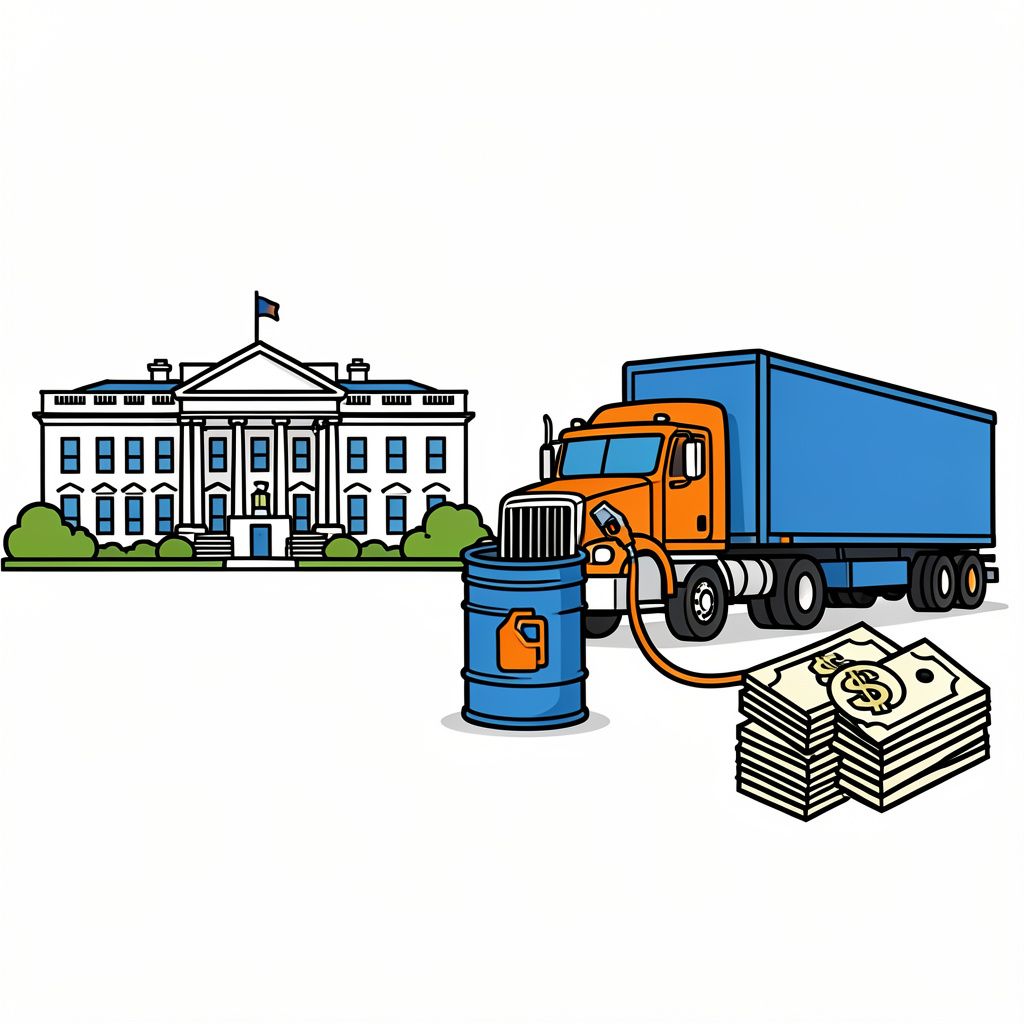
To combat soaring diesel prices near $6.50 per gallon, officials are evaluating the temporary release of tax-exempt off-road fuel for highway commercial fleets to mitigate supply shortages.
Record-High Prices and Supply Constraints
As of the week ending September 21, 2026, the U.S. national average diesel price reached $6.529 per gallon, marking a significant increase from $5.454 per gallon just one month prior [1]. This surge represents a percentage increase of 19.71 over the four-week period, placing substantial pressure on commercial trucking and logistics sectors [1]. Underlying this price volatility are tight inventory levels, with U.S. distillate stocks recorded at 107.4 million barrels on September 18, 2026 [1]. Energy Information Administration projections indicate these stocks will remain below the 2021-2025 five-year low through 2026 and into most of 2027 [1]. Despite domestic refineries maintaining production levels averaging 5.1 million barrels per day from January to August 2026, high international demand continues to strain availability [1].
Federal Policy Options Under Review
In response to the crisis, the White House is actively evaluating policy interventions, including the temporary authorization of tax-exempt, red-dyed diesel for highway use [1]. Typically restricted to off-road agricultural and construction equipment, red-dyed diesel is exempt from the 24.4 cents-per-gallon federal highway tax [1]. On September 28, 2026, reports confirmed the administration is considering this measure alongside potential restrictions on U.S. diesel exports to mitigate high energy costs [1][3]. President Donald Trump stated on September 27, 2026, that his administration is thinking about an export ban very seriously, though he acknowledged it could lead to increased gasoline prices for cars [3][4]. A White House official confirmed on September 28, 2026, that no final policy decision has been made, with officials evaluating all options on the table [3].
State-Level Emergency Measures
While federal deliberations continue, several state governments have already implemented emergency measures to alleviate fuel costs for key industries. On September 24, 2026, Alabama Governor Kay Ivey directed law enforcement to cease enforcement of red-diesel restrictions for a four-month period [4][5]. Similarly, Louisiana Governor Jeff Landry declared a state of emergency on September 23, 2026, rescinding penalties for farmers and loggers using off-road diesel on highways through late October 2026 [4][5]. Nebraska Governor Jim Pillen issued an executive order on September 24, 2026, permitting highway-registered vehicles to use off-road diesel without penalty and authorized diesel tax refunds for livestock and produce transporters [4][5]. These actions reflect a growing regional response to the supply shortage ahead of the harvest season.
Economic Implications and Market Warnings
Financial analysts warn that federal intervention carries significant economic risks. Morgan Stanley strategists noted on September 24, 2026, that while an export restriction could lower domestic diesel prices, it might create a negative feedback loop for U.S. gasoline prices as refinery runs adjust [2]. Goldman Sachs estimates a temporary diesel export ban could reduce diesel prices by about 25 cents per gallon, but once storage capacity is reached, each subsequent week could increase gasoline prices by 30 cents per gallon [6]. The American Fuel & Petrochemical Manufacturers warned on September 25, 2026, that blocking exports would force refiners to cut overall fuel production, increasing reliance on imported fuel [6]. Consequently, while red-dyed diesel authorization could reduce the tax burden, experts caution it would not resolve the underlying supply problem [1].
Sources
- realnarrativenews.com
- www.cnbc.com
- finance.yahoo.com
- www.unionleader.com
- www.bostonherald.com
- www.cbsnews.com