AI Data Centers Rely on Natural Gas Amid Growing Energy Demand
Memphis, Thursday, 1 October 2026.
To power its expanding AI data centers, xAI operates 62 natural gas turbines, shifting away from solar energy goals as SpaceX prepares for a major public stock offering.
xAI Shifts to Natural Gas as SpaceX Prepares for Historic IPO
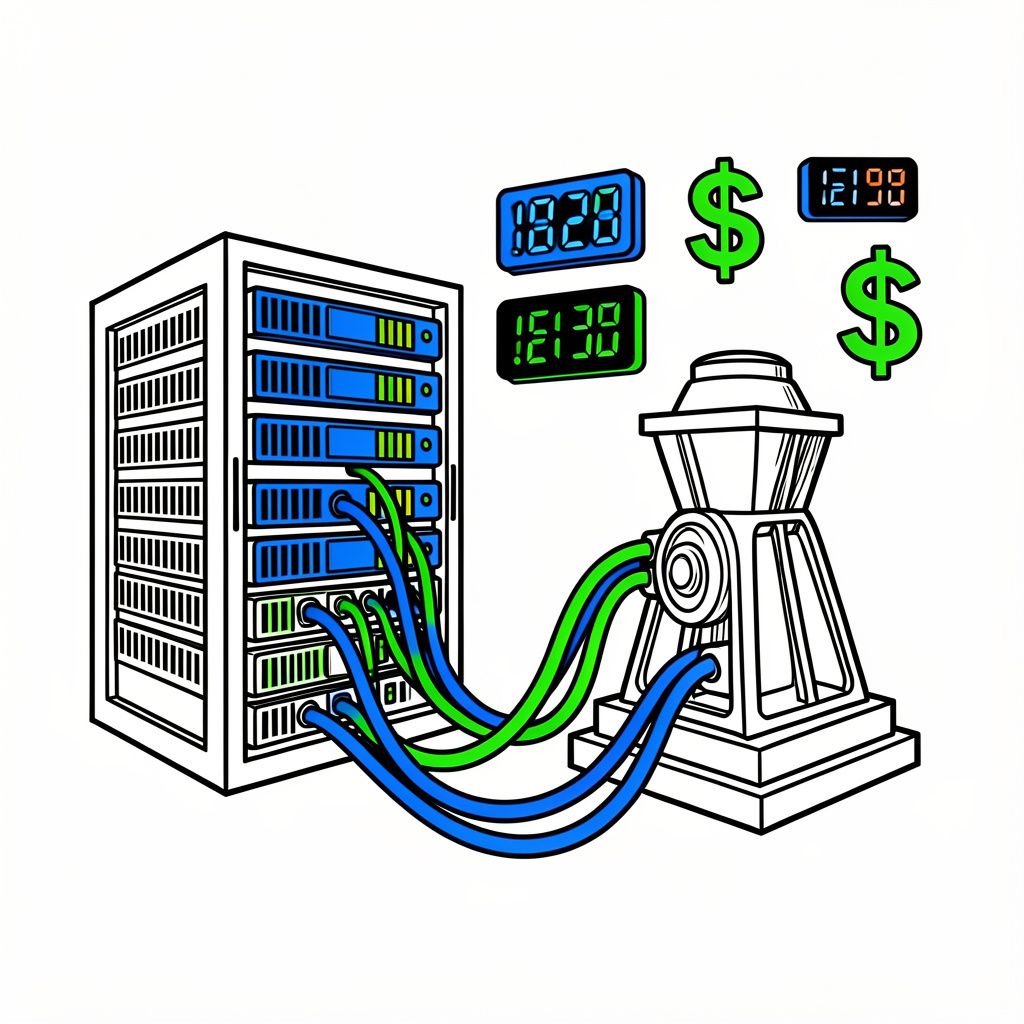
As of October 1, 2026, artificial intelligence startup xAI has significantly altered its energy strategy, relying on natural gas power generation to fuel massive data center operations for the Grok chatbot [1]. This move marks a departure from founder Elon Musk’s long-promoted vision of a solar-powered economy, even as SpaceX advances plans for a historic initial public offering scheduled to pitch space-based solar concepts to investors [1]. The reliance on fossil fuel energy highlights the mounting tension between rapid enterprise AI scaling and corporate sustainability targets across the technology sector [8]. While Musk previously advocated that a 100-mile by 100-mile solar array could power the entire United States, current operations utilize 62 unpermitted methane gas turbines across data centers in Memphis, Tennessee, and Southaven, Mississippi [1]. These facilities power Colossus supercomputers, with operations having the potential to emit over 6 million tons of greenhouse gases annually [1].
Infrastructure Expansion and Power Capacity
The Colossus 2 data center is currently operational with AI chips owned by SpaceXAI, hosting an estimated 1,112k H100-equivalents of AI compute [4]. Infrastructure currently supports approximately 830 MW to 900 MW of total IT power, with future site infrastructure aiming to support a total capacity of 1.5 GW of IT power [4]. This expansion represents a significant increase in energy demand, calculated as a growth potential of 84.458 percent based on projected IT power figures [4]. The first compute cluster consists of approximately 110,000 GB200 processors and 210 MW of compute power, supported by natural gas turbines at a facility in Mississippi [4]. A second cluster includes 110,000 GB300 processors and 220 MW of compute power, indicating a modular approach to scaling compute capacity alongside power generation [4].
IPO Valuation and Space-Based Energy Thesis
On May 20, 2026, SpaceX filed an S-1 with the SEC for an IPO targeting a valuation between $1.75 trillion and $2 trillion, aiming to raise $75 to $80 billion [1]. The filing introduces a new energy thesis proposing space-based solar arrays, with SpaceX filing with the FCC for an orbital data center constellation of up to one million satellites [1]. Corporate documents state that third-party estimates on data center demand are constrained by the practical supply limitations that exist in a terrestrial context [1]. Concurrently, xAI has secured significant revenue streams, including a deal with Anthropic paying $1.25 billion monthly for compute, totaling over $40 billion through 2029 [1]. This revenue supports the capital-intensive nature of the infrastructure, despite Anthropic CEO Dario Amodei being previously criticized by Musk as misanthropic and evil [1].
Regulatory Challenges and Environmental Impact
Regulatory scrutiny has intensified following the EPA closing a regulatory loophole previously exploited by xAI regarding power plant emissions in January 2026 [1]. Despite this, thermal drone footage from February 2026 confirmed turbines were still operational, and reports indicate SpaceXAI installed unpermitted, highly polluting turbines at a data center complex in the southeastern United States [1][8]. Julie McNamara, federal energy policy director, noted that tech companies are pressuring leaders to accept severe and largely avoidable harms under the assertion that accountability will mean losing the race for AI dominance [8]. Global data center water consumption is projected to more than double between 2023 and 2030, reaching approximately 1,200 billion liters annually, compounding the environmental footprint [8]. While Building 3 construction was slated for completion following the midpoint status of its roof as of April 30, 2026, verification of current operational status is required [alert! ‘Building 3 completion status unverified as of 2026-10-01’] [4].
Sources
- electrek.co
- www.instagram.com
- www.facebook.com
- epoch.ai
- www.facebook.com
- www.nytimes.com
- www.facebook.com
- www.bmj.com