South Korea Achieves First Back-to-Back Growth Capacity Boost in Four Decades
Seoul, Monday, 19 October 2026.
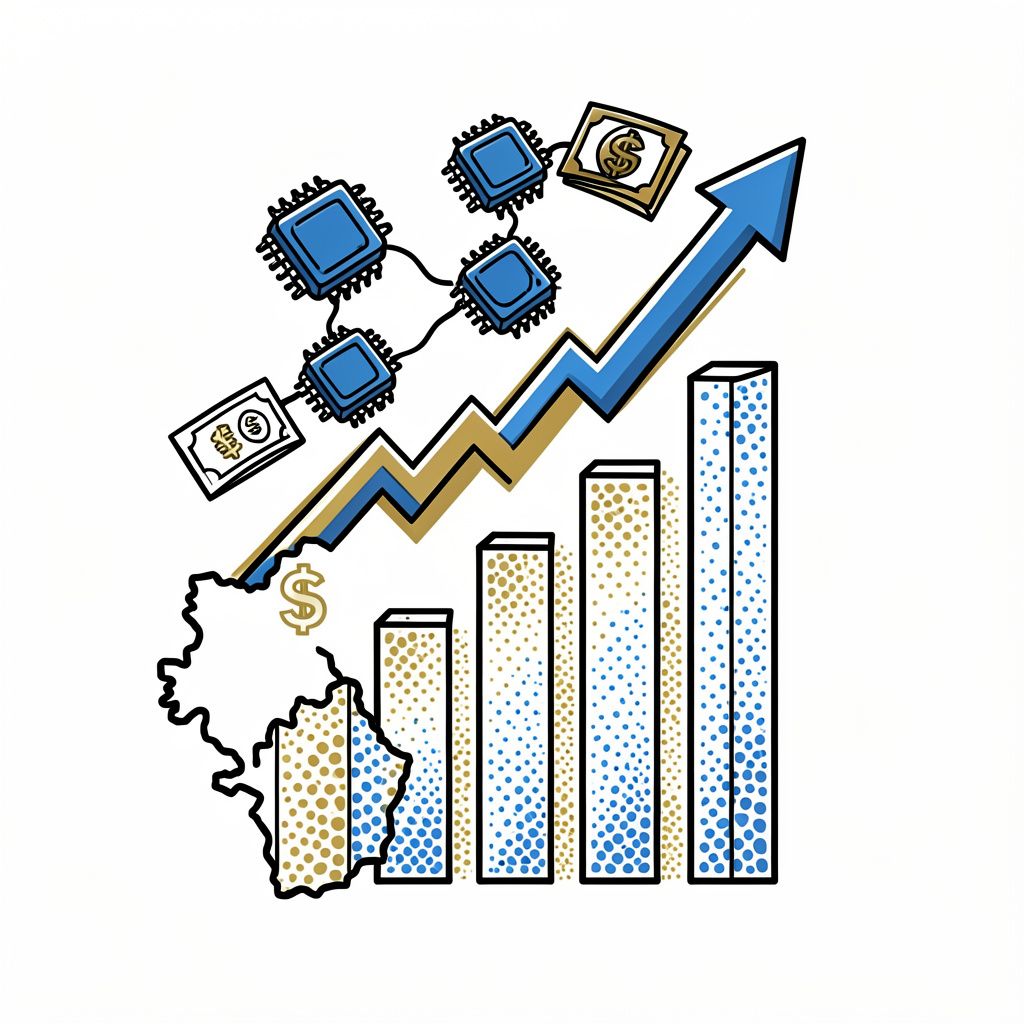
Driven by global artificial intelligence chip demand, South Korea’s economic potential is expanding for two consecutive years for the first time in four decades, boosting per-capita income projections.
Historical Shift in Economic Capacity
The International Monetary Fund released its October 2026 World Economic Outlook on 18 October 2026, projecting South Korea’s potential growth rate to reach 2.14% in 2026 [1][2]. This figure represents a significant upward revision from the 1.94% recorded in 2025 [3][4]. The trajectory continues into 2027, with forecasts indicating a further rise to 2.20% [5][6]. This marks the first instance of consecutive annual increases in forty years, dating back to the 1986–1987 period known as the three-lows boom [7][8]. The magnitude of the increase from 2025 to 2026 is calculated as 0.2 percentage points [2][3]. This reversal contrasts with the long-term decline from 4.05% in 2010 to a low of 1.28% in 2020 [6][7].
Semiconductor and AI as Primary Drivers
Structural expansion is primarily driven by surging global demand for high-bandwidth memory chips and advanced semiconductors supporting artificial intelligence infrastructure [1][4]. Investment in semiconductor facilities has expanded alongside productivity improvements linked to AI adoption [6][7]. The IMF notes that real GDP growth is projected at 3.33% for 2026 and 2.83% for 2027 [2][6]. Output gap readings are expected to improve from 0.548% in 2026 to 1.168% in 2027 [1][2]. However, the IMF issued a warning on 17 October 2026 that a potential slowdown in AI investment could undermine this momentum [1][7]. The percentage increase in potential growth from 2025 to 2026 is 10.309 [2][3].
Income Targets and Government Strategy
Per-capita GDP is expected to exceed $40,000 in 2026, specifically reaching $43,512 [2][5]. Projections indicate this figure will surpass $50,000 by 2028, reaching approximately $52,100 [1][2]. This aligns with the South Korean government’s 3·4·5 economic leap vision announced in July 2026 [4][8]. The strategy targets a 3% potential growth rate and a top-four global export ranking [4][8]. Among 27 comparable nations, South Korea ranks 7th in potential growth for 2026 and 2027 [3][5]. This ranking places it ahead of major advanced economies including the United Kingdom, France, Japan, and Germany [2][5].
Risks of Concentration and Disparity
Despite macroeconomic improvements, experts caution that benefits remain concentrated in large export-oriented firms [4][8]. Employment data shows only 116,000新增 jobs from January to September 2026, the smallest increase in six years excluding 2020 [3]. Critics warn of an AI divide where the majority of the workforce may be excluded from gains [2][3]. Sonali Das of the IMF Asia-Pacific Department noted that reduced AI investment could lead to decreased exports and tax revenue [7]. Economists suggest that without broader diffusion of growth, the structural recovery may remain fragile [3][6].
Sources
- mbiz.heraldcorp.com
- www.yna.co.kr
- www.hani.co.kr
- www.mk.co.kr
- www.instagram.com
- news.kbs.co.kr
- www.hankyung.com
- www.rocketpunch.com