Retirees Turn to Credit Cards for Groceries as Inflation Persists
Washington, Saturday, 1 August 2026.
Accumulating food inflation is driving fixed-income seniors to rely on high-interest credit cards for basic necessities, escalating consumer debt strains and default risks across the economy.
Escalating Reliance on Credit for Essentials
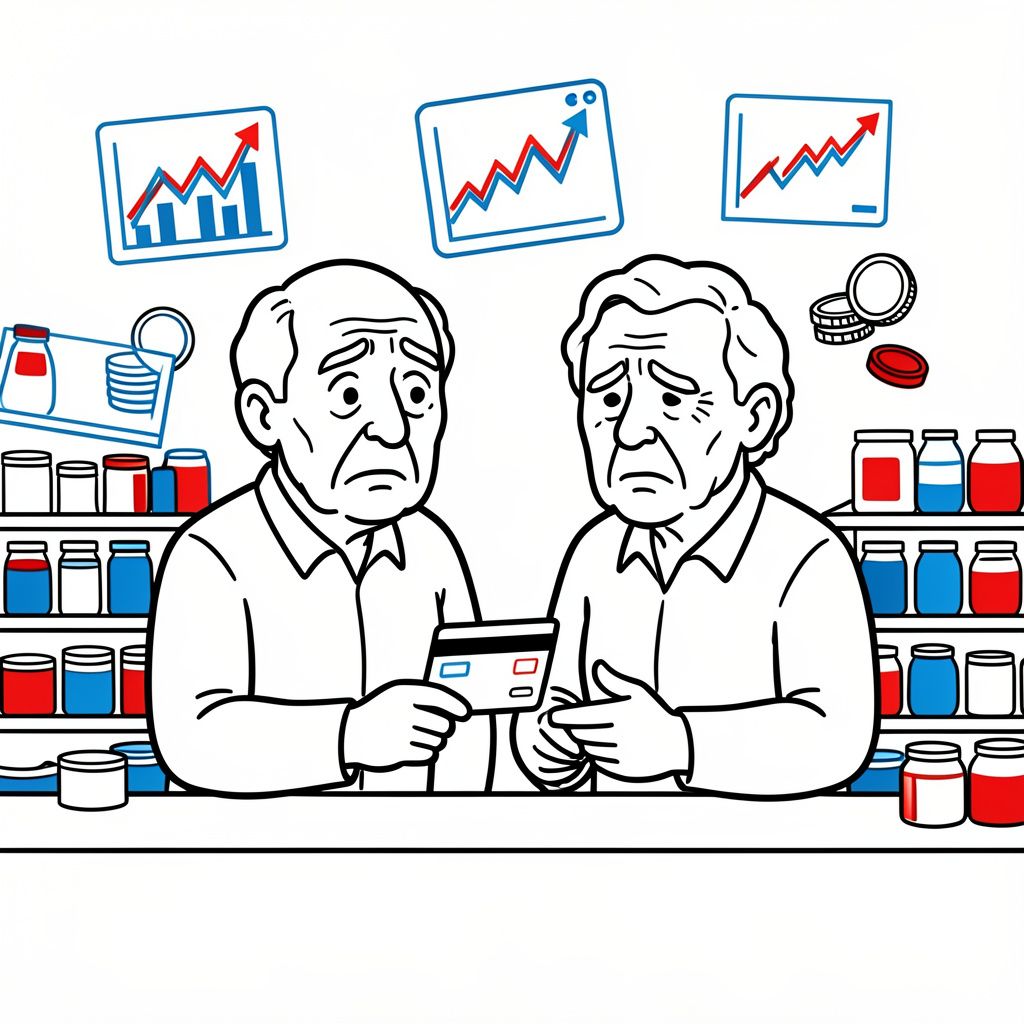
Fixed-income retirees and low-income households in the United States are increasingly depending on high-interest credit cards to cover basic grocery expenses, driven by accumulated inflation and elevated living costs as of August 2026 [1]. Financial analysts warn that this growing reliance on revolving credit for non-durable goods signals mounting consumer debt strain, which could dampen broader macroeconomic consumer spending and increase default risks for major credit card issuers [1]. The Urban Institute’s “2025 Well-Being and Basic Needs Survey” reports a 32% cumulative increase in grocery costs over the five-year period leading up to 2026, exerting severe pressure on household budgets [1].
The U.S. Department of Agriculture’s Economic Research Service (ERS) Food Price Outlook, updated on 30 July 2026, projects food-at-home prices will rise 2.7% in 2026 and 2.9% in 2027 [1]. Specific food category price increases projected for 2026 include beef and veal at 10.7%, fresh vegetables at 6.8%, and sugar and sweets at 7.2% [1]. Moody’s Analytics chief economist Mark Zandi reported that the Iran war is costing the average American household more than $1,200 due to fuel shortages impacting supply chains, further exacerbating the financial burden on consumers [1].
The Debt Trap for Boomers
According to a Northwestern Mutual study published on 18 May 2026, the average American with personal debt owes $21,700 [5]. Among boomers with debt, 29% have credit card debt, 11% have auto loans, and 5% have medical bills; nearly 1 in 3 boomers overall hold credit card debt [5]. Data from the Boston Fed indicates that only approximately 35% of Americans pay their credit card bills in full each month, leaving the majority exposed to compounding interest [5]. Dexter T. Wyckoff, a financial advisor at Northwestern Mutual, noted that carrying balances exposes consumers to interest and penalties that make pay-down harder, particularly when inflation is cited as the top obstacle to financial security [5].
Case studies illustrate the severity of the situation, such as Laurie Lumbra, a 72-year-old retired teacher from Rotterdam, New York, who accumulated $10,000 in credit card debt for groceries on a $1,400 monthly income [1]. She eventually sold her car to pay off the debt, stating, “It gets very depressing. You feel like you’re just such a failure” [1]. This sentiment is echoed by Robert Kiyosaki, who warned that a significant portion of the baby boomer demographic faces the risk of becoming homeless or having their savings “wiped out” across the United States [1].
Regional Food Insecurity Trends
The Capital Area Food Bank (CAFB) conducted an annual general population survey in partnership with NORC at the University of Chicago, surveying nearly 4,000 residents in the DMV area to assess regional food insecurity [6]. Survey results finalized in early June 2025 indicate that food insecurity remains at persistently high levels as of December 2025, with the number of individuals experiencing “very low food security” rising for the third consecutive year [6]. The severity of food insecurity has increased, with the share of food-insecure households classified as having “very low food security” rising from 16% in 2022 to 22% in 2025; this represents a 37.5 percent increase over the period [6].
Regional economic stressors include federal job and spending cuts occurring over the nine months prior to the 31 December 2025 report, which have disproportionately impacted federal and contractor workers [6]. As of 2025, 41% of households with direct or indirect federal employment that experienced job losses in the Greater Washington area were food insecure, a rate higher than the general population [6]. Over two-thirds of food-insecure households impacted by 2025 federal reductions in force suffer from “very low food security,” with many households possessing only 1–2 months of savings to cover expenses after job loss [6].
Assistance Programs and Policy Risks
Federal and state benefits programs, such as the Supplemental Nutrition Assistance Program (SNAP), remain underutilized by older adults who are often unaware of their eligibility or the application process [3]. The NCOA identifies that an estimated 9 million older adults are currently eligible for SNAP benefits but remain unenrolled [3]. The U.S. Department of Agriculture (USDA) offers food assistance for older adults who have a low income, including the Senior Farmers Market Nutrition Program and the Commodity Supplemental Food Program, though these are not available in every state [2].
However, policy changes lo large; the passage of House Resolution 1, the “One Big Beautiful Bill Act,” in July 2025 mandates approximately $186 billion in cuts to SNAP over the next 10 years [6]. SNAP administrative costs shifted to states will increase from 50% to 75% effective October 2026, while states will be required to pay a portion of SNAP benefit costs for the first time starting October 2027 or later [6]. Additionally, while 16 states have been approved for Medicaid Section 1115 waivers to fund social determinants of health, the status of five additional states awaiting federal approval is unknown as of 1 August 2026 [alert! ‘status unknown as of 2026-08-01’][6].
Sources
- www.aol.com
- www.usa.gov
- www.ncoa.org
- www.capitalareafoodbank.org
- www.aol.com
- hunger-report.capitalareafoodbank.org