Low Danube Water Levels Force Power Cuts at Hungary's Paks Nuclear Plant
Budapest, Saturday, 1 August 2026.
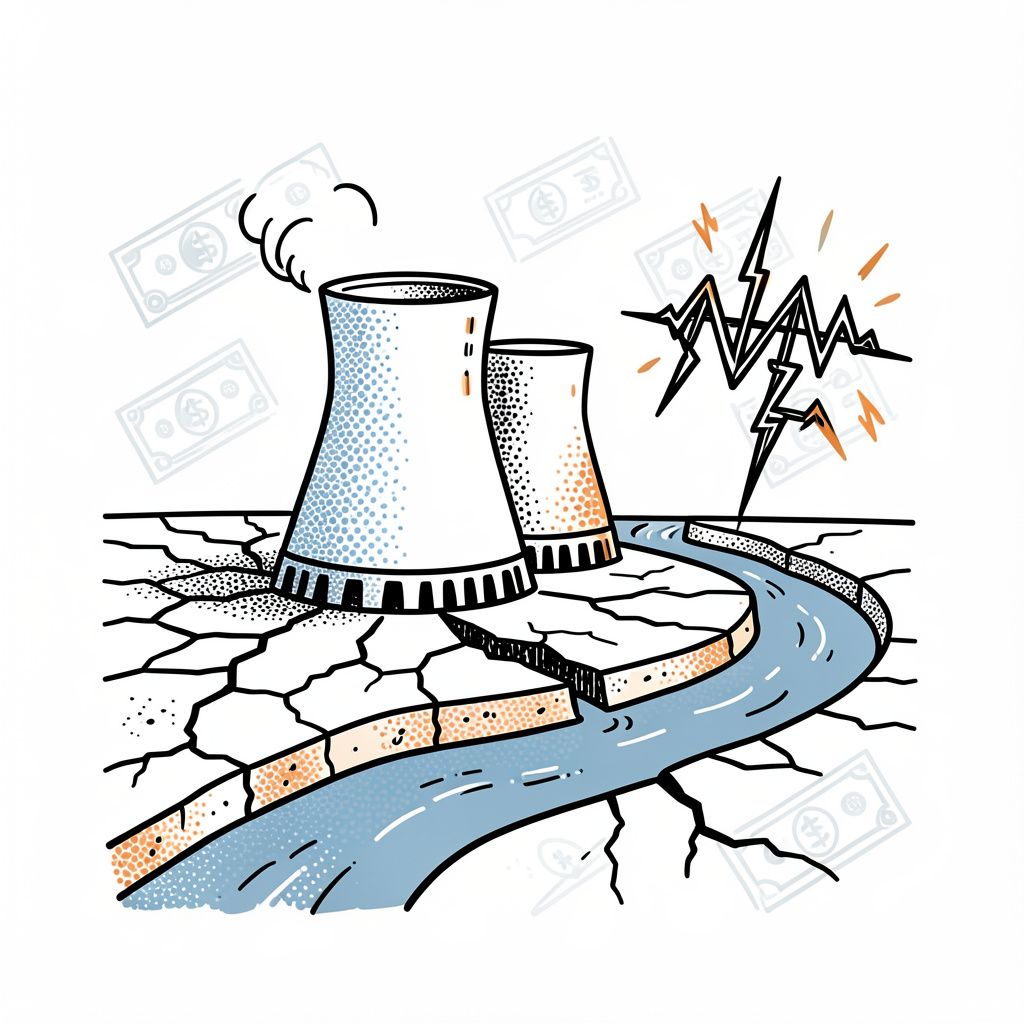
Record-low Danube water levels and extreme summer heat forced Hungary to cut output and begin shutting down reactors at the Paks nuclear plant, threatening the nation’s grid stability.
Operational Shutdowns and Record Water Levels
Following earlier reductions, officials announced on July 29, 2026, the shutdown of Block 3 at the Paks nuclear facility due to the Danube water level dropping to –118 centimetres at the Paks section [2]. This decision followed a 237-megawatt performance reduction on Block 3 implemented on July 28, 2026, as water levels continued to fall [3]. In Budapest, the Danube dropped to a record-low 23 centimetres on Wednesday, breaking the previous record of 33 centimetres set in 2018 [1]. The facility was operating at less than half of its two-gigawatt capacity after falling Danube water levels limited the cooling water available to the reactors [1]. Earlier in the summer, on June 28, 2026, the plant was also forced to reduce production by 320 megawatts due to high water temperatures, representing 16 percent of total capacity [4].
Political Accountability and Energy Strategy
Hungarian Prime Minister Peter Magyar has blamed former leader Viktor Orban for years of poor energy planning that failed to prepare the plant for record-low water levels [1]. Speaking at the MVM Paks Nuclear Power Plant, Magyar argued that earlier investment in climate adaptation could have prevented the current situation [1]. The Prime Minister stated that if the previous government had focused on Hungary’s real sovereignty instead of a pro-Russian energy policy, Paks 1 could still be operating under such record-low Danube water levels [1]. Magyar also questioned why work to prepare Paks 1 for low water levels had been awarded to a joint venture involving Russia’s Rosatom [1]. The prolonged drought has also disrupted cargo shipping on parts of the Danube and reduced nuclear power generation in neighbouring Romania [1].
Technical Constraints and Safety Regulations
Experts are continuously monitoring water flow and temperature changes to make necessary decisions in line with the situation [2]. According to regulations, the temperature of the receiving water 500 metres from the hot water channel mouth must not exceed 30 Celsius degrees [2]. In extraordinary cases, for supply security reasons, this limit can be exceeded up to 31.5 Celsius degrees with the consent of the minister responsible for energy policy [2]. Minister of Economy and Energy István Kapitány stated that the performance reduction is not a malfunction but a responsible measure based on predetermined rules [3]. Officials have placed four pump ships and two floating cranes on standby, with 55 people working 0–24 hours on site to ensure cooling water supply remains completely safe [2].