North Korea Threatens Military Action Following Japan's Cruise Missile Test
Pyongyang, Wednesday, 5 August 2026.
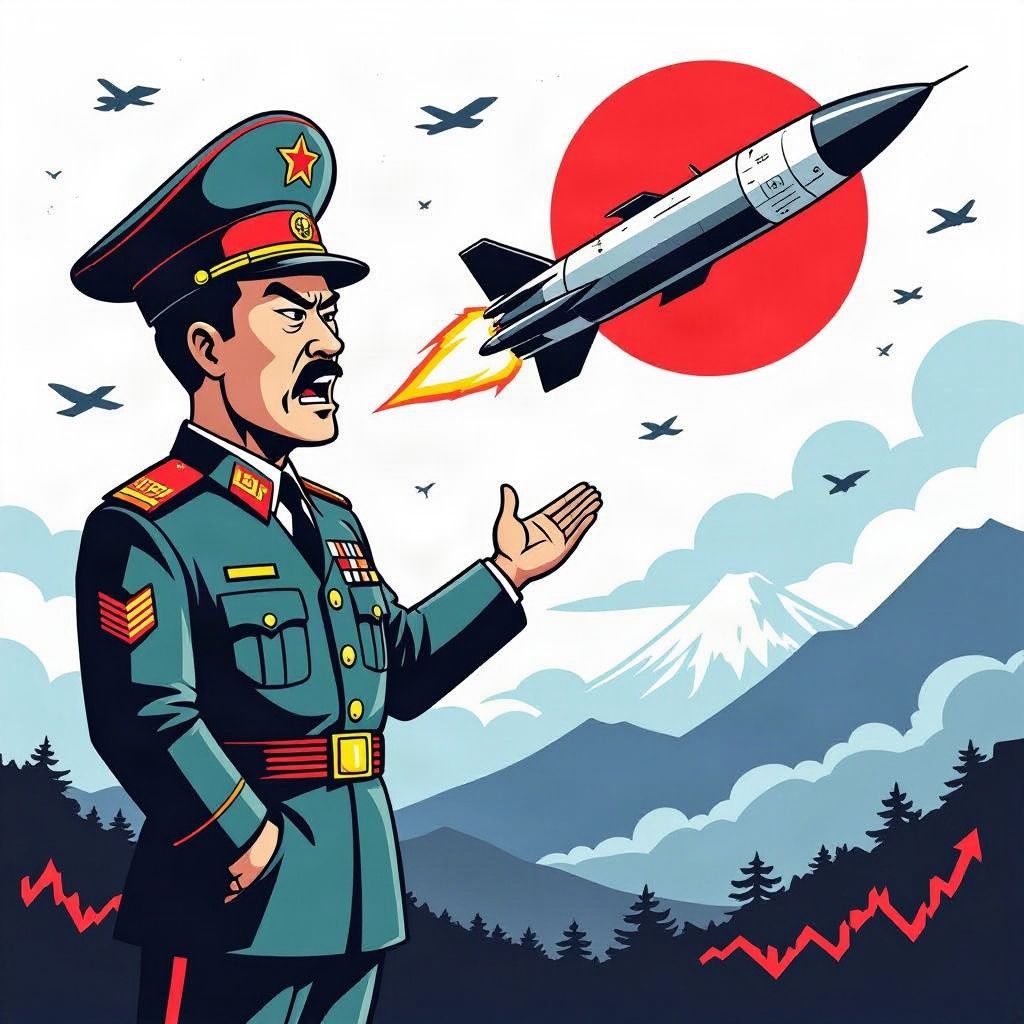
North Korea warned it will pursue new military options after Japan test-fired a U.S.-made Tomahawk cruise missile, claiming Tokyo’s expanding long-range strike capabilities directly threaten regional stability.
Escalating Rhetoric from Pyongyang
On Wednesday, August 5, 2026, Kim Yo Jong, the influential sister of North Korean leader Kim Jong Un, issued a stern warning that Pyongyang would adopt “additional military options” in response to Japan’s expanding defense capabilities [1][2][3]. She accused Tokyo of transitioning from its traditional pacifist stance into an active military power capable of preemptive attacks and overseas military operations [1][2]. This diplomatic escalation follows Japan’s recent military test-firing of a United States-made Tomahawk cruise missile from the Aegis destroyer Chokai in the Pacific Ocean [1][2][6].
The Accusation of a ‘War State’
In her statement, which was carried by the state-run Korean Central News Agency (KCNA), Kim Yo Jong declared that North Korea would not remain a “passive onlooker” as Tokyo accelerates its rearmament programs [3]. She accused Japan of reviving the historical ambitions of a “war criminal state” and becoming a “war state” [3][5]. Raising the diplomatic temperature further, Kim warned that Pyongyang’s military responses would make Japan realize its security has been exposed to much greater danger, asserting, “We should make it regret” [1][2][4].
The Role of U.S. Alliances and Joint Drills
The North Korean leadership explicitly targeted the United States for facilitating Japan’s military modernization [1][2]. Kim Yo Jong accused Washington of enabling Tokyo’s buildup by supplying Tomahawk missiles, modifying naval vessels for their deployment, and supporting the test-firings [1][2]. “The U.S. is behind such dangerous military moves of Japan,” she stated, noting that Japan’s acquisition of long-range strike capabilities effectively places North Korea and neighboring nations within target range [1][2].
Geopolitical Implications and Future Demonstrations
Pyongyang’s objections extend beyond the recent Tomahawk test to broader trilateral security cooperation. Kim’s statement highlighted Japan’s participation in a U.S.-led joint military exercise in the Philippines in May 2026, alongside other missile tests [1][2]. Since July 2026, KCNA has published at least six editorials and commentaries condemning joint military activities by the United States, South Korea, and Japan as direct threats to regional security [1][2].
A Strategic Pretext for Weapons Development
Regional analysts suggest that North Korea is leveraging Japan’s military modernization to justify its own defense programs [1][2]. Yang Moo-jin, a professor at the University of North Korean Studies in Seoul, remarked that Kim’s rhetoric seeks to frame Japan’s defense initiatives as part of a wider U.S. strategy to enhance proxy military capabilities in East Asia [1][2]. According to Lim Eul-chul, a professor at Kyungnam University’s Institute for Far Eastern Studies, the warnings could lay the groundwork for future North Korean military demonstrations, including missile tests or public displays of its undersea strike capabilities [1][2].
Sources
- www.nbcnews.com
- www.aljazeera.com
- www.bloomberg.com
- www.facebook.com
- www.facebook.com
- www.instagram.com
- www.facebook.com