Surging Artificial Intelligence Demand Drives Global Air Shipping Rates Higher
Taipei, Wednesday, 2 September 2026.
Booming AI hardware exports are overwhelming Asian air cargo capacity, while severe weather and port delays keep ocean rates elevated despite weakening broader consumer demand.
AI Demand Reshapes Freight Markets
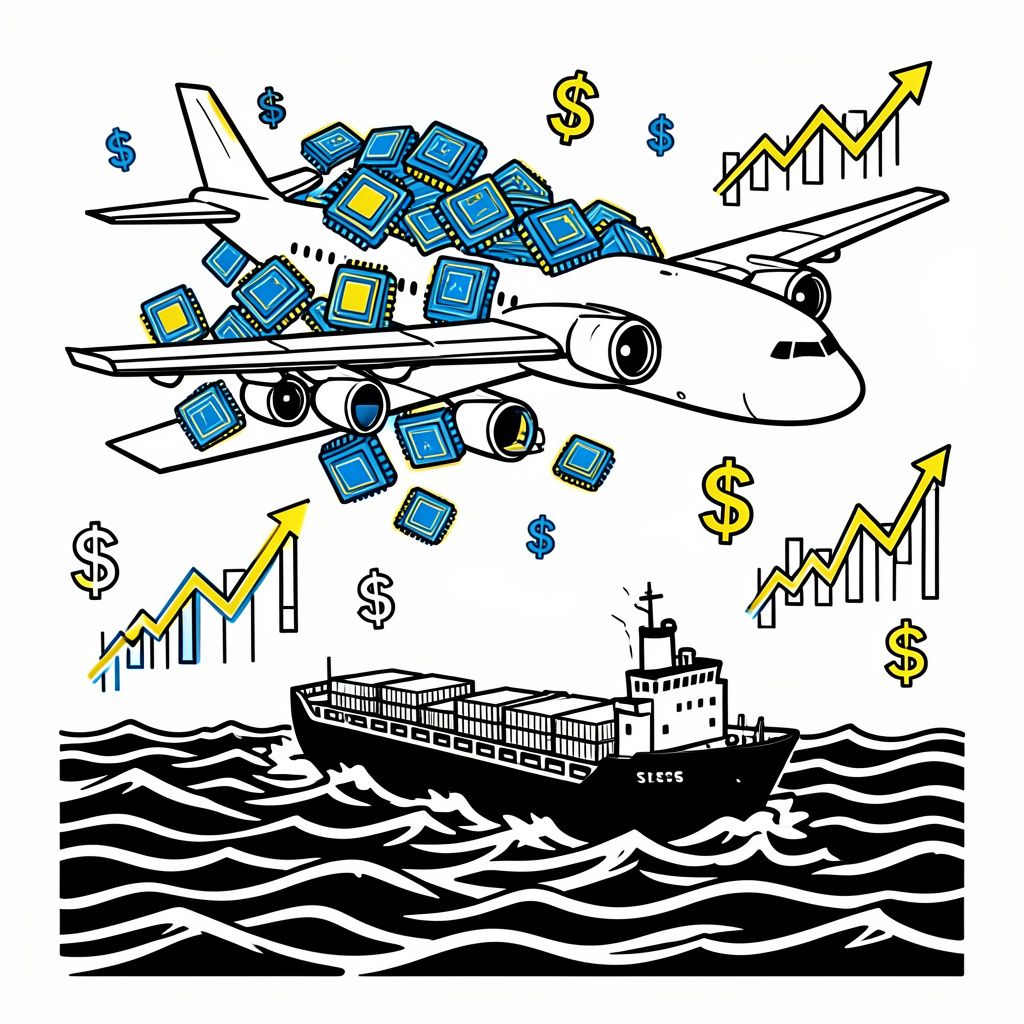
The Dimerco September Freight Report, released on September 2, 2026, indicates that surging global demand for artificial intelligence hardware is straining Asian air cargo capacity [1]. Executives and supply chain managers are facing shifting logistics costs as technology exports squeeze air freight bandwidth, creating strategic challenges for global trade heading into the fourth quarter [1]. While broader consumer demand shows signs of softening, the bifurcation in the market is distinct, with AI and semiconductor exports from Taiwan and South Korea tightening air capacity significantly [1]. South Korean air cargo is experiencing high demand, with Asia-US load factors currently operating near 90% [1]. This surge in technology exports is offsetting weak e-commerce volumes in Europe following regulatory changes earlier in the summer [1].
Ocean Freight and Weather Disruptions
Ocean freight rates are being sustained by supply chain disruptions rather than demand growth, specifically typhoons affecting ports in Shanghai, Ningbo, Yantian, and Hong Kong [1]. Recent typhoons caused shutdowns in these major hubs, with East China congestion involving approximately 400,000 TEU awaiting clearance [1]. Vessel wait times have extended to three to eight days in Shanghai and two to four days in Ningbo [1]. Additionally, Panama Canal draft restrictions are scheduled to begin on September 3, 2026, impacting US-bound cargo [1]. These supply-driven disruptions ensure that slowing demand is not pulling rates down as traditionally expected [1].
Regional Rate Divergence
Air cargo rates from China to the United States climbed 30 per cent year-on-year ahead of the peak shipping rush, driven by steady semiconductor and e-commerce shipments [3]. By contrast, rates on the China-to-Europe corridor rose 12 per cent over the same period, slowed by the European Union ending its de minimis tax exemption on July 1, 2026 [3]. The price split reflects an uneven recovery across Asian export corridors, with the transpacific air freight maintaining a sharp premium [3]. The difference in rate increases between the US and Europe corridors is 18 percentage points [3]. Furthermore, 84.1% of APAC shippers report that ocean freight volatility is having a moderate to severe impact on their air freight operations [2]. As cargo shifts from ocean to air, 55.6% of air shippers cite rate volatility as their biggest challenge [2].
Economic Implications and Outlook
Dimerco Express Group anticipates rising freight rates on Taiwan-US air routes leading into the Q4 2026 peak season [1]. The firm also anticipates Q4 peak-season pressure will intensify across Southeast Asia, India, and Australia throughout September 2026 [1]. As of July 2026, the Global Manufacturing PMI reached 52.1, marking 12 consecutive months of expansion, with Taiwan leading the regional manufacturing index at 55.1 [1]. However, air freight demand on Asia-Europe lanes remains subdued due to the July 2026 removal of the EU de minimis exemption for e-commerce parcels [1]. Strategic planning for inventory and logistics must now account for this commodity-specific volatility rather than broad regional averages [3].