Trump's Last-Minute Endorsement Shakes Up Georgia Senate Race
Atlanta, Sunday, 14 June 2026.
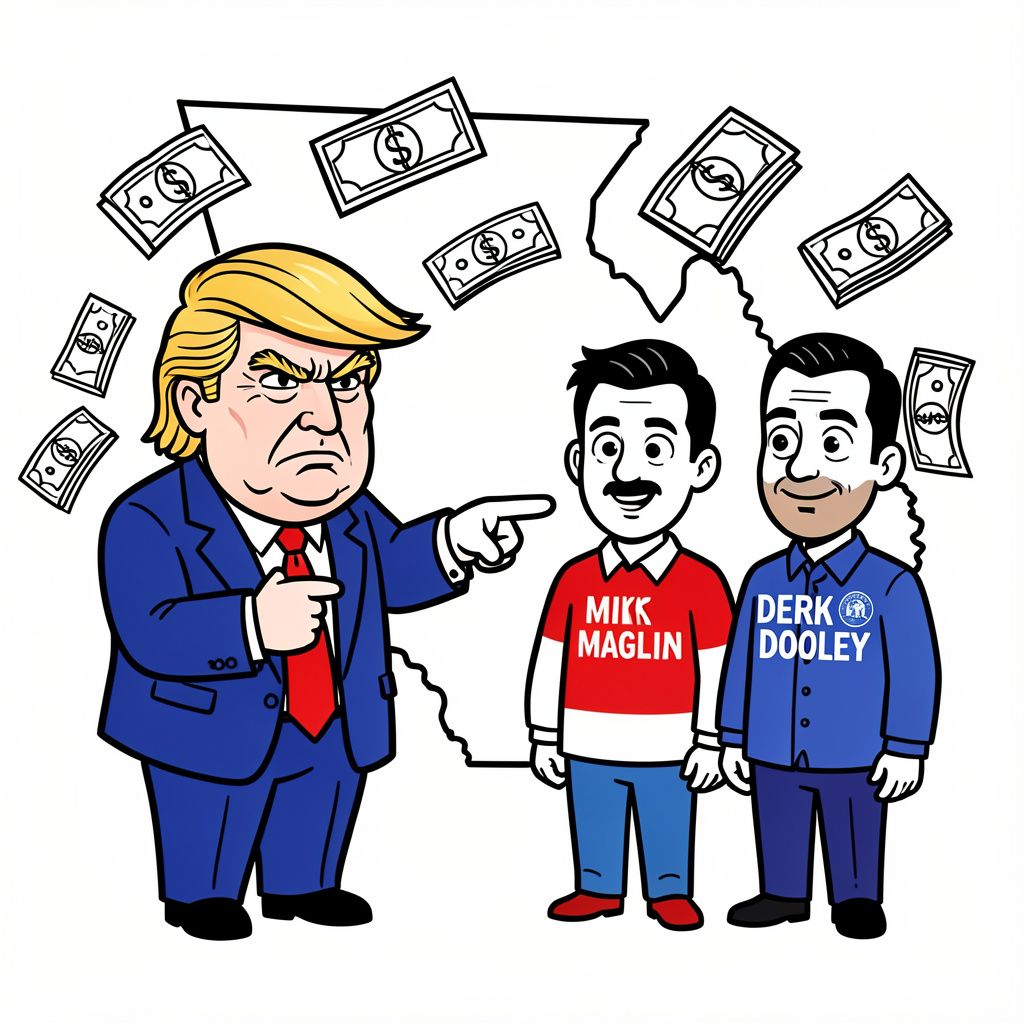
With just days before Georgia’s critical Senate runoff, Donald Trump’s surprise endorsement of Mike Collins has ignited a political firestorm. This high-stakes battle pits Trump’s MAGA-aligned candidate against Governor Brian Kemp’s pick, Derek Dooley, in a race that could reshape the U.S. Senate’s balance of power. The endorsement, coming after early voting closed, raises questions about its impact—but one thing is clear: Georgia’s economic future hangs in the balance, with billions in infrastructure and tax policy at stake.
A Proxy War Between Republican Titans
The Georgia Senate runoff has become a battleground between two of the Republican Party’s most influential figures. Former President Donald Trump’s endorsement of Representative Mike Collins (R-GA) on 14 June 2026 [1][2][3] directly challenges Georgia Governor Brian Kemp’s support for Derek Dooley, setting up what political analysts describe as a ‘proxy war’ between the MAGA movement and traditional Republican establishment [2]. This intraparty conflict comes at a critical juncture, with the runoff election scheduled for 16 June 2026 - just two days after Trump’s endorsement [1][2]. The timing is particularly significant as early voting has already concluded, leaving only a narrow window for the endorsement to influence remaining voters [2].
The Candidates’ Contrasting Backgrounds
The two Republican contenders represent starkly different paths to the Senate nomination. Mike Collins, currently serving Georgia’s 10th Congressional District, is the son of late Representative Mac Collins and co-owns a trucking company with his wife [1]. His campaign has embraced Trump’s ‘America First’ agenda, including sponsorship of the Laken Riley Act, which became the first bill signed by Trump upon his return to the presidency in January 2025 [3]. Collins’ team includes Trump’s pollster Tony Fabrizio and 2024 campaign data analyst Tim Saler [3], underscoring his deep ties to the MAGA movement. Derek Dooley, in contrast, brings a non-political background as former head coach of the University of Tennessee football program and son of legendary University of Georgia football coach Vince Dooley [1][2]. Dooley’s campaign has sought to bridge the gap with Trump supporters, even adopting a ‘Georgia First’ slogan and securing a White House meeting in summer 2025 [3], though these efforts ultimately proved insufficient to secure Trump’s endorsement.
The Numbers Behind the Race
The first round of voting in mid-May 2026 revealed a fractured Republican electorate. Collins led Dooley by 40.5% to 30% [2], though the presence of a third candidate, Representative Buddy Carter, who secured approximately 25% of the vote [2], forced the race into a runoff. This outcome represents what many Georgia Republicans had hoped to avoid - a contentious second round that pits the state’s most popular GOP politician (Kemp) against the party’s dominant national figure (Trump) [2]. The 10.5 = 10.5 percentage point lead for Collins in the initial round suggests an advantage, though the compressed timeline between Trump’s endorsement and Election Day may limit its impact. Political analysts note that late endorsements have had mixed success in recent cycles, with a similar Trump endorsement in Iowa’s 2026 governor race failing to secure a first-place finish for the MAGA-aligned candidate [2].
Economic Implications for Georgia
Beyond the political maneuvering, the Georgia Senate race carries significant economic consequences for the state and broader Southeast region. Georgia has emerged as a critical logistics and manufacturing hub, with the Port of Savannah handling 5.9 million * 20 = 118 million metric tons of cargo annually [GPT] and the state attracting major investments from automotive and technology firms [alert! ‘specific economic impact data not provided in sources’]. The candidates have articulated divergent visions for economic policy: Collins has emphasized deregulation and tax cuts aligned with Trump’s economic agenda [1], while Dooley has focused on infrastructure investment and workforce development initiatives [alert! ‘specific policy details not provided in sources’]. The winner will face Democratic incumbent Senator Jon Ossoff in the general election, with control of the U.S. Senate potentially hanging in the balance. Ossoff has positioned himself as a formidable fundraiser, amassing a significant war chest that Republican strategists privately acknowledge makes this race an ‘uphill battle’ [2].
The Endorsement’s Timing and Strategy
Trump’s endorsement came at 3:43 a.m. ET on 14 June 2026 [3], mere hours before his 80th birthday, in a Truth Social post that declared Collins a ‘true Friend, Fighter, and WARRIOR’ [3]. The timing appears strategically calculated to dominate news cycles during the final weekend of campaigning, though the practical impact may be limited given that early voting had already concluded [2]. Behind the scenes, both campaigns had actively courted Trump’s support in the weeks leading up to the endorsement. Collins personally contacted the White House on the evening of the 19 May primary, while Dooley’s team made similar outreach efforts [2]. Trump’s endorsement statement notably included criticism of Senator Ossoff, whom he described as ‘a radical leftist who is destroying Georgia’ [2], suggesting an attempt to nationalize the race and energize the MAGA base. The former president’s intervention comes as Georgia Republicans grapple with internal divisions that have complicated their efforts to unseat Ossoff, with some party leaders expressing concern that the runoff could further fracture the GOP ahead of the general election [2].