Why Baby Boomers Still Dominate U.S. Wealth in 2026—and What It Means for Everyone Else
Washington D.C., Sunday, 14 June 2026.
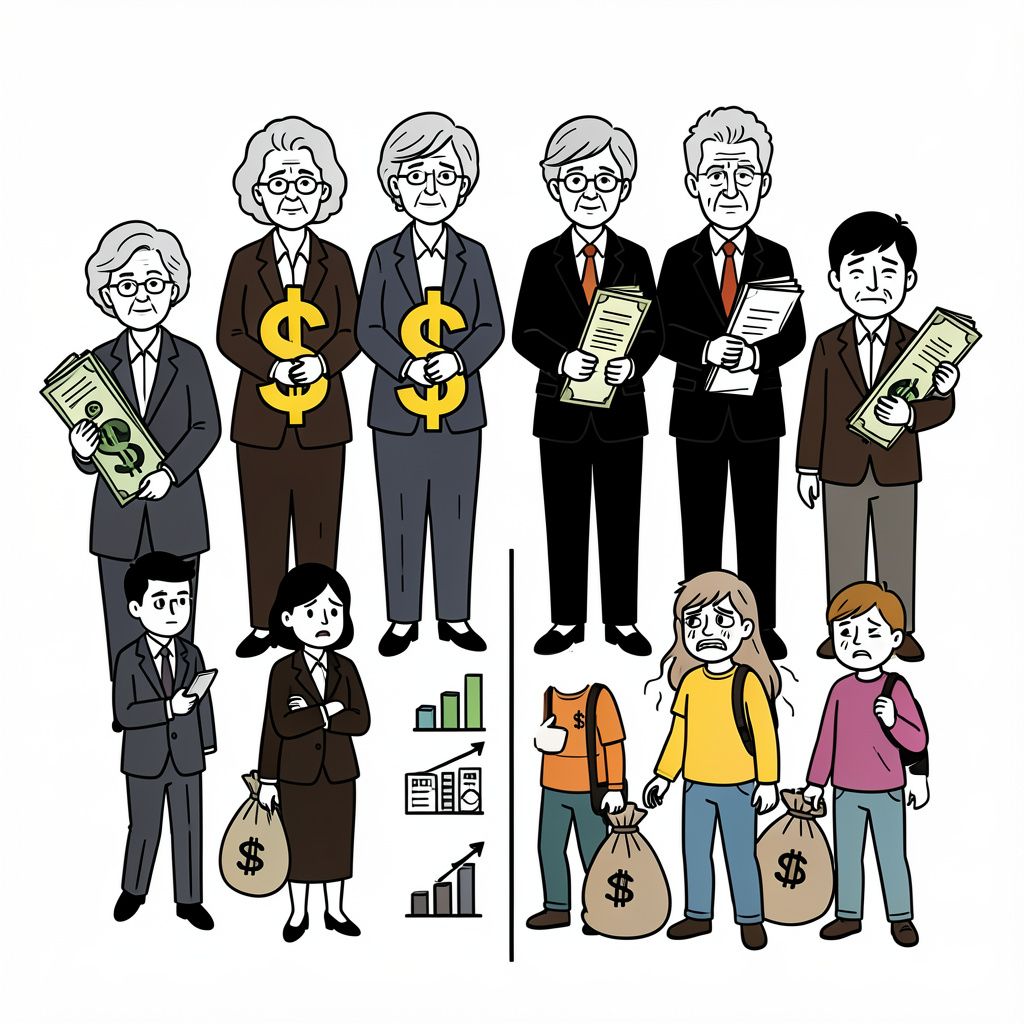
Federal Reserve data reveals a staggering truth: Baby Boomers, just 20% of the U.S. population, control 52% of the nation’s $85 trillion in wealth—while Millennials, a larger workforce, hold only 8%. This isn’t just a gap; it’s a chasm reshaping housing, retirement, and economic policy. The top 10% of Boomer households alone own 71% of their generation’s wealth, fueling debates about generational equity. With Boomers holding power for decades, policies favored homeownership and pensions—luxuries younger generations can’t access. The result? A K-shaped economy where wealth soars for the few and debt crushes the rest. The question isn’t just why this happened, but whether the system can adapt before tensions boil over.
The Wealth Gap in Numbers: A Generational Divide
Federal Reserve data from the first quarter of 2026 confirms what economists have long suspected: Baby Boomers (born between 1946 and 1964) continue to dominate U.S. household wealth, holding approximately 52% of the nation’s $85 trillion net worth. This figure is particularly striking when compared to Millennials (born between 1981 and 1996), who hold just 8% of total wealth despite representing a larger share of the workforce [1]. The disparity becomes even more pronounced when examining the top 10% of Boomer households, which control 71% of their generation’s wealth—a concentration that has only intensified over time [2]. For context, the top 1% of all U.S. households now own 30.9% of the nation’s wealth, up from 23% in 1989, while the bottom 50% hold a mere 2.5% [3]. These figures underscore a growing economic divide that transcends generational lines, raising questions about the sustainability of current wealth distribution patterns.
Historical Context: How Boomers Built Their Wealth
The roots of this wealth disparity trace back to the uniquely favorable economic conditions Baby Boomers encountered during their formative years. In the postwar era, manufacturing was at its peak, housing was affordable (with median home prices roughly 2-3 times the average annual income, compared to 10 times today), and defined-benefit pensions were the norm [1]. Public universities were heavily subsidized, and tax structures favored wage earners over investors. These conditions allowed Boomers to accumulate wealth at an unprecedented scale—$85 trillion in aggregate wealth, exceeding any prior generation at the same life stage [1]. Their political influence further cemented these advantages: Boomers formed the largest voting bloc in U.S. history for nearly four decades (1978 to the mid-2010s), enabling policies that prioritized homeownership, capital gains taxation, and pension protections [2]. The result? A generational cohort that not only amassed wealth but also shaped the economic rules in its favor.
The Millennial Burden: Debt, Housing, and Delayed Mobility
While Boomers enjoyed a landscape of opportunity, Millennials face a starkly different reality. Federal Reserve data from May 2024 reveals that Millennials hold over one-third of all student loan debt, a burden that has no historical parallel in prior generational transitions [2]. Mortgage debt for Millennials and Gen X is nearly double that of Boomers in absolute terms, despite stagnant wage growth [2]. Housing affordability has collapsed: the median home price in 2026 is approximately 10 times the median annual income, compared to 2-3 times for Boomers in their prime earning years [1]. This has led to delayed homeownership, a key driver of wealth accumulation. Stéphane Francioli, Felix Danbold, and Michael North, researchers in intergroup threat theory, argue that Millennials’ hostility toward Boomers stems from what they term ‘realistic threat’—the fear that Boomers’ delayed transmission of power and wealth is permanently hampering their life prospects [1]. The numbers support this claim: in 2022, Boomer households held $77 trillion in wealth, with the top 10% of these households owning 71% of that total [2].
Policy and Power: The Boomer Legacy
Boomers’ political dominance during their peak earning years (1978 to the mid-2010s) enabled policies that favored their financial interests. During this period, capital gains tax rates were lowered, public university funding was reduced, and defined-benefit pensions were phased out in favor of 401(k) plans—shifts that disproportionately benefited those already wealthy [2]. The consequences of these policies are now evident. Social Security and Medicare, programs Boomers rely on heavily, face long-term funding shortfalls, with the Social Security Trust Fund projected to be depleted by 2034 [GPT]. Meanwhile, younger generations face a retirement landscape where traditional pensions are rare, and 401(k) balances are often insufficient. The Federal Reserve’s Q1 2026 data shows that directly and indirectly held equity decreased by $1.8 trillion, while deposits increased by $0.4 trillion, suggesting a shift toward safer, lower-yield assets—a trend more common among older, risk-averse investors [4]. This concentration of wealth among older Americans has broader economic implications: consumer spending patterns are shifting, with Boomers prioritizing healthcare and leisure, while Millennials delay major purchases like homes and cars [1].
The Road Ahead: Can the System Adapt?
The concentration of wealth among Baby Boomers presents both challenges and opportunities for policymakers. On one hand, the sheer scale of Boomer wealth—$85 trillion in aggregate—could fuel economic growth if transferred to younger generations through inheritance or spending. On the other, the current distribution risks exacerbating intergenerational tensions and stifling economic mobility. Goldman Sachs projects that AI could displace 6% to 7% of U.S. jobs over the next decade, primarily in administrative support and routine office work, further straining younger workers [5]. However, AI could also boost global GDP by ~7% and add 1.5 points to annual U.S. productivity growth over 10 years, offering a potential path to economic expansion [5]. The question is whether this growth will be broadly shared or concentrated among those already wealthy. As Tony Isola, a financial commentator, notes, ‘Millionaires aren’t losing the game; they’re just looking at the wrong scoreboard’ [5]. The challenge for policymakers is to design systems that ensure wealth and opportunity are more equitably distributed, lest the current disparities become permanent. With Boomers set to transfer an estimated $68 trillion to heirs by 2042, the coming decades will test whether the U.S. can create a more inclusive economic future [GPT].
Sources
- fortune.com
- www.federalreserve.gov
- www.instagram.com
- www.federalreserve.gov
- realinvestmentadvice.com
- realinvestmentadvice.com