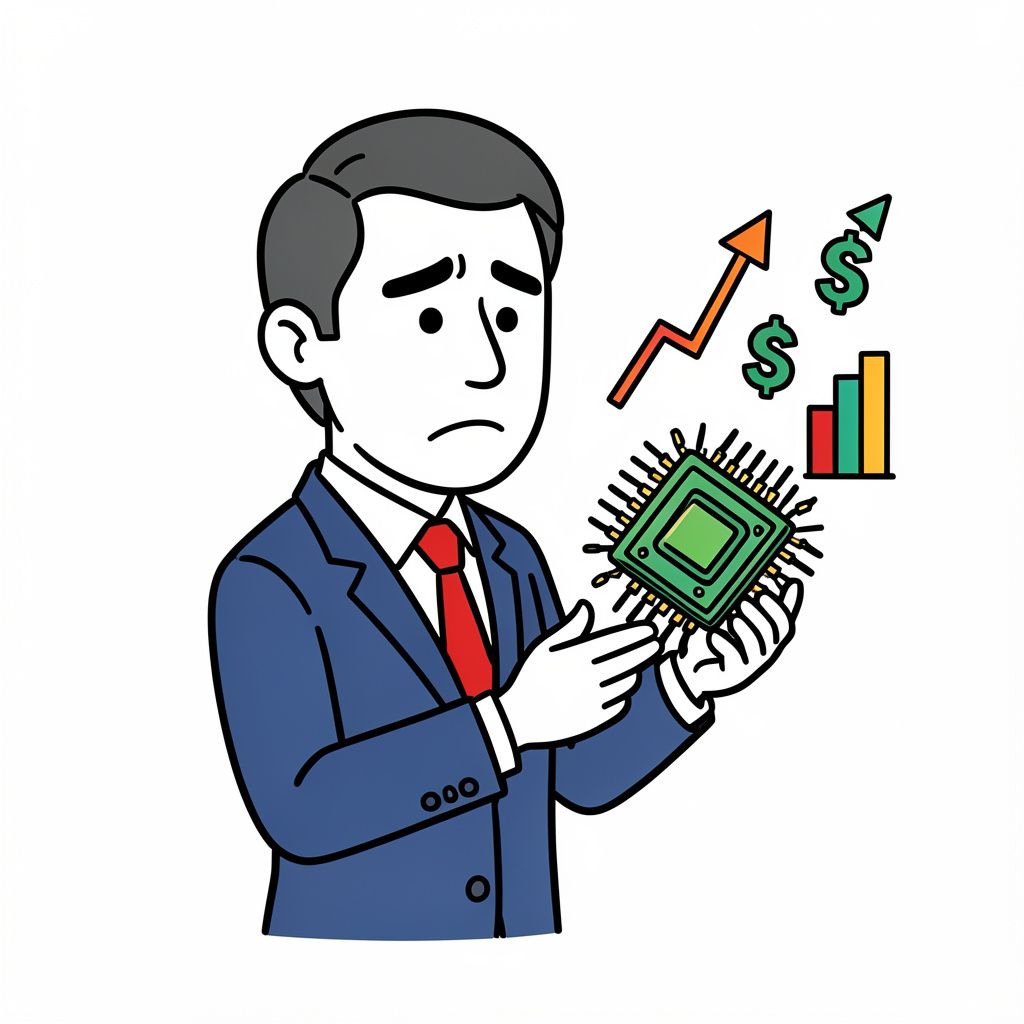
Rising Component Costs Threaten Apple Holiday Profit Margins
New York, Tuesday, 3 November 2026.
Surging memory chip expenses and tightening holiday profit guidance drove Apple shares down 4%, overshadowing record quarterly revenue in new Chief Executive Officer John Ternus’s first earnings report.
Apple’s Mixed Earnings Report Under New Leadership
Apple Inc. delivered record fiscal fourth-quarter earnings on 2 November 2026, reporting earnings per share of $2.10—surpassing the $1.99 consensus estimate—and revenue of $114.48 billion, which exceeded Wall Street’s $113.39 billion forecast [2][3][4]. Despite this upbeat performance, Apple shares fell 4% in premarket trading to $325, reflecting growing concerns about the company’s holiday quarter guidance [3][4]. The market reaction underscores the challenges facing new Chief Executive Officer John Ternus, who assumed the role in October 2026 amidst high investor expectations [5][6].
Margin Pressures and Memory Chip Challenges
The primary driver of Apple’s stock decline was the company’s weaker-than-expected gross margin forecast for the December quarter, projected to fall within a range of 45% to 46% [2][3][4]. This outlook represents a notable compression from the 47.9% gross margin reported in the September quarter, driven by surging memory chip costs that have squeezed profitability across Apple’s product lines [3][4][8]. Analysts at Morgan Stanley and JPMorgan responded by lowering their price targets for Apple to $350 and $355, respectively, reflecting concerns about margin sustainability amid rising component expenses [2].
Supply Constraints and Geographic Weaknesses
Apple’s guidance also highlighted supply constraints, particularly for Mac and iPad products, which are expected to limit the company’s ability to capitalize on holiday demand [3][4]. Sales in China—a critical market for Apple—fell short of estimates, totaling $17.5 billion compared to forecasted levels [2][7]. Revenue in Japan also underperformed, contributing to broader concerns about demand in key Asian markets [2]. Despite these headwinds, Apple forecasted revenue growth of 7% to 10% for the holiday quarter, outpacing Wall Street’s 6.1% estimate [5][6][9].
Broader Market Implications and Investor Sentiment
The decline in Apple’s stock has broader implications for the technology sector and investor sentiment heading into the year-end trading stretch. Mega-cap tech stocks such as Microsoft and Meta exhibited mixed reactions, with Microsoft dipping 1% and Meta holding steady, while Alphabet saw minimal movement [3]. Analysts at Vital Knowledge warned that if financing conditions tighten, the substantial capital expenditures required for artificial intelligence infrastructure—much of which is debt- or equity-financed—could face scaling back [1]. This sentiment was echoed by Daniel Newman of Futurum Group, who suggested that a reduction in oil prices could alleviate pressure on interest rates and ease funding challenges for AI-related investments [2].
Geopolitical Risks and Energy Market Volatility
Geopolitical developments added another layer of uncertainty to the market landscape on 3 November 2026. Reports indicated that the U.S. military had conducted a strike on Iran’s Qeshm Island, prompting concerns about potential disruptions to energy supplies through the Strait of Hormuz [1][2]. Oil prices rebounded following this news, reversing a significant sell-off from the previous day and renewing fears of supply chain disruptions [1][2]. The volatility in energy markets coincided with the start of U.S. midterm elections on 2 November 2026, which introduced additional political risk into the trading environment [2].
Analyst Perspectives and Long-Term Outlook
Despite the near-term headwinds, many analysts remained bullish on Apple’s long-term prospects. Analysts at CNBC highlighted Apple’s strong free cash flow of $26.8 billion for the quarter, which, while below consensus estimates, underscored the company’s robust cash generation capabilities compared to peers heavily invested in AI infrastructure [2][4]. Apple’s CEO John Ternus struck an optimistic tone, stating that the company had ‘never been more confident that the best is yet to come,’ reflecting confidence in Apple’s innovation pipeline and market positioning [2][6][9]. However, the market’s reaction suggests that investors are closely scrutinizing margin sustainability and the company’s ability to navigate rising costs and geopolitical risks.
Sources
- investorshub.advfn.com
- www.cnbc.com
- 247wallst.com
- www.facebook.com
- www.bloomberg.com
- www.facebook.com
- www.linkedin.com
- www.cnbc.com