Local Opposition Targets Data Centers While Solar and Battery Projects Gain Ground
Washington, Wednesday, 16 September 2026.
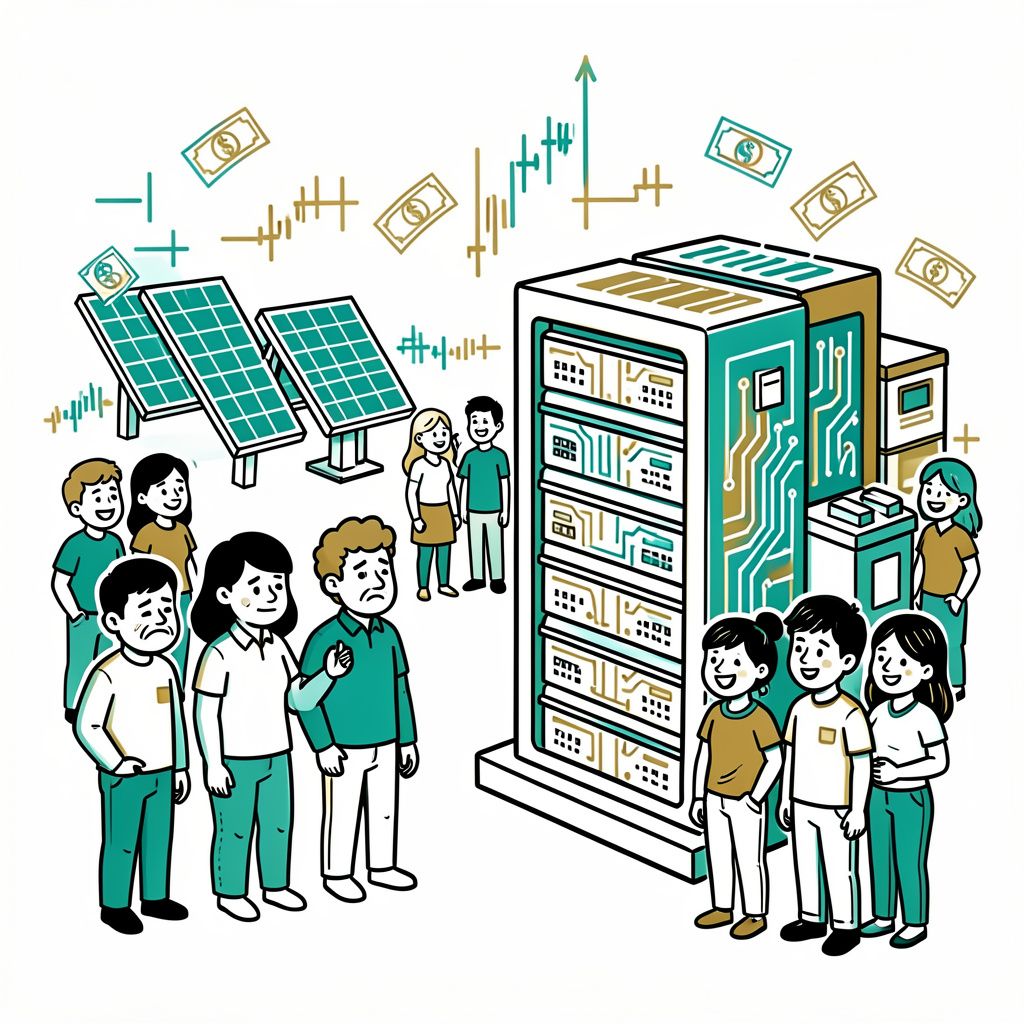
A nationwide study reveals that community pushback against data centers rarely affects solar or battery storage projects. In fact, 72% of counties opposing data centers remain receptive to green energy.
Local Opposition Targets Data Centers While Solar and Battery Projects Gain Ground
A nationwide study reveals that community pushback against data centers rarely affects solar or battery storage projects. In fact, 72% of counties opposing data centers remain receptive to green energy [1]. A comprehensive analysis of 3,142 U.S. counties released on September 16, 2026, indicates that local community opposition to hyperscale data centers remains technology-specific and rarely extends to adjacent green energy initiatives like solar farms or utility-scale battery storage [1]. For corporate executives and clean energy developers, the data highlights a strategic pathway: while land acquisition and zoning approvals for energy-intensive artificial intelligence infrastructure face mounting public pushback, renewable energy projects retain strong local support [1]. This allows energy firms to proceed with grid decarbonization plans even amidst growing resistance to data center expansion [1]. The data suggests residents distinguish between technologies rather than reject development outright [1].
Regional Divergence in Energy Sentiment
Geographic analysis reveals significant variance in technology sentiment across the United States. Florida exhibits the largest technology sentiment split, scoring +0.27 for solar, +0.30 for storage, and −0.84 for data centers [1]. In contrast, the Northeast region averages −0.75 for data centers, with 34% of its counties imposing restrictions [1]. Statistical data shows that 13 counties, representing 0.414 of the total analyzed, have banned all three technologies [1]. Conversely, 282 counties restrict only data centers, indicating a targeted regulatory approach [1]. Of 802 counties unfavorable to data centers, 578 are neutral or positive for solar and storage, confirming the 72.07 compatibility rate [1]. Battery storage has the highest national feasibility average at +0.23, the lowest restriction rate at 2.2%, and negative sentiment in fewer than 10% of counties [1]. Twelve states, including West Virginia, Mississippi, Idaho, and Alaska, show positive averages for data centers, offering potential development hubs [1].
Regulatory Responses and Moratoriums
Local governments are actively responding to infrastructure pressures with temporary zoning measures. On July 9, 2026, Missoula County commissioners enacted a one-year moratorium on new or expanded data centers outside city limits to evaluate impacts on public health, safety, and the environment [2]. This temporary moratorium expires on July 8, 2027, with the possibility of a one-year extension following a public hearing [2]. County staff aims to complete a draft study for public presentation in early November 2026 [2]. In Oregon, the Woodburn City Council approved a 120-day freeze on new data center projects on Monday night, September 15, 2026 [3]. This measure halts the acceptance, review, and approval of city permits for new data storage and processing facilities under the Woodburn Development Ordinance [3]. Previously, Hillsboro enacted a 120-day moratorium on new data center and battery storage applications in late July 2026 [3]. Earlier this month, Oregon Gov. Tina Kotek paused state land requests for new data centers on September 8, 2026 [3]. Clackamas County and Salem are also considering moratoriums, signaling a broader regional trend [3].
Economic Implications for Developers
The divergence in sentiment creates a complex landscape for capital allocation. Existing data center density drives opposition; 66% of counties with 10+ operating facilities have negative sentiment toward new data centers [1]. Population size also correlates with negative data center sentiment, which rises from 13% in the least-populous quartile to 55% in the most populous [1]. Counties with data center backlash have a median population of approximately 60,000 versus the 26,000 national median [1]. There are 363 counties concentrated in Georgia, Iowa, Kentucky, Tennessee, and Kansas that combine supportive sentiment with restrictive zoning, making local ordinance changes the primary barrier for data center developers [1]. As of September 2026, Dickens County, Texas, is identified as the sole county rated favorable for all three technologies [1]. Residents are advised to evaluate proposals on a project-specific basis rather than assuming general development opposition [1]. This nuance suggests that while AI infrastructure faces hurdles, the broader energy transition retains public license to operate [1].