Proposal Suggests Paying Direct Cash Dividends to Homeowners to Ease AI Data Center Resistance
Washington, Wednesday, 9 September 2026.
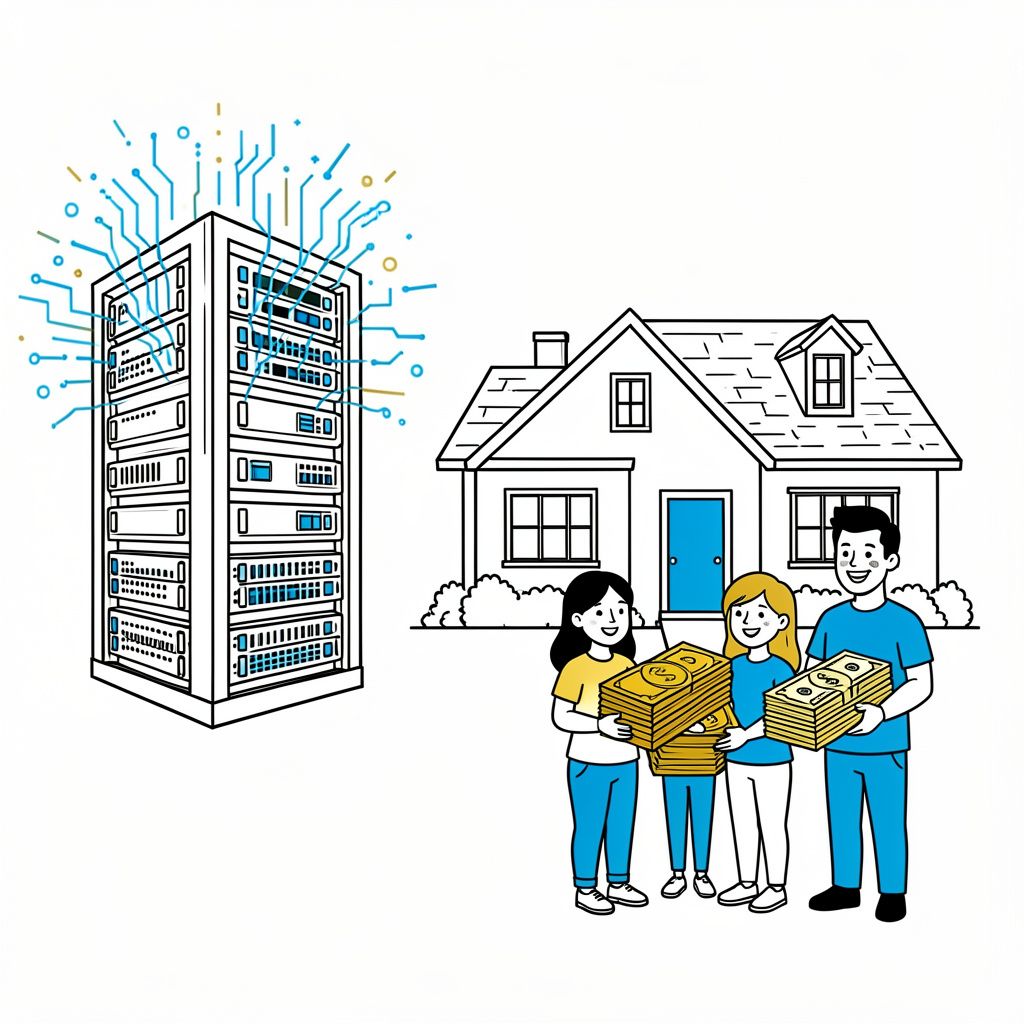
To counter surging public opposition, a think tank has proposed redistributing tax revenues from AI data centers to local households, offering annual payouts of up to $8,900 per family.
Proposal Suggests Direct Cash Dividends to Counter Data Center Backlash
In a strategic move to mitigate growing public resistance against the rapid expansion of digital infrastructure, the Bitcoin Policy Institute released a proposal on 8 September 2026 advocating for direct dividend payments to homeowners [1]. The framework suggests redistributing local data center tax revenues directly to residents in the form of annual payments estimated between $4,500 and $8,900 per household [1]. This initiative aims to provide tech firms and real estate developers with a blueprint to ease community opposition and secure municipal permits for large-scale cloud projects [1]. Sam Lyman, head of research at the Bitcoin Policy Institute, stated that every American deserves to benefit from the AI boom, emphasizing that the economic revolution should not be limited to Silicon Valley developers [1]. The proposal outlines five distribution options, including annual cash dividends, property tax credits, utility bill credits, scholarship endowments, and county-managed permanent investment funds [1].
Surge in Local Moratoriums and Public Opposition
The urgency of this proposal is underscored by a dramatic increase in local data center moratoriums, which rose from 6 in 2024 to 59 in 2025, reaching 294 in August 2026 [1]. This trajectory represents a 4800 percent increase in moratoriums over two years, indicating intensifying local pushback [1]. A Gallup poll conducted in 2026 found that 71% of Americans oppose AI data center construction in their area, compared to 53% opposition for nearby nuclear plants [1]. Opposition campaigns have been linked to a network of nonprofits funded by Neville Roy Singham, including the Party for Socialism and Liberation and CodePink, which have campaigned against data centers over the past year [1]. In West Feliciana Parish, Louisiana, lawmakers passed Act 434 earlier in 2026, allowing property tax credits funded by new data center revenue, though an earlier version authorizing direct cash payments was removed [1].
Economic Implications and Revenue Models
The report estimates that one gigawatt of AI infrastructure generates approximately $165 million in annual property tax revenue, based on data from Loudoun County, Virginia, which collected $685 million in personal property taxes on data center equipment in fiscal year 2024 [1]. If one-quarter of data center revenue were shared, annual payouts could reach $5,600 per household, while sharing half could yield $11,200 annually [1]. A $4,500 dividend is estimated to cover the average American household’s electricity bill for over two years, addressing concerns regarding increased energy costs from data center operations [1]. The proposal draws comparisons to Alaska’s Permanent Fund, which disburses oil revenue dividends to residents, serving as a primary example for this model [1]. Global investment in AI infrastructure is forecast to hit US$31.6 trillion through 2050, highlighting the scale of capital involved [2].
Political and Security Dimensions of Infrastructure Development
Political discourse surrounding data centers has intensified, with Senator John Kennedy criticizing operators for seeking taxpayer subsidies and demanding they adopt closed-loop water cooling systems [4]. Former NSA director Rob Joyce described influence actions against data centers as cognitive warfare, warning that a free society unable to govern advanced technology may wind up renting it from adversaries like the PRC [1]. McKinsey projects almost $7 trillion will be poured into data centers by 2030, with over 40% of that spending expected to be in the US [3]. Representative Ro Khanna has proposed a Data Center Bill of Rights to grant communities authority to restrict projects in farmland and residential zones [4]. As the industry expands, the balance between local community benefits and national security imperatives remains a critical focal point for policymakers [1][4].