US Lunar Ownership Claim Raises Questions for Private Space Investment
Washington, Monday, 7 September 2026.
President Trump’s claim that the US owns the moon raises critical legal and economic questions regarding international treaties and the growing commercial space industry.
Presidential Social Media Activity Sparks Legal Debate
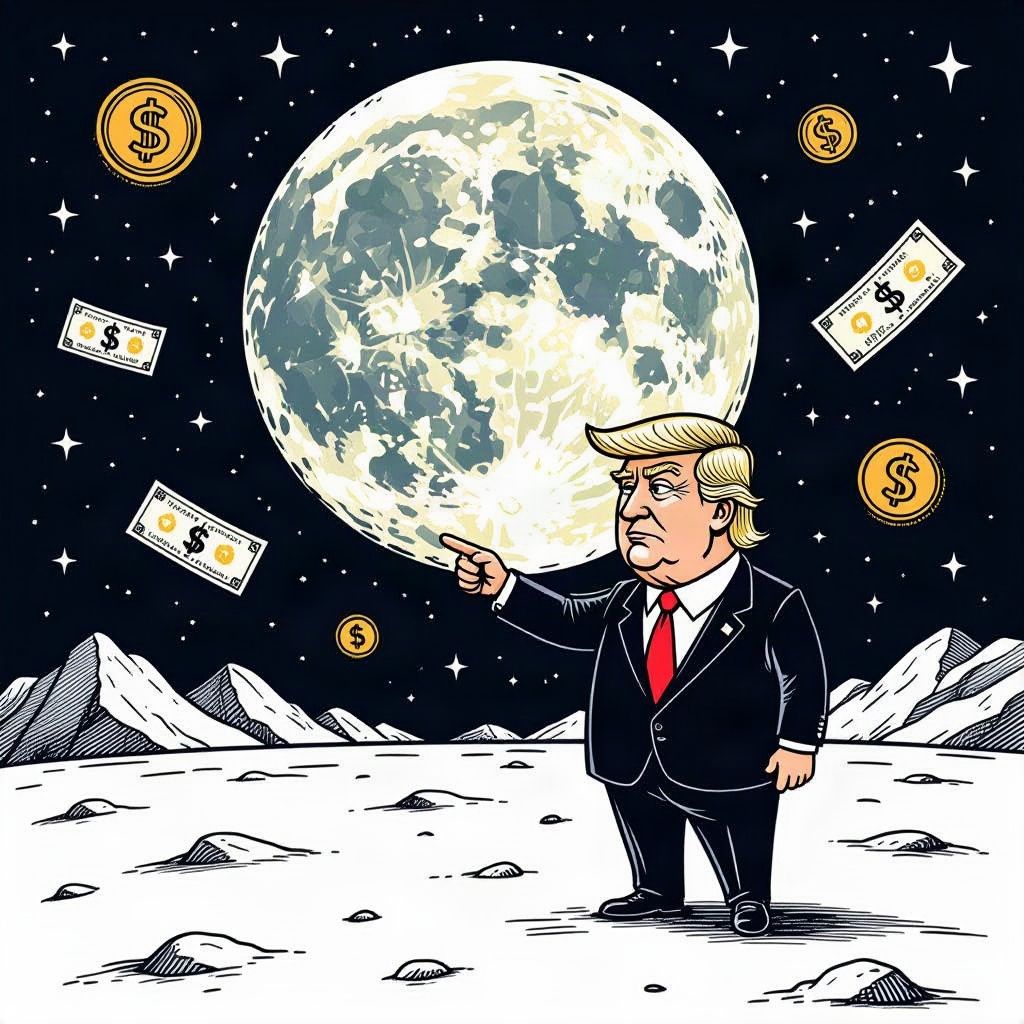
On Sunday, 6 September 2026, President Donald Trump generated significant controversy through a series of rapid social media posts, including one asserting United States ownership over the moon [1]. The specific post featured an image of the moon with an American flag and the text, “THE MOON IS OURS,” marking a stark declaration without accompanying legislative or executive action [2]. Legal experts and political analysts have since raised questions concerning international space treaties and the stability of executive communications as corporate investments in the private space economy continue to accelerate globally [1]. This sequence of events occurred within a concentrated timeframe, with reports indicating the publication of three dozen online posts in the span of two hours [1]. This frequency suggests a posting rate of 18 posts per hour, intensifying scrutiny on the coherence of presidential communications during market hours [1].
Expert Reactions and Market Stability Concerns
The reaction from commentators was swift, with Tom Nichols, a staff writer for The Atlantic, stating on social media that “Something is very wrong with the president” [1]. Nichols further noted the gravity of the situation by highlighting that the president retains access to nuclear codes despite the erratic nature of the communications [1]. John Jackson, a political commentator and former trial lawyer, described the situation as akin to watching a “slow-motion train crash,” suggesting historians will view the period with alarm [3]. These reactions underscore the tension between presidential rhetoric and the expectations of stability required by international investors and allies [1]. The lack of immediate clarification from the White House regarding the legal standing of the moon claim has left regulatory frameworks in a state of uncertainty [1].
Pattern of Renaming Proposals and Executive Actions
This incident aligns with a broader pattern of renaming proposals observed throughout 2026, including a suggestion on Sunday to rename the state of New Mexico to “New America” [5]. According to reporting by The Daily Beast, President Trump previously signed an executive order in January 2025 titled “Restoring Names That Honor American Greatness,” which included renaming the Gulf of Mexico to the Gulf of America [4]. In August 2026, shortly before this latest controversy, the administration officially changed the name of Lake Ontario to “Lake America,” prompting mapping services to adopt the change following reported pressure [4]. These actions indicate a strategic focus on symbolic gestures, though the lunar ownership claim represents a shift from domestic geography to international celestial bodies [4]. Unlike the domestic renaming efforts, claiming ownership of the moon conflicts with the Outer Space Treaty, to which the United States is a signatory [1].
Economic Implications for Space and Stock Markets
Beyond geopolitical implications, the posts included references to personal financial gains, with an AI-generated image depicting the president buying stocks in the Oval Office [6]. Accompanying text admitted to having “made Hundreds of Billions of Dollars on Stocks, and Many other type Holdings,” raising ethical questions about potential conflicts of interest while in office [7]. Private space companies rely on stable regulatory environments to justify the high capital expenditures required for lunar exploration and development [1]. Any perception of unilateral claims over celestial bodies could complicate licensing and insurance for commercial ventures operating in lunar orbit or on the surface [1]. Investors are now monitoring whether these statements represent campaign-style rhetoric or a precursor to formal policy shifts that could disrupt the emerging space economy [1].
Sources
- www.rawstory.com
- truthsocial.com
- x.com
- www.thedailybeast.com
- truthsocial.com
- truthsocial.com
- www.rawstory.com