US Military Forces Retaliate and Destroy Three Iranian Shadow Fleet Oil Tankers
Washington, Saturday, 5 September 2026.
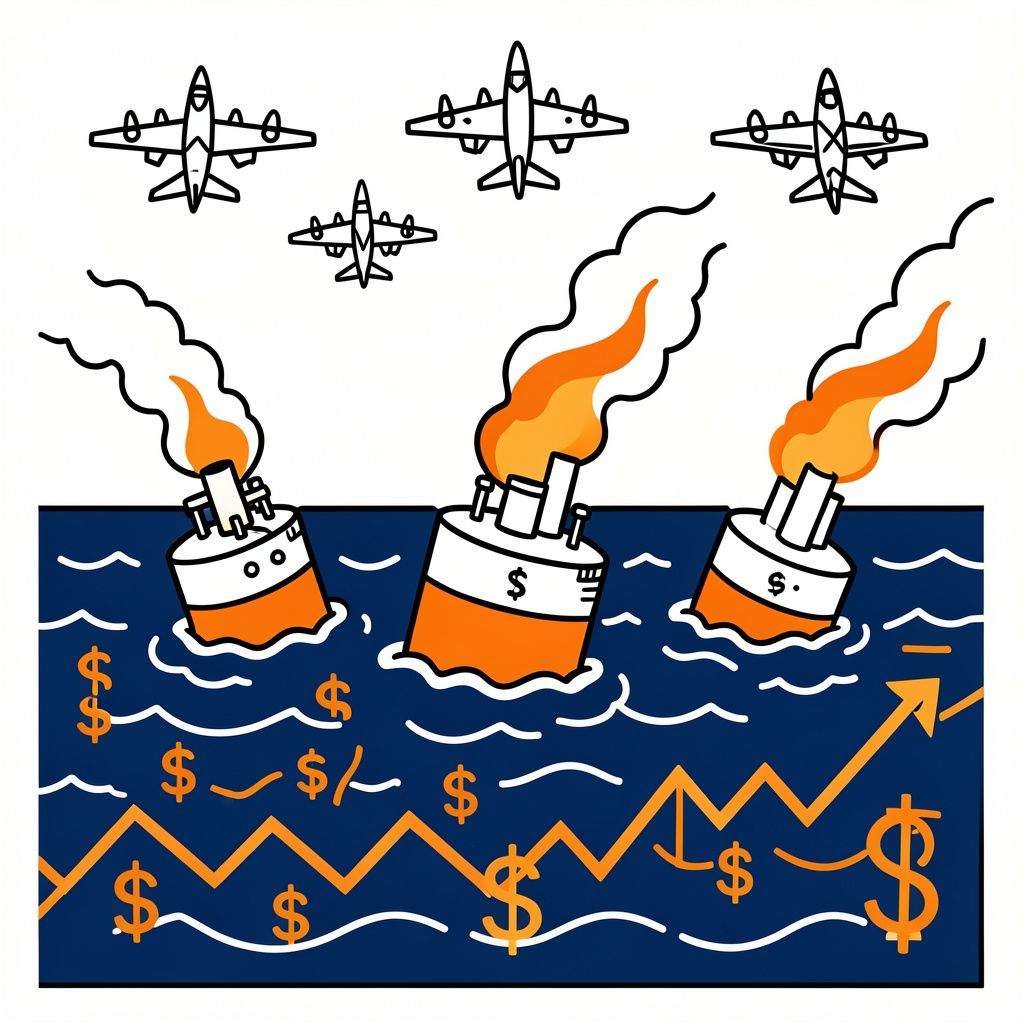
Following IRGC missile attacks on American warships, U.S. forces destroyed three Iranian oil tankers financing regional proxies, threatening global energy supply chains and pushing diesel prices to record highs.
Escalation in the Gulf Following Naval Attacks
Building on the renewed military conflict previously reported in the Strait of Hormuz, U.S. Central Command (CENTCOM) forces struck three Iranian crude oil carriers on September 5, 2026 [1]. This action follows a direct escalation where the Islamic Revolutionary Guard Corps (IRGC) launched ballistic missiles toward two U.S. Navy warships patrolling regional waters [1][2]. A U.S. aircraft carrier and guided-missile destroyer successfully evaded the multiple unprovoked Iranian attacks, with no American personnel harmed during the incident [1]. This development marks a significant intensification from the earlier strikes on Iranian launchers and subsequent missile attacks targeting American bases in Jordan discussed in previous coverage [5]. The rapid sequence of events threatens critical energy shipping corridors in the region, posing immediate risks to global oil supply chains [2].
Targeting the IRGC Shadow Fleet
CENTCOM permanently disabled the IRGC crude oil carriers M/T Downy off the coast of Kharg Island and M/T Stark 1 near Jask [1]. American forces also completely destroyed the unladen crude oil carrier M/T Kylo, also known as the Noxen, in the Gulf of Oman after directing the crew to abandon ship [1][3]. The three Iranian crude oil tankers are part of a multibillion-dollar shadow network that funds the IRGC and its regional proxies [1]. Admiral Brad Cooper, CENTCOM commander, stated that if Iranian forces shoot at two U.S. ships, the U.S. will impose an even higher economic cost by taking out three of theirs [2]. Iranian media reported that one tanker was struck by four missiles roughly 10 kilometers from Kharg Island, with the crew successfully evacuated and no casualties reported [3].
Impact on Maritime Transit and Energy Markets
The strikes come amid severely disrupted transit levels in the Strait of Hormuz, which remain significantly below pre-war volumes since the conflict began on February 28, 2026 [4]. Between September 1 and September 2, 2026, U.S. forces facilitated 44 transits through the Strait of Hormuz, following 39 transits between August 30 and August 31 [4]. This volume remains significantly below the pre-war daily average of 138 transits, representing a decrease of 68.116 percent in traffic capacity [4]. Global refinery capacity is under severe strain due to Iranian attacks on Gulf state refineries and Ukrainian attacks on Russian oil infrastructure [4]. Diesel prices have hit all-time highs in the U.S. amid these war woes, reflecting the tightening supply conditions [2].
Political Context and Strategic Outlook
The military engagement occurs within a broader six-month war that the U.S. and Israel began, with negotiations having collapsed to end the conflict [2]. The conflict has resulted in the deaths of 18 U.S. service members, a toll President Donald Trump previously described as small potatoes compared to historical conflicts [2][3]. President Trump has indicated the U.S. may strike Iran’s Fordow nuclear facility if developments warrant it, stating they may hit Fordow very soon [3]. CENTCOM did not immediately provide further details about whether the strikes on the tankers caused casualties beyond the crew evacuation [2]. The situation remains fluid as both sides attempt to inflict economic and military pain on the other [2].