How Unexpected Immigration Surges Skewed U.S. Employment Data
Chicago, Tuesday, 4 August 2026.
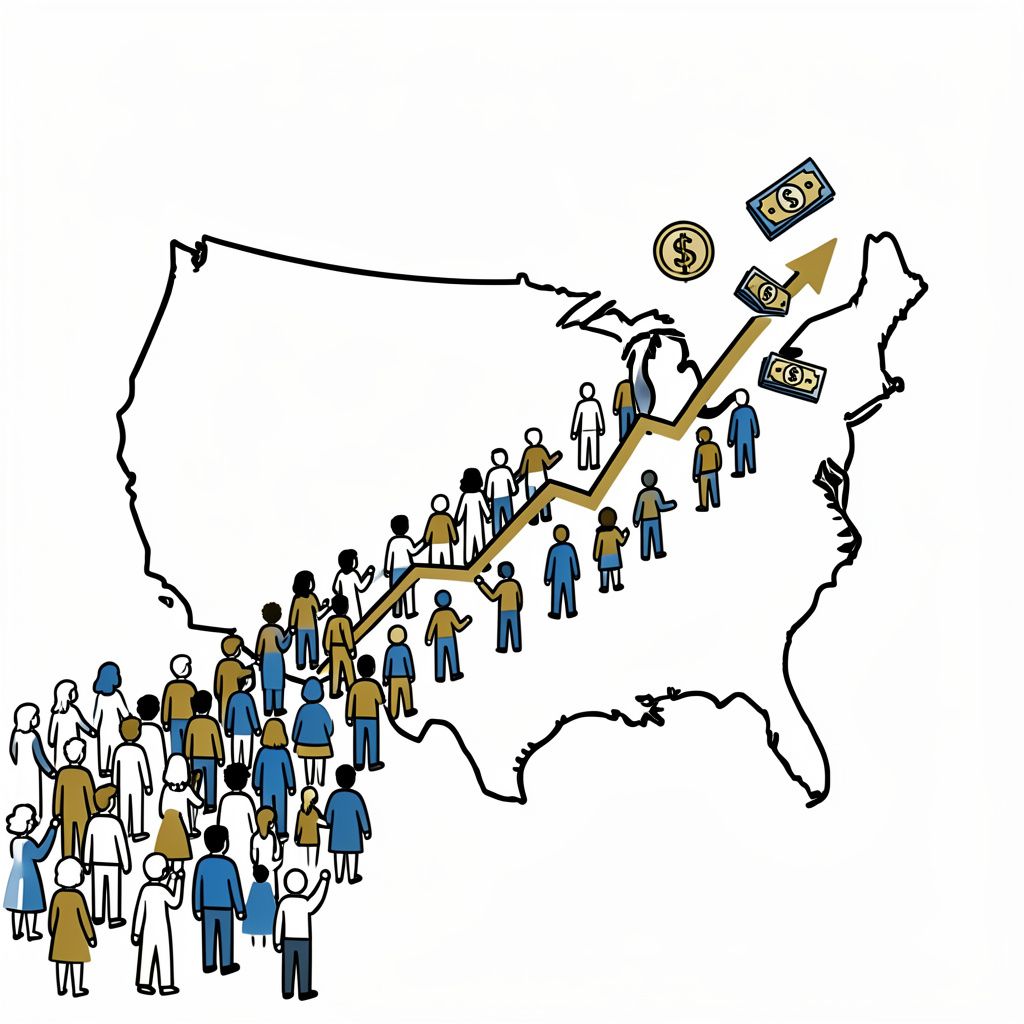
Research from the Federal Reserve Bank of Chicago reveals post-pandemic immigration distorted key labor metrics, overstating market tightness in 2022 and 2023 due to population miscalculations that skewed monthly breakeven estimates by up to 66,000 jobs.
The Mechanics of the Breakeven Gauge
To evaluate whether monthly job additions signal a tightening or loosening labor market, economists frequently rely on a “breakeven” payroll estimate—the net monthly job growth required to keep the unemployment rate stable [1][2]. The Federal Reserve Bank of Chicago calculates this gauge using a model integrating four distinct variables: the working-age population (specifically the civilian noninstitutionalized population age 16 and over, or CNIP 16+), the long-term trend in labor force participation, the natural rate of unemployment, and a payroll-to-household-survey adjustment factor [1][2]. Under normal economic conditions, these inputs—particularly the working-age population—remain highly stable and predictable [2].
Historical Predictability Versus Post-Pandemic Volatility
Historically, population projections have been remarkably consistent. Between 2011 and 2018, the U.S. Census Bureau’s year-to-year population vintage revisions averaged a mere 270,000 people (approximately 0.1%), while its one-year-out projections required average revisions of only 380,000 people (approximately 0.15%) [1][2]. This stability allowed the breakeven gauge to serve as a reliable anchor for monetary policy [2]. However, the post-pandemic era starting in 2020 shattered this predictability, as unprecedented surges in net international migration introduced massive, real-time forecasting errors into the working-age population data [1][2].
How the Immigration Surge Distorted Real-Time Data
During the peak of the post-pandemic immigration surge between 2022 and 2024, successive population vintages from the U.S. Census Bureau and the Congressional Budget Office (CBO) began “fanning out” upward [1][2]. For instance, the Census Bureau’s Vintage 2023 expected the working-age population to reach 268 million by early 2024, which was subsequently revised upward to 270 million in Vintage 2024, and ultimately to 271 million in the CBO’s February 2026 projections [2]. This represents a substantial upward adjustment of 3 million people. Because real-time models were running on these understated initial population figures, the calculated breakeven payroll targets were artificially low, causing the labor market in 2022 and 2023 to appear significantly hotter than subsequent revisions justified [1][2].
The Scale of the Statistical Discrepancy
The impact of these population mismeasurements on labor market assessments was profound. At the peak of the demographic discrepancy, the difference between real-time and revised breakeven estimates reached up to 66,000 jobs per month, which represents roughly 60% of the average monthly job gains recorded during the post-pandemic period [2]. Discrepancies in the breakeven calculation between the Census Bureau’s Vintage 2023 data and the CBO’s 2026 projections widened from approximately 25,000 in the third quarter of 2022 to nearly 100,000 by the first quarter of 2023 [2]. This statistical gap led policymakers to observe an overstated degree of labor market tightness during a critical period of monetary tightening [1][2].
Rebalancing and the Modern Labor Landscape
As the immigration surge subsided and statistical agencies integrated the new demographic data into their models, the gap between real-time and ex-post breakeven estimates finally converged in the second half of 2024 [1][2]. This adjustment revealed a rapidly shifting baseline. According to research from the Dallas Fed, the monthly breakeven payroll requirement plummeted from over 200,000 jobs during the 2022–2024 peak to fewer than 50,000 jobs in the second half of 2025 [1][2]. Consequently, the modest monthly job gains recorded in late 2025 actually represented a balanced labor market rather than a weak one [1][2].
Current Labor Market Realities in 2026
In the current economic climate of mid-2026, the labor market continues to show signs of cooling and rebalancing. While realized payroll gains in the second quarter of 2026 rose back above estimated breakeven levels, broader demand metrics are softening [1][2]. For instance, U.S. Bureau of Labor Statistics data for June 2026 revealed that job openings fell to 7.36 million [3]. This represents a decrease of approximately 230,000 from the 7.54 million openings recorded in May 2026, marking the third consecutive monthly decline and signaling a steady compression of the openings-to-unemployed ratio [3].
Methodological Lessons for Corporate and Policy Leaders
The primary takeaway from this post-pandemic episode, as outlined by Chicago Fed researchers Kristin Butcher, Anne Fournier, Camilo Garcia-Jimeno, Aneesh Kudrimoti, and Alan Mathew, is that population growth is ultimately a forecast subject to extreme volatility when underlying migration flows shift rapidly [2][4]. To prevent future policy errors, the researchers advise central bankers and corporate executives to attach much wider uncertainty bands to breakeven-based labor assessments during periods of rapid demographic change [1][2]. Meanwhile, the Chicago Fed is continuing its research into refining these models for 2026 and beyond, with future updates to trend labor force participation metrics expected as new Census Bureau demographic data becomes available [1][2].