New York Mets Invest in Outfielder A.J. Ewing With Historic Deal
New York, Saturday, 21 November 2026.
The New York Mets committed $95 million over eight years to 22-year-old outfielder A.J. Ewing, completing the largest early-career contract extension in franchise history to secure their long-term core.
A Historic Commitment to a Rising Star
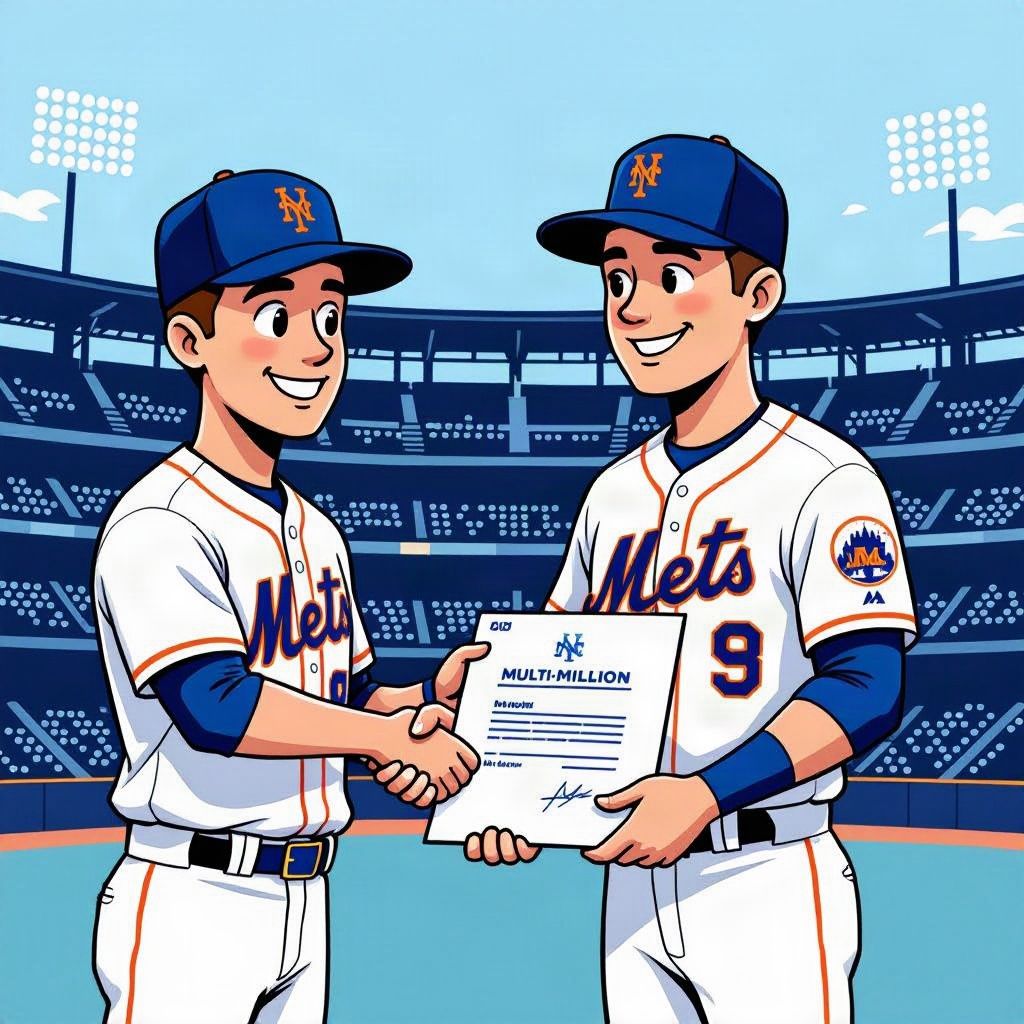
The New York Mets have finalized an eight-year, $95 million contract extension with 22-year-old outfielder A.J. Ewing, marking the largest pre-arbitration agreement in franchise history and underscoring the team’s strategic investment in its core young talent [1][2][4]. The deal, which includes a club option for a ninth season in 2035, was first reported by SNY’s Chelsea Janes and later confirmed by multiple sources, including The Athletic’s Will Sammon and MLB.com’s Anthony DiComo [2][4][5]. While the club has not yet issued an official statement, the reported agreement solidifies Ewing’s place as the cornerstone of the Mets’ future outfield alongside Carson Benge and Juan Soto, both of whom are controlled through at least 2031 [1][4].
Beyond the Numbers: A Player Who Fits the Mets’ Culture
Ewing’s $95 million extension eclipses the previous record set by David Wright’s six-year, $55 million deal in 2006, representing a 72.727 = 72.7% increase in total value for a pre-arbitration player [1][2][4]. The extension reflects a broader MLB trend where teams prioritize early-career security for elite prospects to balance long-term payroll flexibility and roster stability under luxury tax constraints. Ewing, who debuted in May 2026, posted a .252/.324/.376 slash line with 11 home runs and 25 stolen bases in 120 games, finishing ninth in National League Rookie of the Year voting [1][2][6]. His defensive versatility—playing center field while capable of manning the corners—added to his appeal as a foundational piece [1]. Team officials cited his maturity and alignment with the Mets’ organizational culture as key factors in the decision, with one describing him as ‘the type of person you want to invest in’ [1].
Strategic Implications for the Mets’ Roster and Payroll
The Mets’ aggressive move comes as the franchise navigates roster construction amid the departure of first baseman Pete Alonso to the Orioles in 2025 and the pending free agency of outfielder Brandon Nimmo, whose emotional farewell resonated with fans in late October 2026 [6][7]. By locking in Ewing through 2034 (with a 2035 option), the Mets ensure continuity in the outfield while maintaining financial flexibility to address other needs, such as the first-base position [1][6]. The deal also aligns with MLB’s evolving contract norms, where big-market teams like New York leverage early extensions to mitigate long-term uncertainty [GPT]. However, the success of such agreements hinges on players like Ewing developing into stars—risking sunk costs if projections falter. As one observer noted, the Mets rarely pursue pre-arbitration extensions outside of Wright (2006), José Reyes (2006), Jon Niese (2012), and Juan Lagares (2013), underscoring the rarity of this commitment [1].
What’s Next for the Mets’ Young Core?
With Ewing’s future secured, attention turns to whether the Mets will extend similar offers to other pre-arbitration talents like catcher Francisco Alvarez or infielders Brett Baty and Nolan McLean—all of whom are projected to remain under team control through at least 2027 [1][8]. The Mets’ 40-man roster decisions, finalized on November 20, 2026, included tendering contracts to Alvarez, Baty, Benge, Ewing, and Nate Lavender, signaling confidence in their young core [8]. For now, Ewing’s $95 million gamble reflects a franchise betting on potential over immediate returns, a strategy that could redefine the Mets’ competitive trajectory in the coming decade [1][2][4].
Sources
- www.mlb.com
- bleacherreport.com
- x.com
- x.com
- x.com
- www.instagram.com
- www.instagram.com
- metsmerizedonline.com