Why Joe Gibbs Racing Is Fighting to Delay Denny Hamlin's Planned Retirement
Huntersville, Sunday, 15 November 2026.
Despite Denny Hamlin’s plan to retire after 2027, Joe Gibbs Racing is actively moving to extend the 64-time winner’s contract, driven by elite performance and crucial sponsorship backing.
A Veteran Driver’s Retirement Plan Collides with Corporate Ambitions
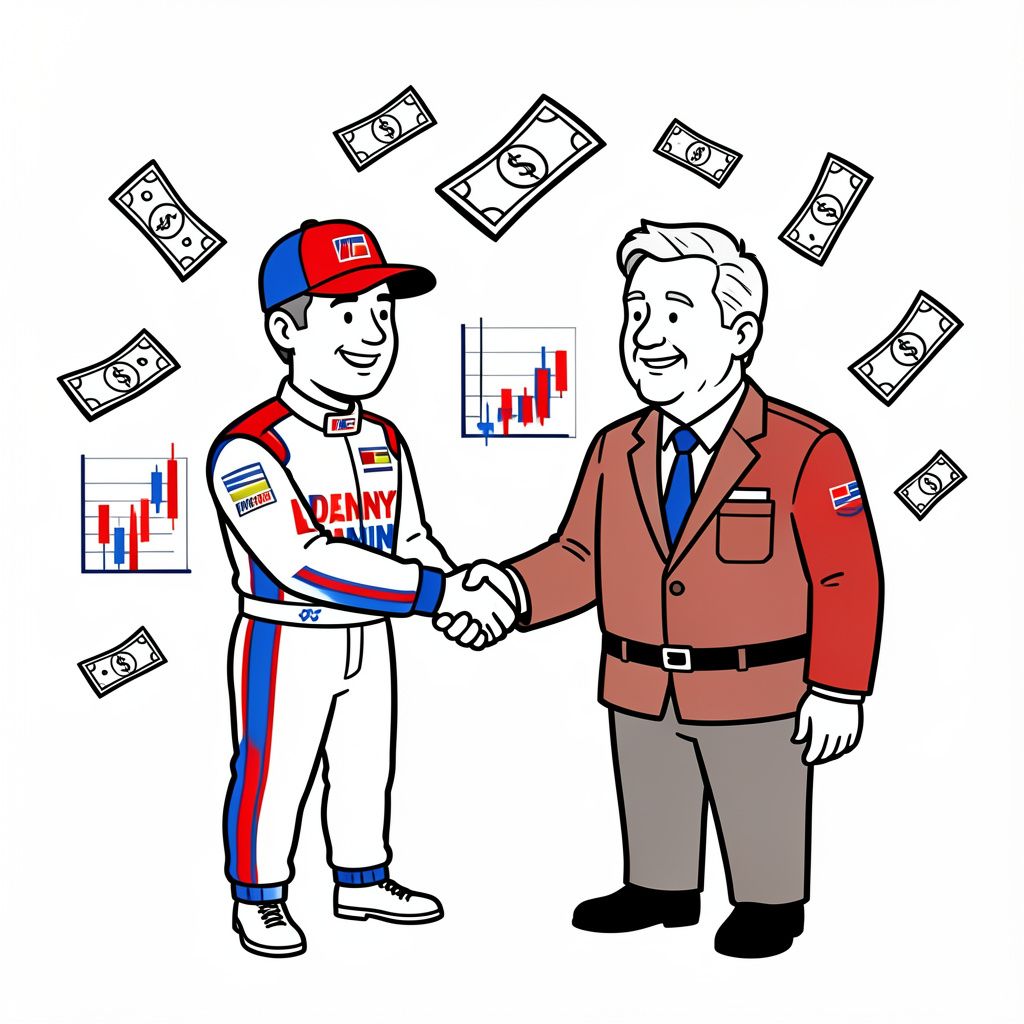
Denny Hamlin’s long-planned exit from NASCAR’s Cup Series at the end of the 2027 season is facing an unexpected challenge as Joe Gibbs Racing (JGR) pushes to keep the 64-time race winner behind the wheel beyond that date. The veteran driver, who turns 46 in November 2026, had signaled his intent to retire after the 2027 season to ‘know I can win my last race,’ according to his own statements [2]. However, JGR leadership is actively working to prevent that outcome, with team president Dave Alpern telling SiriusXM NASCAR Radio that the organization is ‘hoping it doesn’t happen’ and may even ‘tackle him if he tries to leave’ [2].
Performance on the Track Fuels the Urgency
Hamlin’s 2026 campaign, which saw him finish third in the Cup Series standings with 4 race wins, 16 top-five finishes, and 24 top-10 finishes across 36 races, has reinforced his commercial and competitive value [2]. He led 1,120 laps, earned 6 pole positions, and entered the Chase as the top seed, demonstrating that Father Time has not yet caught up to the veteran’s skill [2]. Alpern emphasized this point, stating based on ‘my eyeball test, he can still win every week’ and adding, ‘When is Father Time going to catch up? I don’t know right now. Denny’s doing a pretty good job eluding Father Time’ [2].
Sponsorship and Franchise Valuation Hang in the Balance
Sponsorship dollars are the lifeblood of NASCAR teams, and Hamlin’s No. 11 Toyota remains one of the series’ most valuable assets. Progressive Insurance, the primary sponsor, has already committed to backing Hamlin for 24 Cup Series races in 2027, underscoring the driver’s ability to deliver value to corporate partners [2]. This sponsorship continuity is critical not only for JGR’s 2027 revenue projections but also for the franchise’s long-term valuation. In a sport where ‘you’ve got to have a sponsor before you can sign your driver, because that’s how we fund it,’ Hamlin’s proven track record and marketability make him an indispensable asset [2]. The potential loss of a driver of his caliber could trigger ripple effects across JGR’s brand partnerships and franchise value.
The Broader Implications for NASCAR’s Competitive Landscape
Hamlin’s potential retirement isn’t just a personnel issue for JGR—it’s a strategic inflection point for NASCAR’s Cup Series. The sport has faced scrutiny over its mainstream relevance, with television ratings for the 2026 championship race at Homestead-Miami Speedway dropping 11% compared to previous years, according to Hamlin’s own assessment [1]. His decision to delay a critical shoulder surgery to compete in the 2026 season highlights his commitment to the sport at a time when leadership is paramount [2]. Brad Keselowski’s pending transition from RFK Racing, where he confirmed receiving six offers as he prepares for life after racing, further illustrates the fluid dynamics in team ownership and driver management [1]. For JGR, retaining Hamlin would not only stabilize its on-track performance but also send a message to sponsors, partners, and competitors about its commitment to excellence.
The Business Behind the Driver: Co-Ownership and Cross-Sport Influence
Hamlin’s role extends beyond driving; he is a co-owner of 23XI Racing alongside NBA legend Michael Jordan, a partnership that has elevated the franchise’s profile and commercial appeal [GPT]. This dual role amplifies the stakes for JGR’s contract maneuvering, as Hamlin’s influence transcends the racetrack. His presence on the track and in the boardroom ensures continuity in 23XI Racing’s growth strategy, which includes expanding its footprint in motorsports. For JGR, keeping Hamlin in the driver’s seat aligns with broader industry trends where driver-owners and celebrity partners are increasingly shaping the business of racing.
What’s Next: Contract Negotiations and the 2027 Crossroads
As of mid-November 2026, the timeline for contract negotiations remains fluid, with JGR’s leadership expressing cautious optimism about convincing Hamlin to reconsider his retirement plans. Alpern’s remarks suggest a strategy that blends flattery with pragmatism: ‘It may be his plan, but I think I’ve said before, we may tackle him if he tries to leave’ [2]. Meanwhile, Hamlin’s focus on winning ‘my last race’ reflects a personal and professional milestone that transcends mere competition [2]. For NASCAR fans and industry observers, the coming months will determine whether a 64-time winner’s career extends beyond 2027—or if a new chapter in his storied legacy will begin.
Sources
- heavy.com
- www.essentiallysports.com
- www.facebook.com
- www.facebook.com
- www.facebook.com
- www.centraloregondaily.com
- www.youtube.com