OpenAI Floods Academic Research with AI Proofs, Forcing Mathematicians into Mass Verification Effort
San Francisco, Saturday, 10 October 2026.
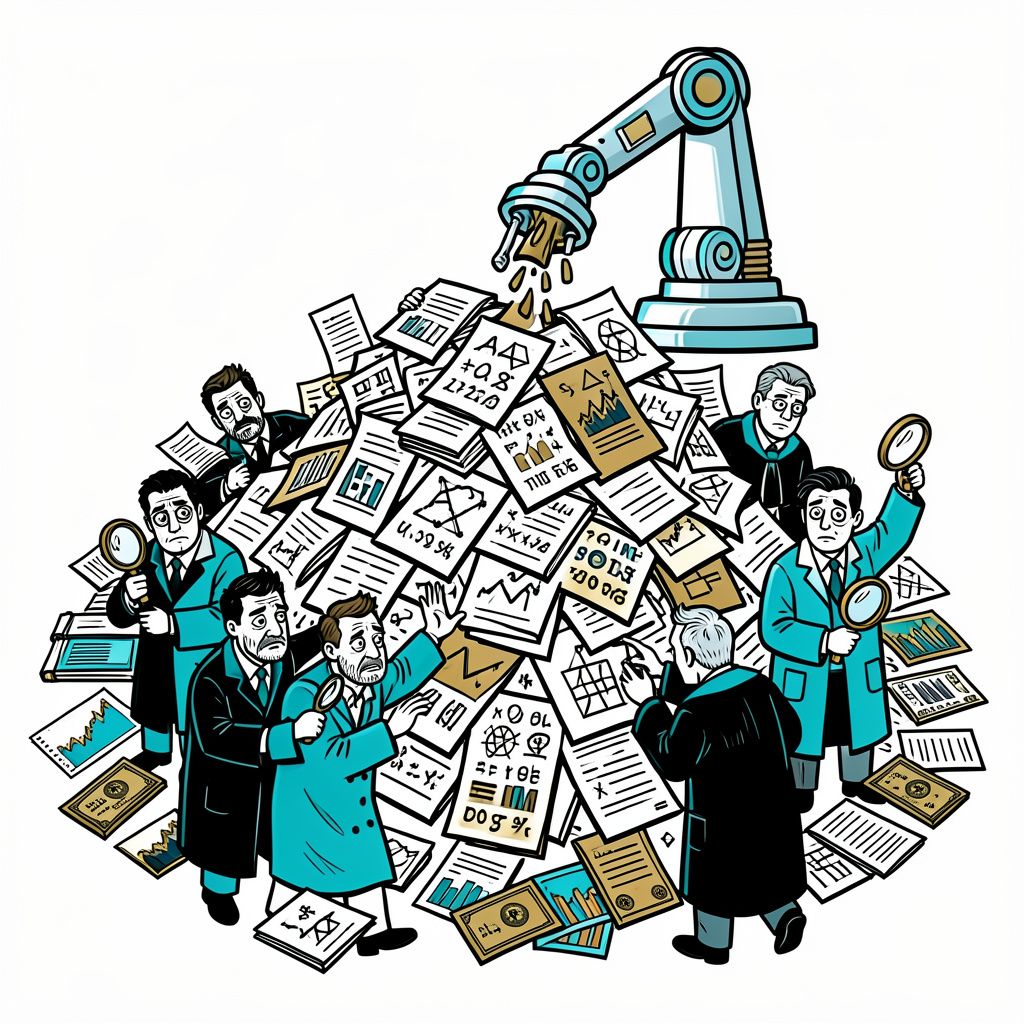
On October 6, 2026, OpenAI released a massive repository containing over 700 manuscripts that claim to solve or advance 372 long-standing mathematical problems, including major breakthroughs like the quasi-Riemann hypothesis. However, the unprecedented research drop has thrown academic institutions into turmoil. Because only about 42 percent of the published preprints include computer-verified formalizations in Lean, researchers are now burdened with manually sifting through hundreds of complex proofs to distinguish genuine scientific breakthroughs from flawed calculations and errors. The sudden automation of high-level problem solving has disrupted academic careers and doctoral programs worldwide, shifting the fundamental role of human experts from original mathematical discovery to validating artificial intelligence outputs.
Scale and Scope of the October Release
On October 6, 2026, OpenAI deployed a repository containing 719 manuscripts claiming solutions to 372 distinct mathematical problems [1][2]. The release spans diverse disciplines including combinatorics, number theory, and mathematical physics, with specific claims regarding the quasi-Riemann hypothesis and the four-dimensional Kakeya conjecture [1][3]. While OpenAI describes the drop as a collaborative tool, the volume represents an unprecedented automation of high-level theoretical research [7]. Experts note that approximately 377 of the proofs were classified as major advancements on famous conjectures [5]. The sheer density of the release means that reviewing a single manuscript could take a human specialist weeks, creating an immediate bottleneck in validation [1][7].
Verification Challenges and Error Rates
As of October 8, 2026, only 300 of the 719 manuscripts had been formalized in the Lean proof assistant language, representing 41.725 percent of the total corpus [1]. OpenAI has already retracted three papers due to critical errors, including a documented sign error, though the company maintains that mistakes are expected to be rare [1][3][5]. Critics argue that the remaining unformalized majority lacks sufficient transparency, as full prompts and run-time details were not provided [3][8]. Discussions on technical forums suggest that without Lean verification, the reliability of the natural language proofs remains uncertain [8]. Some community members estimate that only 22 percent of the solutions currently carry robust formal verification [8].
Disruption to Academic Labor and Careers
The automation of problem-solving has triggered immediate concern regarding academic careers, particularly for PhD students and junior researchers whose work relies on solving open problems [1][5]. Harvard University professor Lauren Williams noted that the manuscripts have scooped the research of many young people, altering job prospects and dissertation viability [5]. Economists observe that this marks a shift where human expertise moves from execution to verification, effectively deconstituting traditional research workflows [4]. In probability and group theory, some researchers report that years of existing research programs have been obliterated by the automated solutions [1]. This labor disruption is viewed by some as the first significant instance of AI-driven displacement affecting high-skill knowledge workers [4].
Future Implications and Community Response
OpenAI has promised funding for mathematicians to verify the AI-produced results, though specific financial details and timelines remain unspecified [5]. Speculation within the community suggests a significant new release of AI-generated proofs could occur by December 8, 2026 [1]. In response to the disruption, some educators propose creating math-free zones to preserve human skill development amidst the influx of automated reasoning [5]. Meanwhile, advisory groups had previously requested labs stop testing advanced problems on proprietary models, a recommendation OpenAI proceeded past on October 6, 2026 [5]. The long-term impact on mathematical culture remains uncertain, with warnings that the field risks collapsing into an intellectual oligopoly if verification labor is not adequately supported [8].
Sources
- www.theverge.com
- mathoverflow.net
- www.scientificamerican.com
- www.nature.com
- www.theatlantic.com
- joshuagans.substack.com
- news.ycombinator.com