Tokyo Stocks Drop as Global Concerns Hit Artificial Intelligence Investments
Tokyo, Wednesday, 14 October 2026.
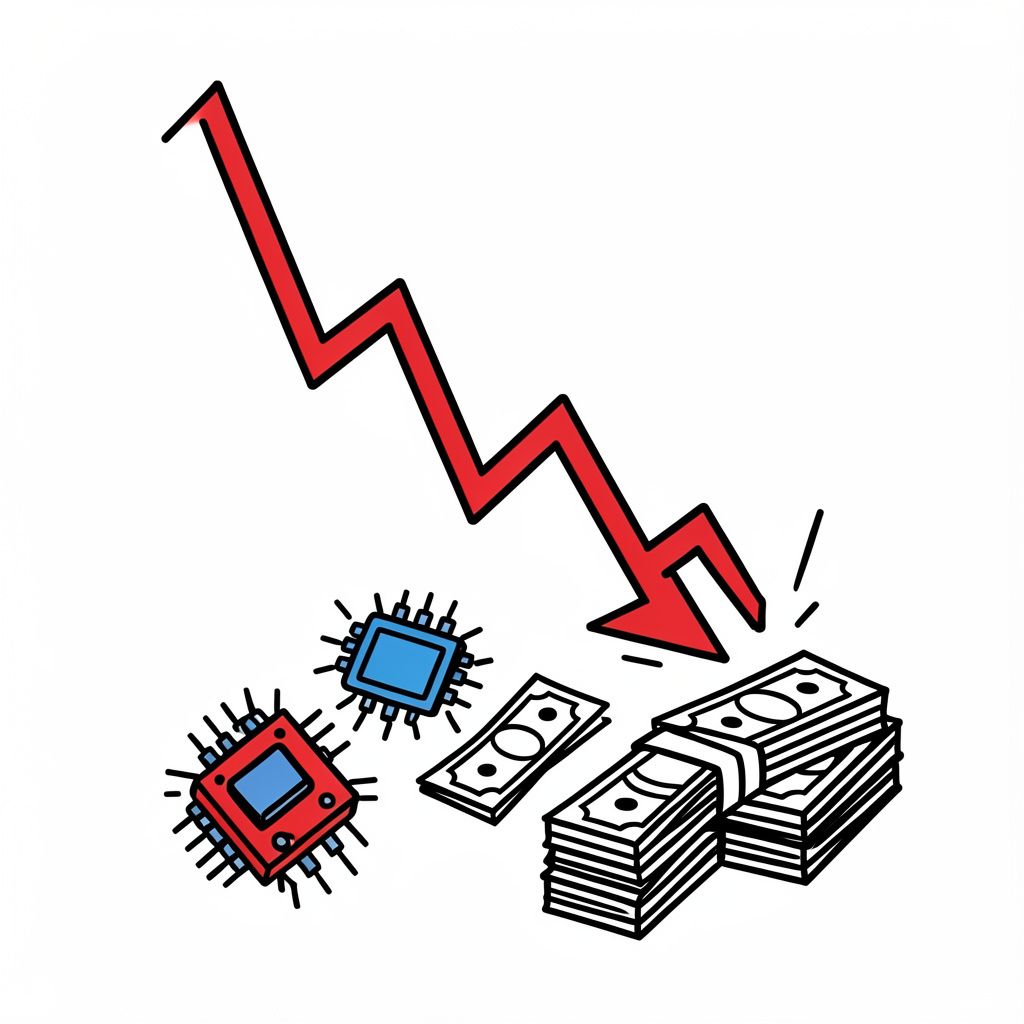
Japan’s Nikkei index suffered its fourth straight drop on October 13, led by a 13% plunge in chipmaker Kioxia amid growing fears of an artificial intelligence market bubble.
Market Performance and Trading Dynamics
Japan’s benchmark Nikkei 225 index experienced significant volatility on Tuesday, October 13, 2026, marking its fourth consecutive session of declines [1]. While early trading saw the index fall 2.64% to 67,206.79, the market staged a partial recovery before the close [1]. The Nikkei 225 ultimately closed at 67,778, representing a loss of 1,253 points for the day [2]. Intraday trading data indicates the index opened at 68,565 before dropping, reflecting a intraday decline of -1.148 percent from the opening bell [2]. The broader Topix index also slipped 0.56% to 4,081.76, signaling cautious sentiment across Asian capital markets [1]. This retreat followed a three-day holiday weekend, during which global market conditions deteriorated [2].
Semiconductor Sector Volatility
The sell-off was heavily concentrated in artificial intelligence and semiconductor-related equities, driven by weakness in U.S. chip shares [6]. Kioxia Holdings emerged as the largest loser within the Nikkei 225, plunging 13.02% amid the downturn [7]. Other technology heavyweights faced substantial pressure, with Taiyo Yuden falling 9.34% and Kokusai Electric losing 9.19% [1]. Tokyo Electron, a key barometer for the sector, dropped 7.2% as investors reassessed capital spending prospects [5]. Analysts note that concerns are mounting regarding whether massive investments in AI hyperscalers will yield sufficient returns [1]. This sentiment was echoed by industry leaders, with Broadcom CEO Hock Tan remarking that some AI investment strategies resembled gambling [5].
Geopolitical and Inflationary Pressures
Beyond corporate earnings, geopolitical tensions further dampened risk sentiment in Tokyo [6]. Investors expressed anxiety over an attack on a Saudi Arabian airport and the feasibility of ceasefire agreements between Russia and Ukraine [1]. These geopolitical risks are particularly potent given their impact on energy prices, with Brent crude oil trading near $105.90 per barrel [2]. Domestically, inflation data added to the complexity of the economic landscape [7]. Wholesale prices in Japan rose 6.8% year-on-year in September, while yen-based import prices surged 24.5% [1]. These figures pressure the Bank of Japan as it evaluates further rate hikes, with Governor Kazuo Ueda noting that policy timing depends on cost pressure spreading to household consumption [2].
Global Market Context and Outlook
The downturn in Tokyo was part of a broader regional trend, with South Korea’s Kospi index tumbling 5.24% [8]. Wall Street’s tech-heavy Nasdaq dropped 0.44% overnight as chip stocks retreated, influencing Asian trading sessions [1]. Despite the tech slump, some sectors showed resilience; marine transportation shares topped gainers in Tokyo, rising 3.35% [1]. Kawasaki Kisen Kaisha gained 4.07%, while Mitsui O.S.K. Lines traded 3.81% higher [7]. Looking ahead, the Bank of Japan is scheduled to hold a meeting on October 29-30, 2026, where updated growth and inflation forecasts will be released [2]. Investors remain watchful of U.S. Federal Reserve policy moves and upcoming earnings reports to gauge the sustainability of the AI trade [5].
Sources
- www.arabnews.jp
- newsonjapan.com
- www3.nhk.or.jp
- www.wsj.com
- tradingeconomics.com
- x.com
- m.economictimes.com
- www.linkedin.com