Senate Blocks Bipartisan Bill to Prevent Rising Electricity Costs From Data Centers
Washington, Friday, 18 September 2026.
Senate Democrats halted a House-passed bill designed to shield consumers from AI data center power costs, arguing the legislation lacked strong enforcement mechanisms to mandate technology company funding.
Senate Procedure Halts Ratepayer Protection Act
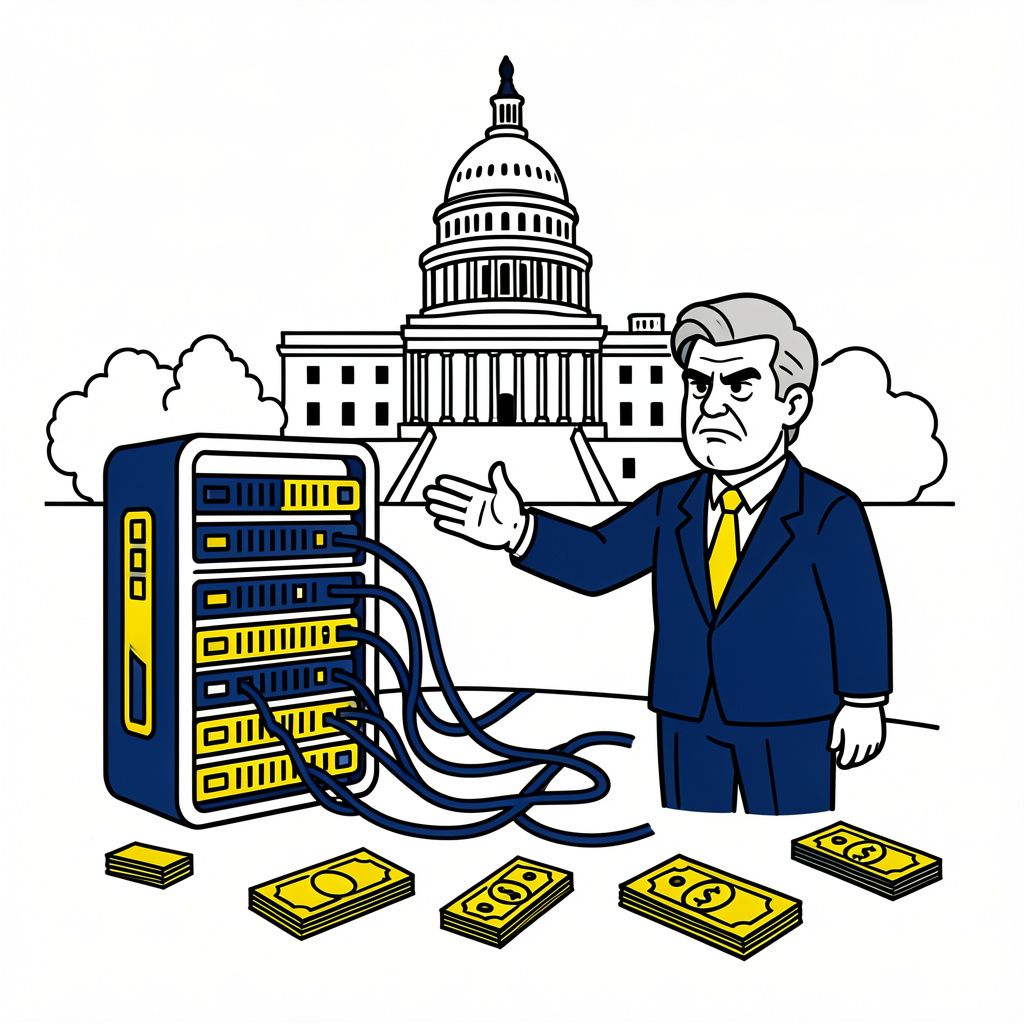
On Thursday, 17 September 2026, Senator Martin Heinrich (D-N.M.) utilized a unanimous consent objection to block the Ratepayer Protection Act in the United States Senate, halting legislation designed to prevent rising consumer electricity bills linked to rapid AI data center expansion [1][2]. The bill, which cleared the House of Representatives on 9 September 2026 in a 417-3 vote, aimed to require large-scale artificial intelligence data centers consuming 100 megawatts or more to fund the necessary electrical grid upgrades themselves [1][3]. Heinrich’s procedural block stalls a major legislative effort to balance tech infrastructure growth with utility affordability for everyday consumers, citing the need for stronger enforcement mechanisms than the House version provided [2].
Bipartisan Support Meets Senate Hurdle
The legislation, known as H.R. 9340, garnered significant bipartisan backing in the lower chamber, with 99.286 percent of voting representatives supporting the measure [1][3]. Despite this overwhelming approval, the bill requires unanimous consent in the Senate to bypass standard committee processes, a hurdle it failed to clear due to Heinrich’s objection [1][2]. Representative Gabe Evans (R-Colo.), a sponsor of the bill, argued that American families should not be forced to cover the costs of new power generation driven by these developments, emphasizing the need to protect everyday Americans while winning the AI race [3].
Legislative Maneuvers and Counterproposals
Immediately following the objection to the Ratepayer Protection Act, Senator Heinrich attempted to pass the Grid Savings Act (S. 5199), which would mandate that large load customers pay for grid infrastructure upgrades rather than suggesting states consider it [1]. This counter-effort was subsequently blocked by Senator Bernie Moreno (R-Ohio), who criticized the stalemate as evidence of a ‘do-nothing Congress’ driven by partisan obstruction [1]. Senator Jon Husted (R-Ohio), sponsor of the original legislation, argued that the House bill’s 417-3 vote count demonstrated a right to passage that should not be obstructed by procedural objections [1][2].
Dispute Over Enforcement Mechanisms
The core disagreement lies in the enforcement of cost allocation, with Heinrich arguing that telling states to consider making data centers pay is insufficient without federal mandates [2]. Heinrich stated, ‘Rather than voluntary pledges or suggestions to states, Congress needs to pass real legislation with real teeth,’ highlighting the divide between voluntary state frameworks and federal requirements [2]. Conversely, supporters of the House bill argued it was a necessary first step to ensure American families are not left footing the bill for energy infrastructure required by data centers [1].
Economic Stakes and Consumer Impact
The economic implications are substantial, with projections indicating America is expected to build the equivalent of 1,000 major data centers during the next five years, alongside more than 2,000 projects currently being proposed or tracked [2]. Northern Virginia currently serves as the world’s largest data center market, hosting approximately 13 percent of global operational capacity as of August 2026, illustrating the scale of energy demand involved [3]. Representative Kathy Castor (D-Fla.) noted that neighbors across Florida are grappling with skyrocketing electric bills, arguing ratepayers should not subsidize wealthy corporations’ growing energy demands [3].
Political Ramifications and Future Outlook
The legislative stalemate carries political weight, particularly for Senator Husted, who is campaigning for the November 2026 election to serve the final two years of his term against former Senator Sherrod Brown (D) [4]. Senate Minority Leader Chuck Schumer (D-N.Y.) stated on 15 September 2026 that any AI-related legislation must be bipartisan, adding another layer of complexity to the path forward [4]. Despite the setback, Senator Husted intends to reintroduce the legislation to push the issue forward, asserting that there is a bipartisan opportunity to get the issue done immediately [1][2].