G7 Backs Historic U.S.-Iran Deal to End Middle East War and Reopen Critical Oil Route
Puglia, Wednesday, 17 June 2026.
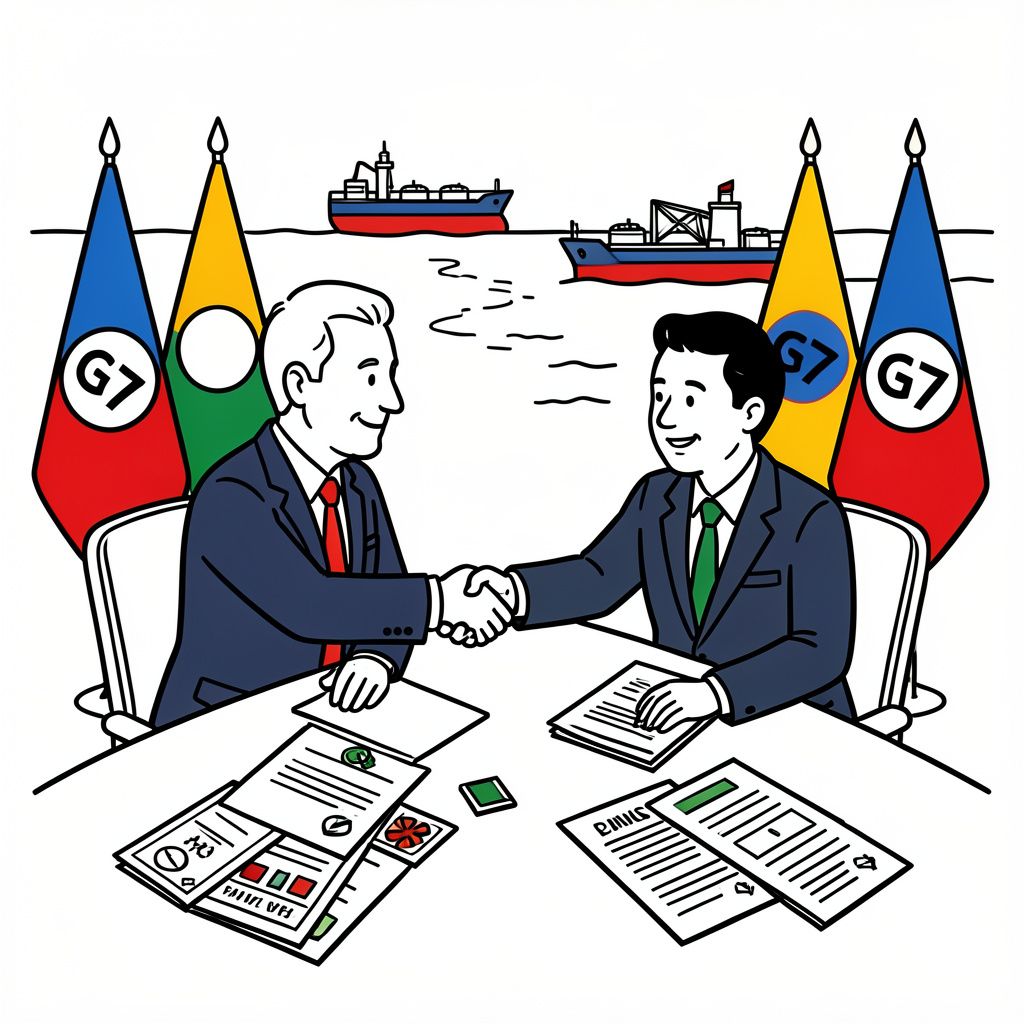
A landmark U.S.-Iran agreement, endorsed by G7 leaders at the 2026 Italy summit, aims to end years of conflict and reopen the Strait of Hormuz—a chokepoint for 20% of global oil. The deal, set for signing on June 20, promises a ceasefire, mine clearance, and sanctions relief, but leaves nuclear negotiations unresolved. Markets surged on hopes of stabilized energy prices, yet tensions persist: Iran insists on managing the strait, while the U.S. demands toll-free access. Israel vows to keep troops in Lebanon, defying Hezbollah’s ceasefire conditions. Analysts warn the deal’s success hinges on enforcing its fragile terms amid deep mistrust.
From Beirut Airstrikes to G7 Endorsement: A Fragile Peace Emerges
The diplomatic breakthrough announced at the 2026 G7 Summit in Puglia, Italy, marks a dramatic shift from the brinkmanship that defined the previous week. Just days after Israel’s precision airstrikes on Hezbollah targets in Beirut killed three civilians and threatened to derail negotiations, world leaders have rallied behind a U.S.-Iran memorandum of understanding aimed at ending nearly four months of regional conflict [1][2]. The June 14 strikes, which occurred hours before a planned signing ceremony, prompted Iran’s chief negotiator to declare talks ‘pointless’ and triggered vows of retaliation from Tehran [1]. The subsequent endorsement by G7 leaders—including U.S. President Donald Trump, German Chancellor Friedrich Merz, and British Prime Minister Keir Starmer—suggests a collective gamble on diplomacy over escalation, despite lingering tensions over the Strait of Hormuz and Lebanon’s sovereignty [3][4].
The Deal’s Core: Ceasefire, Sanctions, and a Strategic Chokepoint
The agreement, set to be formally signed in Geneva on June 20, centers on three key pillars: a ceasefire across all fronts, the reopening of the Strait of Hormuz, and the phased lifting of economic sanctions [5][6]. The Strait, through which approximately 20% of global oil and gas trade transits, has been effectively closed since February 28, when Iran laid mines and declared control over the waterway in response to U.S. naval blockades [7][GPT]. The deal mandates mine-clearance operations to begin immediately after signing, with Western maritime security services estimating a 40- to 50-day timeline for restoring safe passage [8]. In exchange, Iran is expected to regain access to billions in frozen assets, though the U.S. has denied reports of a $12 billion release, while the UAE has reportedly unlocked additional funds [9][10]. The agreement also includes a 60-day window for follow-on negotiations on Iran’s nuclear program, a contentious issue that derailed the 2015 Joint Comprehensive Plan of Action (JCPOA) and remains unresolved [11][12].
Strait of Hormuz: A Flashpoint in the Making
The most immediate challenge lies in reconciling Iran’s interpretation of the Strait’s reopening with international demands for unrestricted access. Iranian officials, including Foreign Affairs Ministry Spokesperson Esmail Baghaei, have stated that Iran and Oman will ‘manage’ maritime traffic through the Strait, including the collection of ‘service fees’—a claim that directly conflicts with the U.S. position [13]. Vice President JD Vance has insisted the waterway must be open ‘in a toll-free way for the long term,’ while the IRGC Navy has warned that the Strait remains closed to all vessels ‘until further notice’ [13][14]. The discrepancy underscores the fragility of the agreement, as shipping companies and insurers weigh the risks of resuming transit through a corridor still littered with mines and patrolled by Iranian forces [15]. The G7’s joint statement, signed by 28 nations, pledges support for a ‘strictly defensive and independent mission’ to clear mines and reassure commercial shipping, though the operational details remain vague [16].
Lebanon and Israel: The Deal’s Weakest Link
While the U.S.-Iran agreement calls for a ‘comprehensive ceasefire’ in Lebanon, the reality on the ground paints a starkly different picture. Hezbollah has framed the deal as a ‘prelude to completing the liberation of Lebanon,’ demanding the full withdrawal of Israeli Defense Forces (IDF) from southern Lebanon—a condition Israel has flatly rejected [17][18]. Israeli Defense Minister Israel Katz has stated that the IDF will maintain an ‘indefinite presence’ in security zones in Lebanon, Syria, and Gaza, defying both Hezbollah’s demands and indirect pressure from the U.S. [19]. The disconnect highlights a critical flaw in the agreement: its failure to address the Israel-Hezbollah conflict, which has simmered for decades and flared violently in recent months [20]. Senior U.S. officials have privately acknowledged that an Israeli withdrawal is ‘not a condition’ for the deal, but Hezbollah’s compliance may hinge on progress toward that goal [21]. With daily skirmishes continuing—including Hezbollah drone strikes and Israeli airstrikes in Beirut’s suburbs—the risk of a localized escalation derailing the broader agreement remains high [22].
Trump’s Gamble: Diplomacy, Threats, and the 2026 Midterms
President Trump’s role in brokering the deal has been framed as a diplomatic triumph, with G7 leaders praising his ‘strong leadership’ in a joint statement [28]. Yet the agreement also reflects the constraints of Trump’s second term, as he navigates a complex geopolitical landscape while facing domestic political pressures. Trump’s threat to ‘resume bombing’ Iran if he dislikes the final terms underscores the deal’s transactional nature, as does his admission that ‘no one really knows’ the agreement’s contents [29]. The president’s focus on the stock market’s reaction—‘Who’s really happy is the market… there’s nothing so smart as the market’—hints at his broader strategy of tying foreign policy successes to economic indicators ahead of the 2026 midterm elections [30]. Meanwhile, Trump’s rejection of an Israeli military support request and his criticism of the Obama administration’s 2015 Iran deal signal a willingness to break with traditional U.S. allies in pursuit of what he calls ‘America First’ diplomacy [31][32]. The deal’s long-term viability may depend on whether Trump’s approach—balancing threats with incentives—can sustain momentum beyond the initial signing ceremony.
Regional Reactions: Winners, Losers, and Uncertain Allies
The agreement has elicited a range of responses from regional actors, with Gulf states standing to benefit the most from the reopening of the Strait of Hormuz. Qatar and the UAE, which rely heavily on maritime exports, have praised the deal, though the latter has denied reports of unlocking billions in frozen Iranian assets [33][34]. Pakistan, which mediated alongside Qatar, has positioned itself as a key diplomatic player, while India has expressed cautious optimism following the deaths of three Indian sailors in a U.S. strike on a commercial vessel on June 11 [35][36]. In contrast, Israel has emerged as the deal’s most vocal critic, with Prime Minister Benjamin Netanyahu facing domestic pressure over the agreement’s perceived concessions to Iran [37]. Netanyahu’s refusal to withdraw IDF troops from Lebanon underscores the limits of U.S. influence over its closest Middle Eastern ally, even as Trump seeks to reset relations with Gulf partners [38]. Iran, for its part, has declared the deal a ‘victory,’ with President Masoud Pezeshkian and Supreme Leader Mojtaba Khamenei rallying parliamentary support amid criticism from hardline factions [39]. The divergent interpretations of the agreement’s terms—particularly regarding the Strait of Hormuz and sanctions relief—suggest that implementation will be fraught with challenges, even as the G7’s unified endorsement signals a rare moment of transatlantic alignment [40].
What Comes Next: The 60-Day Countdown
The signing ceremony in Geneva on June 20 will mark the beginning of a critical 60-day period during which Iran and the U.S. are expected to negotiate the deal’s most contentious issues, including Iran’s nuclear program and the lifting of sanctions [41]. The timeline coincides with the U.S. midterm elections, adding a layer of political urgency to the talks. Analysts warn that the deal’s success hinges on three key factors: the swift reopening of the Strait of Hormuz, the enforcement of the Lebanon ceasefire, and the willingness of both sides to compromise on nuclear inspections [42]. The International Atomic Energy Agency (IAEA) has signaled its readiness to resume monitoring Iran’s nuclear sites, but the agency’s access and the scope of sanctions relief remain points of contention [43]. Meanwhile, the G7’s pledge to ‘lift relevant sanctions in response to clear, verifiable steps by Iran’ leaves room for interpretation, as does Iran’s insistence on managing the Strait’s maritime traffic [44]. With the IRGC Navy still warning ships to avoid Iranian-controlled areas and Hezbollah linking its compliance to Israeli actions, the deal’s implementation phase may prove even more challenging than the negotiations that preceded it [45]. As NATO Secretary General Mark Rutte noted, the agreement ‘improves security for us all,’ but its ultimate test will be whether it can translate diplomatic breakthroughs into lasting stability [46].
Sources
- wsnext.com
- www.usatoday.com
- www.nytimes.com
- www.npr.org
- www.csis.org
- understandingwar.org
- www.aljazeera.com
- understandingwar.org
- www.csis.org
- www.npr.org
- www.aljazeera.com
- www.nytimes.com
- understandingwar.org
- www.npr.org
- www.csis.org
- www.gov.uk
- understandingwar.org
- www.npr.org
- understandingwar.org
- www.aljazeera.com
- understandingwar.org
- www.npr.org
- www.csis.org
- www.csis.org
- www.nytimes.com
- www.nytimes.com
- www.nytimes.com
- www.aljazeera.com
- www.nytimes.com
- www.csis.org
- www.npr.org
- www.nytimes.com
- www.npr.org
- www.csis.org
- understandingwar.org
- understandingwar.org
- www.gov.uk
- www.npr.org
- www.csis.org
- www.gov.uk
- www.gov.uk
- understandingwar.org
- www.nytimes.com