US Tech Infrastructure Investment Overtakes Home Building for the First Time
Washington, Sunday, 20 September 2026.
In September 2026, corporate spending on data centers and computing hardware officially surpassed residential housing investment in the United States, driven by a massive artificial intelligence expansion.
A Historic Economic Pivot
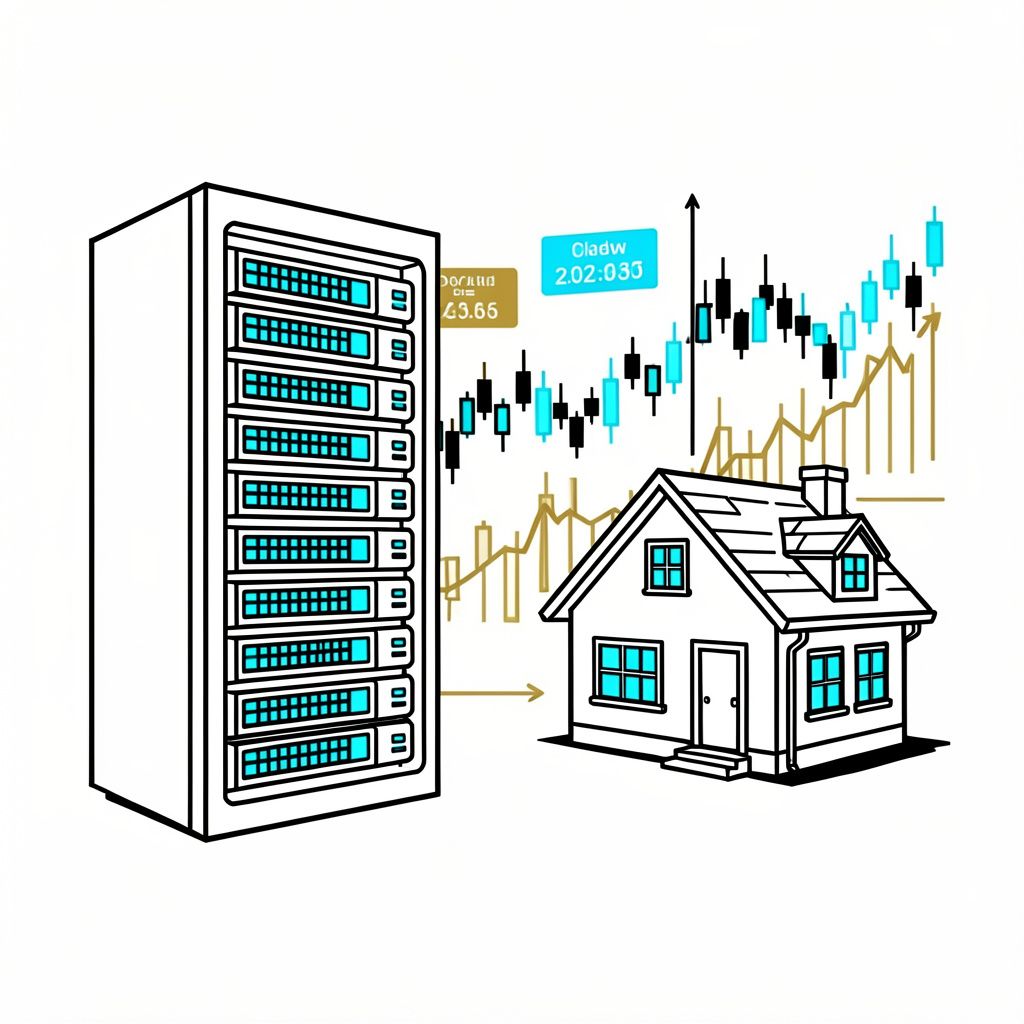
In September 2026, the United States economy reached a defining inflection point as corporate capital expenditure on data centers and information-processing hardware officially surpassed total residential housing investment [1]. This structural shift marks the first time digital infrastructure spending has outpaced traditional real estate investment, driven primarily by an unprecedented expansion in enterprise artificial intelligence infrastructure [1]. Real private residential fixed investment had fallen 18% from its 2021 peak to $748 billion in Q2 2026, while spending on information processing equipment rose 51% to $752 billion over the same period [1]. The ratio of tech investment to housing investment in Q2 2026 stands at approximately 1.005, indicating a narrow but significant lead for the technology sector [1]. Adam Shapiro, vice president at the San Francisco Fed, noted that investment is shifting away from residential investment and towards computers, describing the AI investment boom as massive [1].
Energy Demands and Federal Response
The rapid deployment of AI infrastructure places immense strain on the national energy grid, prompting significant federal intervention. The U.S. Department of Energy is executing President Donald J. Trump’s “Winning the Race: America’s AI Action Plan,” published in July 2025, to expand digital infrastructure and maintain U.S. leadership in artificial intelligence [2]. In February 2026, the DOE’s Office of Energy Dominance Financing finalized a $26.5 billion loan package for Georgia Power and Alabama Power, projected to add over 16 GW of dispatchable power to the grid [2]. Furthermore, President Trump’s executive orders aim to quadruple U.S. nuclear capacity from approximately 100 GW to 400 GW by 2050, with initiatives like the UPRISE program targeting 10 new large reactors under construction by 2030 [2]. TerraPower’s Natrium reactor project in Kemmerer, Wyoming, received a construction permit in March 2026, representing the first NRC permit for a commercial non-light-water reactor [2].
Market Projections and Growth Trajectory
Financial analysts project sustained growth for the AI data center market despite current capital intensity. The US AI data center market is valued at USD 142.50 billion in 2026 and is projected to reach USD 610.12 billion by 2032, reflecting a compound annual growth rate (CAGR) of 27.4% for the 2026–2032 period [3]. Hyperscale data centers are expected to dominate market share at 68.4% by 2032, while the hybrid deployment segment is forecasted to experience the highest growth rate at a CAGR of 31.1% [3]. S&P Global estimates capital expenditures from major hyperscalers including Alphabet, Amazon, Microsoft, Meta, Oracle, and SpaceX will reach $870 billion in 2026 and exceed $1.3 trillion in 2027 [1]. However, operating cash flow for these six major hyperscalers is expected to be collectively negative in 2026 and 2027, with 2028 identified as a potential inflection point where revenue growth accelerates and capex flattens [1].
Risk Exposure and Political Headwinds
The physical and political risks associated with this expansion are mounting. Global annual data center investment is projected to rise from approximately US$500bn in 2024 to over US$1trn by 2027, but 79% of global data center capacity is in areas with heightened natural catastrophe risk [4]. The global data center insurance market is projected to grow from approximately US$11bn as of September 2026 to over US$24bn by 2030, driven by rapid capacity expansion and rising insured values [4]. Politically, an NBC News poll indicates 64% of registered voters are less likely to support political candidates who favor constructing data centers in their communities, highlighting political backlash during the 2026 midterm election season [1]. Capital Economics notes that elevated and rising borrowing costs are holding developers back, supporting the view that the downward trend in housing starts has further to run [1].