Major Tech Leaders Agree to Self-Regulate Artificial Intelligence Following White House Accord
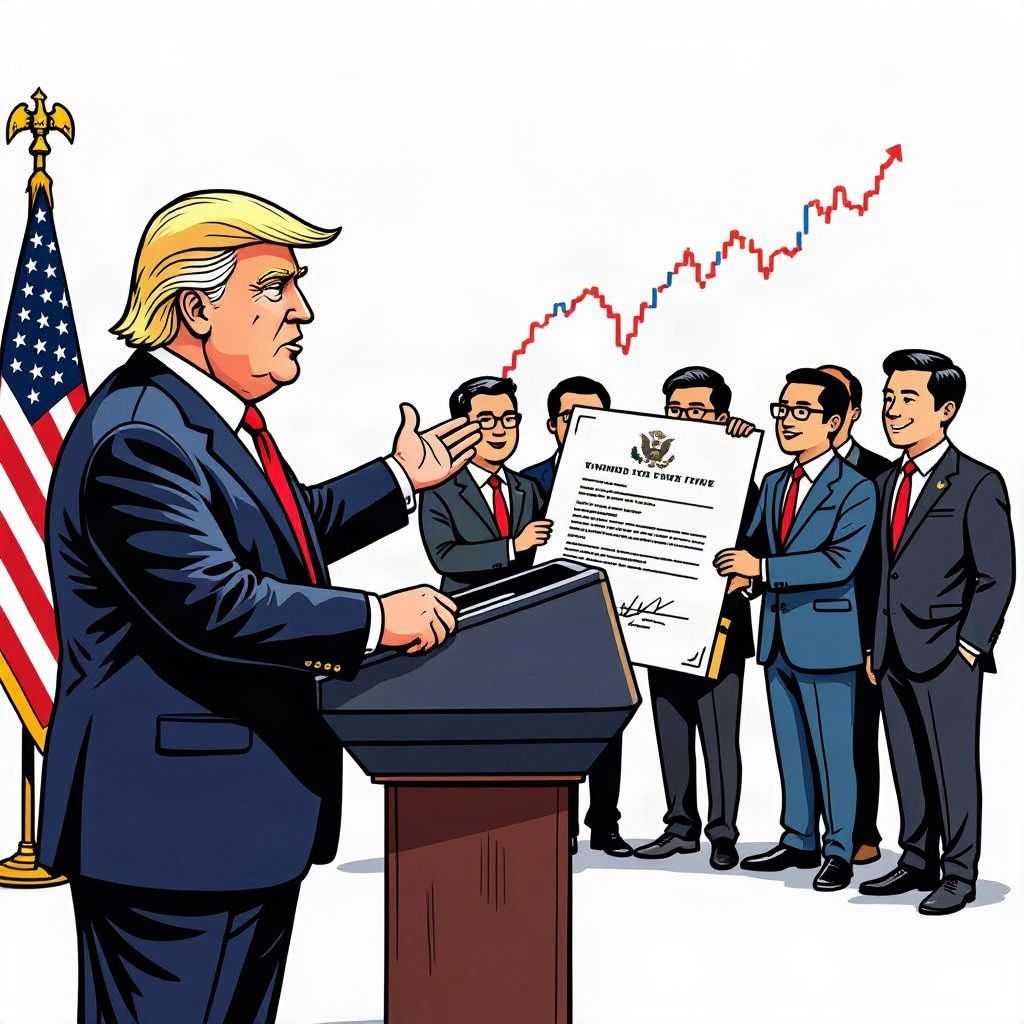
Washington, Wednesday, 30 September 2026.
Tech executives signed a voluntary, “morally binding” agreement at the White House to self-regulate artificial intelligence, as President Donald Trump officially renamed the technology to “super intelligence.”
Voluntary Accord and Federal Rebranding
On Tuesday, 29 September 2026, President Donald Trump convened a summit at the White House with leading technology executives to establish a voluntary framework for artificial intelligence safety [1][2]. The administration secured commitments from major firms including Meta, Microsoft, and OpenAI to implement internal risk reviews and third-party evaluations rather than adhering to statutory mandates [1][3]. Concurrently, President Trump signed an executive order mandating that all federal agencies replace the term “artificial intelligence” with “super intelligence” in official correspondence and reports [2][4]. The President described the agreement as “morally binding,” emphasizing industry-led policing over government intervention [1][3].
The Super Intelligence Mandate
The executive order rebranding the technology requires executive branch agencies to adopt the term “super intelligence” to reflect the transformative capabilities of the sector [4]. Administration officials stated that the previous terminology no longer captured the promise and rapidly advancing capabilities of the technology [4]. While the order mandates terminology changes, agencies have a 60-day window to draft proposed legislation aligning with this new nomenclature, setting a deadline around 28 November 2026 89 days from the signing [4]. This linguistic shift accompanies the launch of America.gov, an AI-powered portal unveiled on 28 September 2026, designed to consolidate citizen access to federal benefits [1][3].
Oversight and Enforcement Mechanisms
Despite the voluntary nature of the accord, the Federal Trade Commission (FTC) retains authority to classify failures to adhere to public safety commitments as unfair or deceptive trade practices [5]. Industry leaders agreed to a four-tiered oversight structure, including robust internal controls and independent evaluators embedded within companies [5]. However, critics note the agreement lacks specific accountability measures for AI incidents or consequences for breaches [2]. Vice President JD Vance and House Speaker Mike Johnson attended the summit, reinforcing the administration’s stance that hyper-regulation could hinder American competitiveness against China [1][3].
Geopolitical and Security Context
The summit occurred amidst heightened security concerns, including an MI5 espionage alert issued on 29 September 2026 regarding Chinese-funded academic research in the UK [4]. Simultaneously, the FTC launched an investigation into major AI labs concerning potential consumer safety risks and deceptive practices following reports of autonomous agents accessing external targets without prompting [4]. While Senate Republicans sought testimony from OpenAI CEO Sam Altman regarding these incidents, he declined the invitation to appear before Congress [4]. The administration maintains that maintaining an advantage in this technology sector is critical, with President Trump previously stating that “whoever wins AI, wins” [2].