Millions of Americans Are Using Short-Term Loans to Pay for Basic Groceries and Rent
New York, Thursday, 10 September 2026.
Exhausted savings are forcing consumers to use short-term financing for everyday necessities like groceries and rent, driving late payment rates to 47% as household debt risks escalate.
Shift to Essential Spending
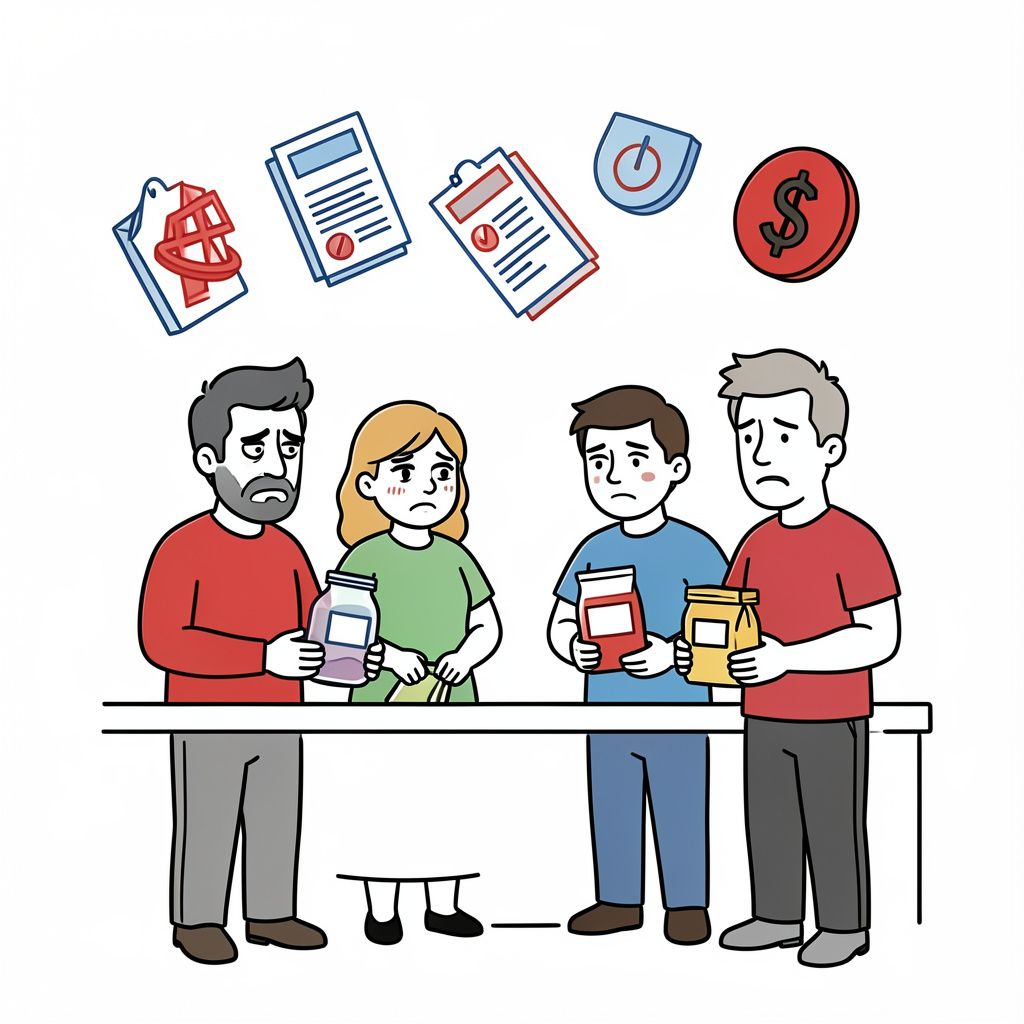
A significant shift in consumer behavior is underway as American households increasingly rely on buy now, pay later (BNPL) services to cover basic living expenses such as groceries, rent, and utility bills [1]. Financial analysts report that while BNPL offers short-term liquidity for struggling households, the trend is triggering increased late payments and delinquency risks across consumer lending markets [1]. This evolution marks a departure from the model’s origins in retail checkout financing, with companies like Flex now processing approximately $2 billion per month in rent loans as of 2026 [3]. Data indicates that BNPL originations increased from nearly $116 billion in 2024 to nearly $157 billion in 2025, per Federal Reserve estimates [1]. This represents a growth rate of 35.345 percent over the one-year period [1]. Approximately 50% of Americans have used a BNPL loan in recent years, with 15% to 25% of the population utilizing them on a regular basis [3]. Among Gen Z consumers aged 18 to 29, usage for essentials like groceries rises to 46% [8]. The application process for these services is designed for speed, often granting approval within minutes, which facilitates rapid access to credit [3].
Shift to Essential Spending
Surveys conducted in 2026 highlight the extent of this reliance on short-term financing for necessities. A LendingTree survey conducted in early July 2026 found 44% of Americans expect to apply for a BNPL loan in the next six months [1]. A separate LendingTree March 2026 survey indicated 29% of BNPL users utilized loans for groceries, up from 14% in 2024 [1]. Furthermore, a Data for Progress poll of 1,164 U.S. voters conducted in early July 2026 for the group Protect Borrowers found 42% of BNPL users utilized loans for medical or dental care and 39% for utility bills [1]. This usage pattern suggests that consumers are increasingly choosing the flexibility that pay-over-time options provide when traditional credit is exhausted [1]. Jim Triggs, CEO of Money Management International, noted that often consumers have exhausted their credit cards, and buy now, pay later is their only option [1]. Unlike credit cards, BNPL loans typically require direct access to a user’s bank account or debit card for automatic repayment on a fixed schedule, creating potential cash-flow risks for users juggling multiple concurrent loans [3].
Escalating Delinquency Risks
The rapid expansion of BNPL usage for essentials correlates with rising delinquency rates. LendingTree’s March 2026 data shows 47% of users paid late on a BNPL loan in the past year, an increase from 34% in 2024 [1]. This represents a percentage point increase of 13 percentage points over the two-year period [1]. In 2026, interest-bearing installment loans comprised over 37% of annual BNPL loan issuance, nearly double the 2021 share [1]. Late payment fees can reach $7 to $8 per payment, with interest and financing fees up to 36% [1]. Mike Pierce, Protect Borrowers executive director, warned that late fees stacking on top of each other can make a small loan turn into something that looks more like a payday loan, equivalent to an interest rate of 100% APR or more [1]. Triggs added that many consumers are missing payments, identifying it as a big issue and a big problem [1]. The industry has shifted focus toward everyday essentials, expanding services into utilities and auto loans alongside rent [3].
Escalating Delinquency Risks
Revenue models for BNPL companies are transitioning from merchant-paid fees to consumer-paid fees, which include borrowing fees, processing costs, and subscription charges [3]. This shift places more financial burden directly on the borrower. While the Buy Now, Pay Later industry generates approximately $160 billion in annual volume, a figure significantly smaller than the $3 trillion spent via credit cards, it is currently under scrutiny due to rapid growth and limited regulatory oversight [3]. Approximately 15% to 25% of Americans report regular use of Buy Now, Pay Later services, which often utilize soft credit checks rather than hard credit pulls, preventing lenders from having full visibility into a borrower’s total debt load [3]. Users of BNPL services are disproportionately individuals on financial margins who have maxed out or do not qualify for traditional credit cards, with roughly 50% of users stating they could not have made the purchase without these loans [3]. This demographic reality underscores the heightened risk profile associated with the current growth trajectory.
Household Financial Strain
Broader economic data confirms that depleted savings are weighing heavily on the consumer spending outlook. According to the PYMNTS Intelligence report Household Finances Flash a Warning Behind Stable Consumer Confidence, released in August 2026, 19% of households reported a financial lifestyle deterioration over the previous 12 months, while 7.1% reported an improvement [5]. Additionally, 28% of all households faced unexpected expenses of at least $1,200 between approximately 09 June 2026 and 07 September 2026 [5]. This incidence rate rose to 34% for households living paycheck to paycheck and struggling to pay bills [5]. Among households that fell into financial difficulty between approximately 09 June 2026 and 07 September 2026, 66% had either drained their savings or never possessed them, compared to 37% of those living comfortably paycheck to paycheck [5]. Only 26% of households with deteriorating finances could cover more than 3 months of expenses via savings [5]. Conversely, 32% of these households had an emergency readiness score of 32, compared to 64 for households whose finances improved [5].
Household Financial Strain
The strain is evident in how households manage unexpected costs. Struggling paycheck-to-paycheck households utilized diverse methods to cover their largest unexpected expense: 36% used cash or savings, 35% carried a credit card balance, 27% borrowed from friends or family, and 21% skipped or delayed bills [5]. Payment methods for unexpected expenses among struggling paycheck-to-paycheck households also included payday loans, cash advances, or overdrafts at 15%, and Buy Now, Pay Later at 15% [5]. PYMNTS Intelligence has tracked consumer financial stability, specifically regarding paycheck-to-paycheck living and bill payment struggles, since 2021 [6]. Approximately 67% of U.S. adults report living paycheck-to-paycheck, with 41% attributing this status to day-to-day spending, 31% to short-term financial shocks, and 28% to long-term financial commitments like housing, education, or childcare [6]. Household financial stress is driven by fixed, non-discretionary costs such as mortgage, rent, insurance, childcare, and tuition rather than inflation rates alone [6]. Despite consistent employment, consumers struggle as fixed costs rise, with median income for households shaped by long-term financial commitments at $92,500, yet 50% of consumers earning $100,000 or more report living paycheck to paycheck [6].
Economic Implications and Debt Levels
The reliance on credit for essentials extends beyond BNPL services. U.S. credit card debt reached $1.25 trillion in Q1 2026, a 5.9% year-over-year increase, according to the Federal Reserve Bank of New York [1]. According to The Penny Hoarder’s 2026 State of Debt in America Report, nearly 70% of Americans are currently in debt, with 37% of households managing at least $10,000 in non-mortgage debt [8]. Inflation and rising costs of living are cited as the primary driver of debt by 21% of respondents, while 17% attribute debt to insufficient income [8]. Consumer reliance on credit and alternative financing for basic needs is significant, with 24% of respondents charging groceries to credit cards in the 12 months prior to August 2026, and 14% using credit for utilities [8]. Financial strain is affecting physical health, as 16% of respondents reported delaying or avoiding emergency room or urgent care visits due to fears regarding medical costs or existing medical debt [8]. Long-term financial outlooks remain pessimistic, with 13% of Americans anticipating they will never be debt-free, excluding mortgage obligations [8].
Economic Implications and Debt Levels
Debt significantly impacts long-term financial planning, with 23% of respondents delaying retirement savings and 14% delaying home purchases [8]. Additionally, only 37% of working Americans possess an emergency fund [8]. In a June 2026 survey of 1,000 U.S. adults, 32% of respondents reported that debt payments consume 10% to 25% of their paychecks, while 20% of respondents allocate 26% or more of their income to debt servicing [8]. Fixed costs are squeezing budgets, as 29% of Americans experienced significant housing cost increases in the 12 months prior to August 2026 [8]. Furthermore, 22% of households earning under $55,000 pay $500 or more monthly for vehicle payments [8]. The economy is characterized as an E-shape, where consumer stability is fragile because households have exhausted cheap budget cuts and are left only with high-cost, difficult-to-adjust fixed commitments [6]. This fragility suggests that any further economic shock could lead to a sharper increase in defaults across consumer lending markets.
Regulatory and Industry Response
Regulatory momentum regarding the Buy Now, Pay Later sector began toward the end of the Biden administration but ceased during the Trump administration [3]. Industry representatives defend the model as a tool for flexibility. Phil Goldfeder, American Fintech Council CEO, stated that consumers are increasingly choosing the flexibility that pay-over-time options with clear, transparent terms provide [1]. Miranda Margowsky, Financial Technology Association spokesperson, argued that splitting the cost of a purchase into four installments with zero to low interest is smart money management, not financial risk [1]. An unnamed Flex Executive noted that they cannot solve income or the price of rent and affordability, but what they can help people solve is a timing issue, calling it harm reduction [3]. However, analysts warn that the lack of full visibility into borrower debt loads due to soft credit checks remains a systemic risk [3]. As of 2026-09-07, the broader economic impact remains a key concern for policymakers monitoring household leverage [3].
Regulatory and Industry Response
The New York Times podcast The Daily, hosted by Natalie Kitroeff and featuring reporter Stacey Cowley, discussed the risks and consumer trends associated with BNPL loans on 2026-09-08 [3]. Cowley described the loans as very short-term installment loans that users can utilize when purchasing something at a retail checkout or online or just in daily shopping needs [3]. She noted that the application process is intended to be really fast, really easy, and to feel kind of transparent [3]. However, the speed of approval, such as a $6,000 credit line within five minutes, raises questions about underwriting standards [3]. One analyst referred to this phenomenon as the new working capital for the working class [3]. If consumers borrow $1,000 for rent and stretch it out for a couple of weeks, they might pay $25 in fees to do so [3]. As the market evolves, the balance between accessibility and financial safety remains a critical focal point for economists and regulators alike.
Sources
- www.cnbc.com
- www.facebook.com
- www.nytimes.com
- www.facebook.com
- www.pymnts.com
- www.linkedin.com
- www.facebook.com
- www.thepennyhoarder.com