Chinese Cargo Ship Completes First Regular Voyage to the UK via Arctic Shortcut
London, Thursday, 10 September 2026.
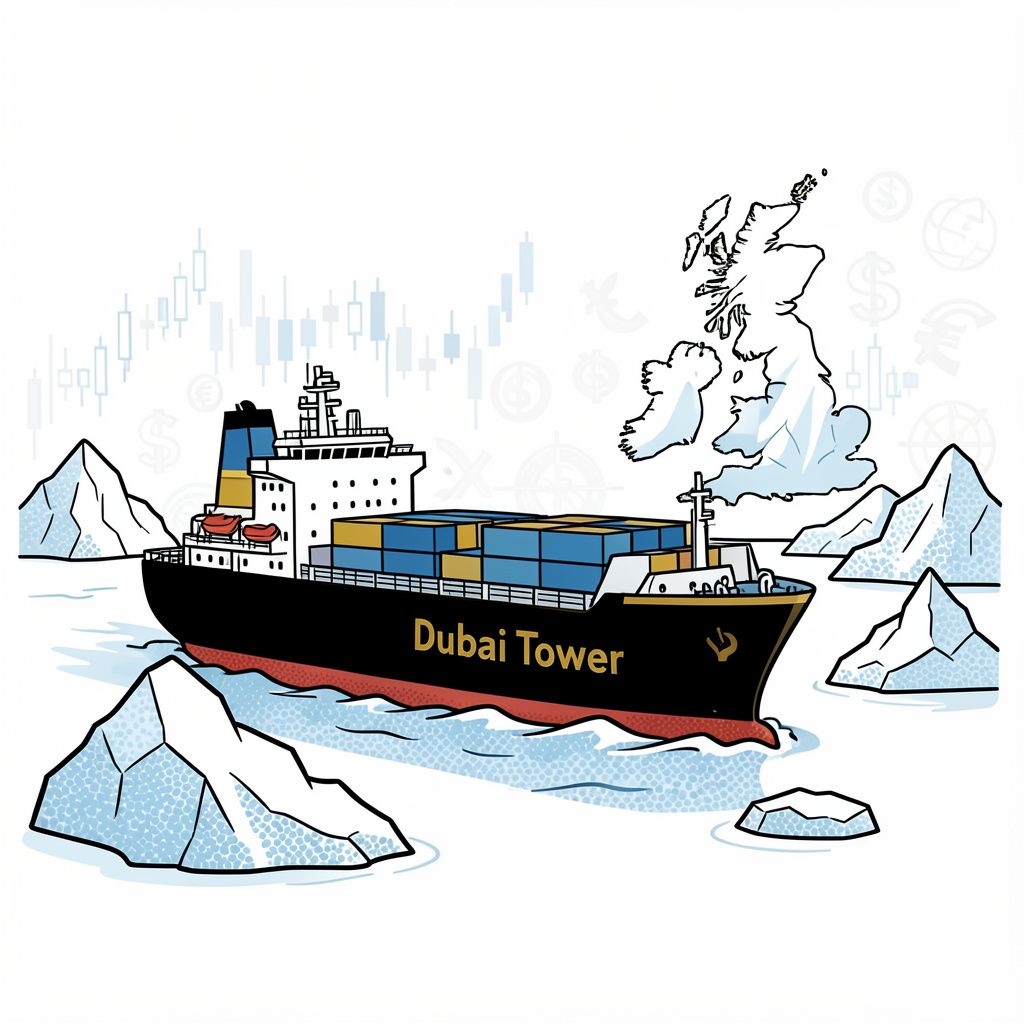
Sea Legend Shipping’s Dubai Tower arrived in the UK after a 25-day Arctic voyage, launching a regular route that slashes traditional Asia-Europe transit times nearly in half.
Arrival and Voyage Confirmation
The Liberian-flagged container vessel Dubai Tower arrived at Teesport in the United Kingdom on Wednesday, September 9, 2026, concluding a landmark transit via the Northern Sea Route [1][5]. Owned by China’s Sea Legend Shipping, the 1,740 TEU vessel completed the journey in approximately 25 days, marking the first completion of the company’s China-Europe Arctic express service [1][6]. The arrival confirms earlier reports that the ship was concluding its transit during the week of September 7, 2026 [2]. This successful passage underscores the growing viability of Arctic logistics as an alternative to traditional maritime corridors [7].
Route Specifics and Timeline
The Dubai Tower departed from Ningbo Port in Zhejiang Province, with additional calls at Shanghai, Taicang, and Qingdao before finally leaving Chinese waters on August 19, 2026 [1]. While some reports indicate a departure from Ningbo on August 15, 2026, the final exit from Chinese waters occurred later in the month [6][1]. Upon leaving its final Chinese port, the vessel took about 20 days to reach Teesport, according to logistics tracking data [4]. The voyage demonstrates a significant reduction in transit time compared to conventional shipping lanes that traverse the Suez Canal or round the Cape of Good Hope [7].
Operational Efficiency and Cargo
Cargo on board the Dubai Tower included photovoltaic modules, containerised energy storage systems, and other high-value items manufactured in the Pearl River Delta and Yangtze River Delta regions [1]. Industry analysis suggests that sailing via the Northern Sea Route roughly halves the typical 40–50 day voyage time required for Asia-Europe routes via the Cape of Good Hope [6]. Using the upper bound of the traditional voyage duration, the time savings 50 percent compared to the 50-day benchmark [6][1]. This efficiency is particularly relevant as disruptions in the Red Sea continue due to ongoing tensions in the Middle East [1].
Strategic and Geopolitical Implications
The initiation of this regular service aligns with China’s self-identification as a “near-Arctic state” and its history of collaboration with Russia on Arctic coast guard patrols [2]. Analysts are currently debating whether the Northern Sea Route service represents a sound commercial venture or a geopolitical maneuver, given the route’s role as a shorter alternative to the Suez Canal [2]. The route’s accessibility is increasing due to climate change, which is causing Arctic ice to melt at an accelerated rate [2]. Furthermore, the pathway offers a way to avoid security risks in the Middle East, such as those associated with regional conflicts [7].
Future Service Plans
Sea Legend Shipping intends to complete another seven voyages via the Northern Sea Route for the remainder of the year, bringing the total planned voyages to eight for the 2026 summer ice season [1][6]. Future ports of call in Europe for this service will include Felixstowe, Hamburg, and Gdynia in Poland [1]. Li Xiaobin, Chief Operating Officer of Sea Legend Shipping, stated expectations that the Northern Sea Route will cut the one-way transit time from Asia to Europe by nearly half compared to traditional routes [1]. However, weather and sailing conditions can remain unpredictable, and the commercial feasibility over the long term is still being assessed [7].
Broader Industry Context
Other carriers are also active in the region, with New New Shipping and OVP Shipping offering Asia–Europe services via the Arctic [6]. A South Korean container ship is currently making a similar voyage, joining China and Russia in having shipping firms test cargo services along the route [7]. Data from the Centre for High North Logistics indicates that in 2025, 88 vessels completed 103 transit voyages of the Northern Sea Route between June 30 and November 30 [6]. This growing traffic highlights the increasing interest in polar logistics corridors among global maritime operators [6].
Sources
- www.bairdmaritime.com
- www.nytimes.com
- www.facebook.com
- x.com
- www.reutersconnect.com
- www.seatrade-maritime.com
- www.bairdmaritime.com