Senate Budget Votes Stall Over $1.8 Billion Federal Compensation Fund
Washington, Saturday, 23 May 2026.
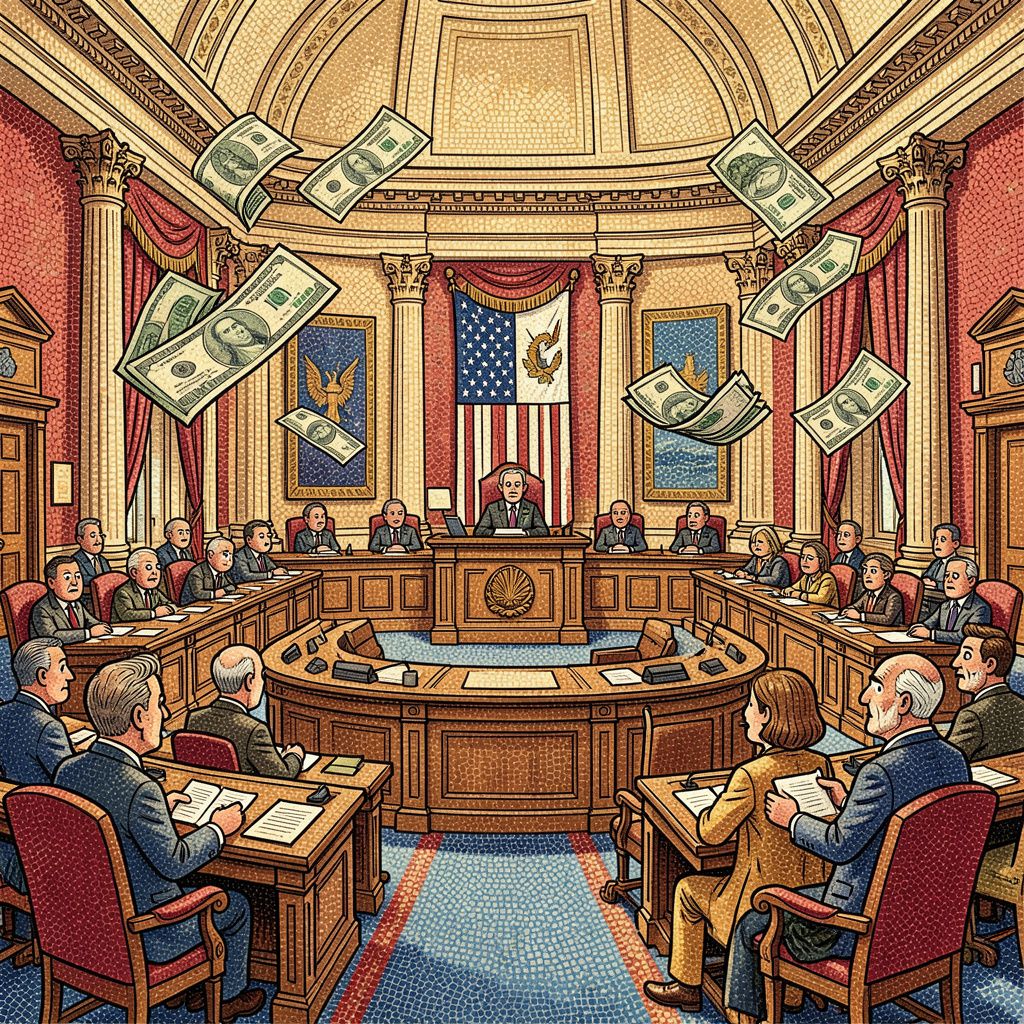
A proposed $1.8 billion federal compensation fund has stalled Senate budget votes, drawing bipartisan scrutiny over its use of taxpayer dollars without direct congressional oversight.
The Origins and Mechanics of the Compensation Initiative
On May 18, 2026, the Department of Justice announced that the U.S. Treasury would direct $1.776 billion into a newly established “Anti-Weaponization Fund” [2][3]. The initiative stems from a settlement agreement in President Donald Trump’s $10 billion civil lawsuit against the Internal Revenue Service concerning the leak of his tax records [1][3]. Under the terms of the settlement, the IRS is permanently barred from investigating the past tax returns of President Trump, his family members, or his business entities [6]. While the President himself will not receive a direct financial payout from the newly created fund, the capital will be drawn from the federal government’s Judgment Fund, an account traditionally used to pay court-ordered remedies [3][6].
Administrative Structure and Eligibility
The fund’s governance structure and broad eligibility criteria have immediately drawn intense scrutiny from lawmakers. Acting Attorney General Todd Blanche—who previously served as President Trump’s personal defense attorney—testified before a Senate committee on May 19, 2026, defending the initiative [6]. Blanche clarified that the fund would be administered by a five-member commission, with four members appointed by the attorney general and one selected in consultation with Congress, though the President retains the authority to remove any commissioner [6]. During his testimony, Blanche stated that the money would be available to “anybody in this country … if they believe they were victims of weaponization,” explicitly refusing to rule out payouts to January 6 Capitol rioters or campaign donors [3][6].
Legislative Gridlock and Bipartisan Pushback
The sudden introduction of the $1.776 billion initiative has severely disrupted the legislative calendar in Washington. By May 21, 2026, the controversy had effectively tanked a planned Senate vote on a broader $70 billion reconciliation package, which included critical funding for U.S. Immigration and Customs Enforcement and U.S. Customs and Border Protection [5]. The $1.776 billion fund represents approximately 2.537 percent of the total reconciliation package’s value, yet it became the primary sticking point that forced Senate Majority Leader John Thune to dismiss members early for the Memorial Day recess without securing a vote [4][5]. President Trump had initially aimed to have the legislation on his desk for signature by June 1, 2026 [5] [alert! ‘It remains unclear if the June 1 legislative deadline can still be met given the current recess and gridlock’].
Efforts to Block the Funding
In response to the administration’s maneuver, a bipartisan coalition has begun mobilizing to block the appropriations. Representatives Brian Fitzpatrick (R-PA) and Tom Suozzi (D-NY) introduced the Bipartisan Transparency for American Taxpayers Act, designed specifically to prohibit federal funds from being used to pay claims submitted to the Anti-Weaponization Fund [2]. Representative Suozzi characterized the initiative as a “slush fund,” while Representative Fitzpatrick raised constitutional concerns regarding the diversion of nearly $2 billion in taxpayer dollars without explicit congressional authorization, court approval, or transparent guardrails [2].
Intra-Party Fractures and the “Revenge Tour”
The legislative stalemate has exposed deepening fissures within the Republican Party, exacerbating what political analysts describe as a “revenge tour” by President Trump against incumbents he views as insufficiently loyal [4]. The internal conflict spilled into public view on Friday, May 22, 2026, when President Trump launched a verbal attack on Republican Senator Thom Tillis of North Carolina, labeling him a “RINO” and a “quitter” [1]. Tillis, who had previously announced he would not seek reelection, drew the President’s ire after criticizing the Anti-Weaponization Fund as a “payout pot for punks” and describing the legal premise of the fund as “stupid on stilts” [1][4]. The President publicly suggested that Tillis’s retirement was a direct result of Trump refusing to endorse him for another term [1].
Growing Republican Dissent
Senator Tillis is not the only Republican voicing opposition. Louisiana Senator Bill Cassidy, who recently lost his primary election following a Trump endorsement of his opponent, has also emerged as a vocal critic [1]. Cassidy publicly advocated for strict congressional review and guardrails on the fund’s disbursements, arguing that American taxpayers are focused on inflation and housing costs rather than funding a massive compensation pool with “no legal precedent or accountability” [1][4][5]. The friction extends beyond the compensation fund; Senate Republicans are also seeking to limit spending on other executive requests, including a proposed billion-dollar White House ballroom construction project, which Cassidy criticized on May 20, 2026, for lacking architectural plans and environmental studies [1][4].
Legal Scrutiny and Broader Economic Implications
Legal experts are raising substantial questions regarding the constitutionality and statutory legality of utilizing the Judgment Fund for these disbursements. The Judgment Fund is traditionally reserved for actual “compromise settlements” where there is a legitimate prospect of the government losing in court [3]. Because a federal judge previously suggested that the Trump family’s lawsuit against the IRS lacked the necessary adversarial relationship between plaintiff and defendant, critics argue that using the Judgment Fund may violate the Anti-Deficiency Act, essentially classifying the payouts as unauthorized gifts rather than lawful settlements [3]. Furthermore, the arrangement has prompted discussions about potential violations of 26 U.S. Code § 7217, which prohibits executive interference in IRS investigations [3].
Market and Policy Outlook
As the Memorial Day weekend begins, the cascading effects of this intra-party dispute are becoming apparent to financial markets and political observers alike. The administration’s struggle to unify its legislative base has already led to the pulling of a war powers vote in the House on May 22, 2026, and sparked rumors of a potential presidential veto over spending bills [4][5]. While Congress could theoretically amend the Judgment Fund to require judicial approval for such settlements, or expand the comptroller general’s authority to halt unjustified fund uses [3] [alert! ‘The status and viability of any congressional amendments to the Judgment Fund remain uncertain amid the current gridlock’], the immediate reality is a paralyzed Senate. For business leaders monitoring Washington, the delayed $70 billion immigration and border package serves as a stark indicator that broader economic policies may remain stalled as long as the dispute over the Anti-Weaponization Fund persists [GPT].
Sources
- abcnews.com
- fitzpatrick.house.gov
- www.lawfaremedia.org
- www.ms.now
- www.newsnationnow.com
- news.wjct.org
- www.facebook.com
- www.facebook.com