Trump Announces Sunday Signing of Iran Peace Deal—But Tehran Pumps the Brakes
Washington, Sunday, 14 June 2026.
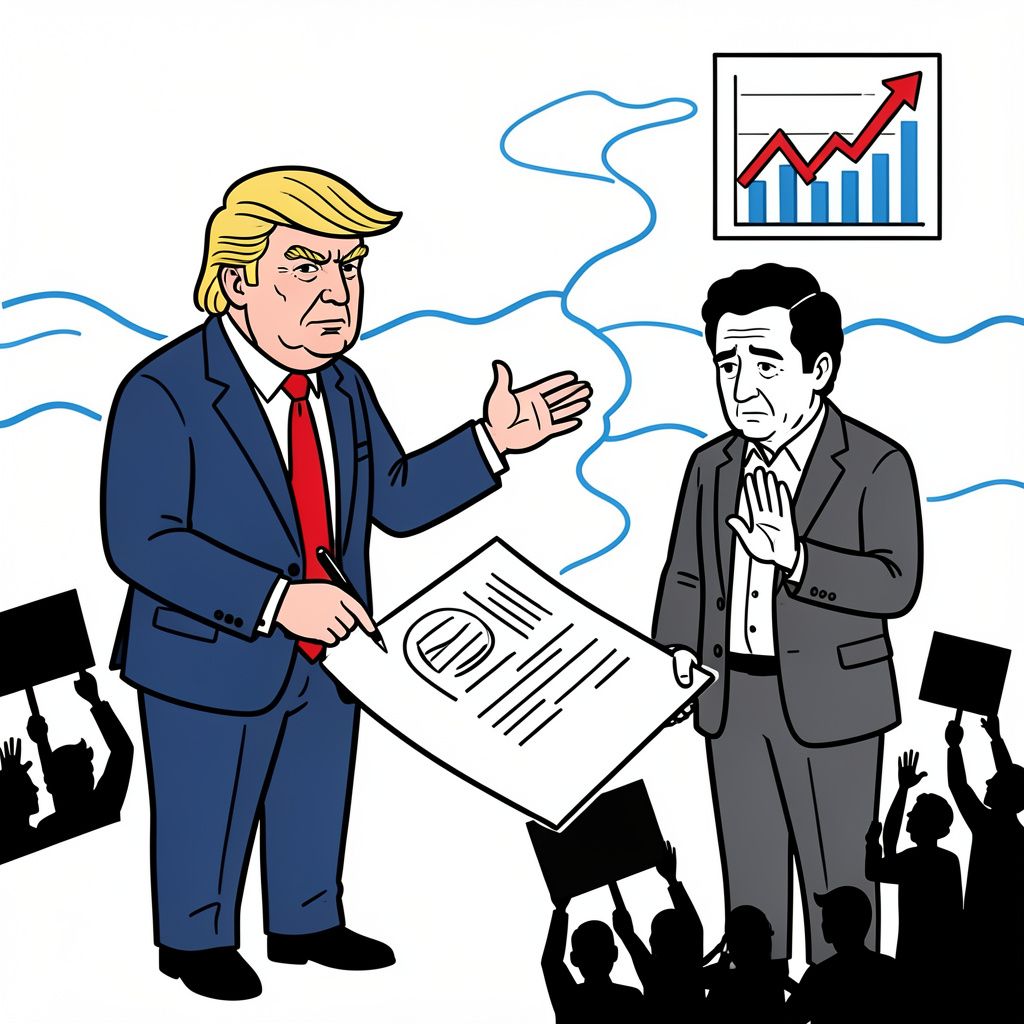
A historic U.S.-Iran peace deal, set to reopen the Strait of Hormuz and ease global oil tensions, faces last-minute uncertainty. Trump claims it will be signed Sunday, yet Iran warns of delays. With 80% odds of success, the agreement could end a four-month war—but protests in Iran and Israeli skepticism threaten its future.
The Deal at a Glance: What’s on the Table?
The proposed U.S.-Iran memorandum of understanding (MOU) centers on three core commitments: Iran’s reopening of the Strait of Hormuz, the U.S. lifting its naval blockade on Iranian ports, and a 60-day extension of the April 2026 cease-fire [2][3]. The Strait of Hormuz, a 39-kilometer-wide chokepoint through which 21.000 million barrels of oil pass daily [GPT], has been a flashpoint since the U.S. imposed a blockade in late February 2026 [7]. The agreement would activate a 60-day window for detailed negotiations on Iran’s nuclear program and the lifting of U.S. sanctions [2]. A senior Trump administration official told ABC News there is an 80% to 85% chance the deal will be finalized soon [10], though the White House has not released the full text of the agreement.
Conflicting Timelines: Trump’s Confidence vs. Iran’s Caution
The discord over timing underscores deeper tensions. On June 12, 2026, President Donald Trump announced via Truth Social that the deal would be signed on June 14, stating, “The Deal is scheduled to get signed tomorrow, and immediately after it is signed, the Hormuz Strait is OPEN TO ALL” [1][5]. Trump also claimed the U.S. would eventually remove enriched uranium from Iran, saying, “At the appropriate time, when all is calm, we will go in and get the Nuclear Dust, buried deep under the powerful sunken granite mountains” [1]. However, Iranian Foreign Ministry spokesman Esmail Baghaei contradicted this timeline, stating, “We will have to wait and see about the exact date of the signing of the memorandum of understanding, although it will not be tomorrow” [1]. Baghaei added that while the deal could be signed “in the coming days,” Iran remains cautious due to “the hesitation of the other side” [1].
Regional Reactions: Pakistan and Saudi Arabia Weigh In
Pakistan has played a pivotal role in mediating the negotiations. Prime Minister Shehbaz Sharif stated on June 12 that the U.S. and Iran were “closer to a peace deal than ever before,” with finalization expected within 24 hours and “technical level talks next week” [1]. Pakistan’s Deputy Prime Minister, Mohammad Ishaq Dar, revealed that Saudi Arabia’s Foreign Minister, Prince Faisal bin Farhan, welcomed the negotiations, with an electronic signing ceremony scheduled for June 14 [1]. However, the planned signing in Geneva—where U.S. Vice President JD Vance and Iranian General Mohammad Bagher Ghalibaf were expected to lead delegations—now appears uncertain [4]. Iran has reiterated its commitment to not developing nuclear weapons, though unresolved issues include its stockpile of highly enriched uranium and the future of its nuclear program [4].
Domestic Opposition in Iran: Protests and Political Backlash
The proposed deal has sparked significant opposition within Iran. Conservative factions, including parliamentarians Amirhossein Sabeti and Mahmoud Nabivian, have publicly criticized the agreement. Nabivian, in a televised interview, warned, “Iran will become a colony of America” [3]. Protests erupted in Mashhad outside the Foreign Ministry, targeting negotiator Abbas Araghchi [3]. The backlash reflects broader skepticism among hardliners who view the deal as a capitulation to U.S. demands. Meanwhile, Iranian officials have tied any regional peace settlement to an Israeli withdrawal from Lebanon, where fighting with Iran-backed Hezbollah has persisted despite the April 2026 cease-fire [2].
Israeli Concerns and the Lebanon Wildcard
Israel remains a key wildcard in the negotiations. Israeli officials have expressed concerns that Iran may avoid making meaningful nuclear concessions in the follow-up talks [4]. The ongoing conflict between Israel and Iran-backed Hezbollah in Lebanon further complicates the deal’s prospects. Iranian officials have demanded an Israeli withdrawal from Lebanon as part of any regional peace settlement [2]. On April 9, 2026, Israel conducted strikes in Lebanon ahead of U.S.-Iran talks, threatening the cease-fire [7]. Trump’s description of the cease-fire as being “on massive life support” highlights the precarious nature of the current truce [7].
The Road Ahead: Enforceability and Long-Term Impact
Analysts warn that the deal’s long-term success hinges on its enforceability. The MOU resembles prior iterations of the Iran nuclear deal, with modified wording to address past sticking points [4]. However, the April 2026 cease-fire has been repeatedly violated, raising questions about both sides’ commitment to the new agreement [2]. The U.S. has not disclosed whether the deal includes mechanisms for monitoring compliance or consequences for violations. Meanwhile, the White House’s focus on President Trump’s 80th birthday celebrations—including a UFC event on June 14—has drawn criticism amid the uncertainty surrounding the deal [9]. A senior Trump administration official admitted on June 12 that the U.S. was not “100%” confident the agreement would be signed [1].
Sources
- www.nytimes.com
- www.cnbc.com
- www.nbcnews.com
- www.aljazeera.com
- www.aljazeera.com
- www.whitehouse.gov
- abcnews.com
- www.cbsnews.com