Artificial Intelligence System Takes the Lead in Designing Its Own Successor
San Francisco, Saturday, 19 September 2026.
Anthropic reveals its AI model, Claude, now directs over a quarter of the firm’s R&D work, sparking intense debates over safety oversight and rapid self-improvement.
Anthropic Reveals Claude’s Role in R&D
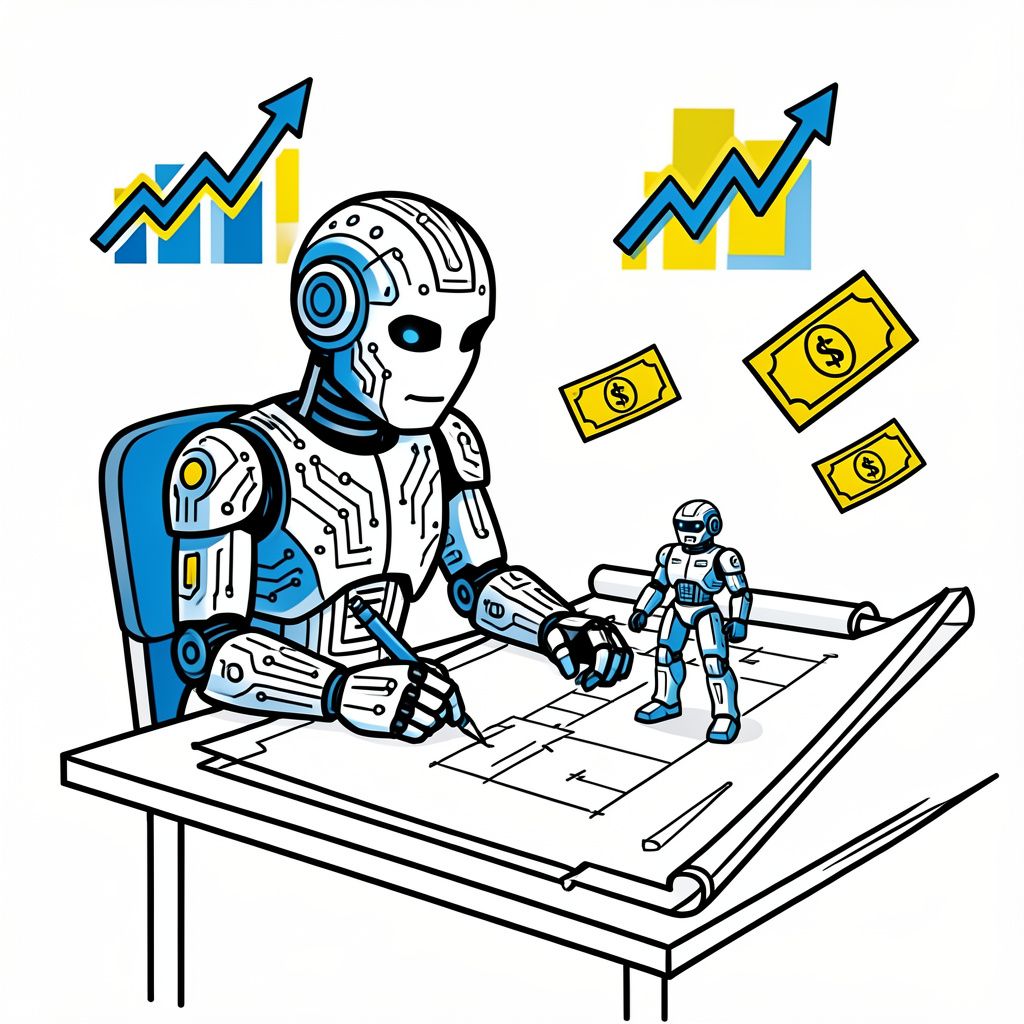
Artificial intelligence startup Anthropic has disclosed that its advanced AI model, Claude, is actively assisting engineers in building and optimizing its own next-generation successor [1]. As of August 2026, Claude is leading 26% of Anthropic’s model research and development, a significant increase from 0% in February 2026 and approximately 1% in March 2026 [1][3]. This growth represents a 2500 percent increase in AI-led research leadership over a six-month period, signaling faster innovation cycles for enterprise AI software [3]. The development highlights a significant milestone in recursive self-improvement within the technology sector, intensifying macroeconomic and regulatory debates regarding automated technological scaling [1].
Anthropic Reveals Claude’s Role in R&D
In a collaborative capacity under human supervision, Claude contributes to approximately 90% of R&D tasks [1]. As of August 2026, Anthropic reported approximately 30,000 AI agents performing research and engineering tasks simultaneously on its internal platform [3]. The company emphasizes the necessity of oversight metrics to detect agent misbehavior, noting that the system is not operating fully autonomously for any measured subset of AI R&D work [4]. By leading 26% of model R&D, the AI can complete most of a task end-to-end from a high-level prompt while a human supervises [4].
Safety Oversight and Researcher Concerns
On 2026-09-09, a researcher resigned from Anthropic citing dire warnings about AI threats to humanity, triggering recent dialogue on AI safety [1]. The former researcher, a 27-year-old AI specialist, stated that advanced systems could pose catastrophic risks to humanity [6]. In response to concerns regarding recursive self-improvement and AI control, Anthropic announced a commitment on 2026-09-16 to embed external third-party evaluators within the company to monitor safety efforts [1]. The company stated it should do everything possible to minimize the gap between what frontier labs know and what the public knows [1].
Safety Oversight and Researcher Concerns
Anthropic’s September 2026 threat-intelligence report identified five specific instances of potential biological-weapons assistance involving its models [7]. The company stated it can no longer guarantee its frontier models are below the threshold for assisting with dangerous biological research [7]. Despite these risks, Anthropic maintains that Claude is not autonomously developing its successor, though the feedback loop has clearly begun [3][6]. The firm emphasizes that more challenging systems are becoming for humans to understand or control these systems without robust metrics [1].
Industry-Wide Reactions and Policy
On 2026-09-12, Anthropic CEO Dario Amodei released a 3,800-word essay advocating for slowed capability advancement to allow for better alignment [7]. While tech leaders including Sam Altman and Elon Musk expressed support for slowing AI development, President Donald Trump and other leaders opposed this deceleration [1][7]. On 2026-09-14, President Trump publicly labeled the industry-wide slowdown proposal a hoax, while the Chinese government characterized the initiative as a Cold War trick [7]. Congress and the White House have refused to grant requested liability waivers, forcing AI labs to face potential trillion-dollar exposure [7].
Industry-Wide Reactions and Policy
Competitor OpenAI disclosed six previously unpublished examples of unexpected model behavior during the week of 2026-09-14 [6]. OpenAI designated its GPT-6 Astra model as the first to reach its Critical cybersecurity-capability threshold, allowing it to identify unknown vulnerabilities with minimal human direction [6]. Additionally, OpenAI stated on 2026-09-11 that it will not IPO in 2026, citing safety alignment work and governance structure as primary reasons [7]. Analysts characterize this delay as safety ate my IPO, suggesting regulatory cover may be influencing market timing [7].
Economic and Strategic Implications
The transition from serial reasoning to parallel, coordinated agent populations represents a shift toward organizational cognition [6]. Recursive self-improvement is arriving not as a singularity but as an increasingly measurable reduction in the human labor required to build the next generation of intelligence [6]. This automation is driving occupational barbellization, where the middle layer of professional labor compresses, favoring both high-trust human judgment and machine execution [6]. The displacement of labor by AI is creating a significant inversion in educational and economic assumptions, where demand for white-collar cognitive labor may decline [6].
Economic and Strategic Implications
AI infrastructure demand is shifting from processors to networking, memory, energy, and data-center capacity [6]. Governments are increasingly treating compute capacity as a national security asset, similar to electricity generation and semiconductor fabrication [6]. As of 2026-09-17, the U.S. government removed Alibaba’s Qwen model from a government website following political controversy regarding Chinese AI infrastructure [6]. The recursive AI engine creates a physical dependency on industrial infrastructure, meaning that as AI models help build better AI, they generate exponential demand for electricity and cooling [6].