Why Europe’s New Tech Independence Plan Still Depends on American Capital and Artificial Intelligence
Brussels, Thursday, 17 September 2026.
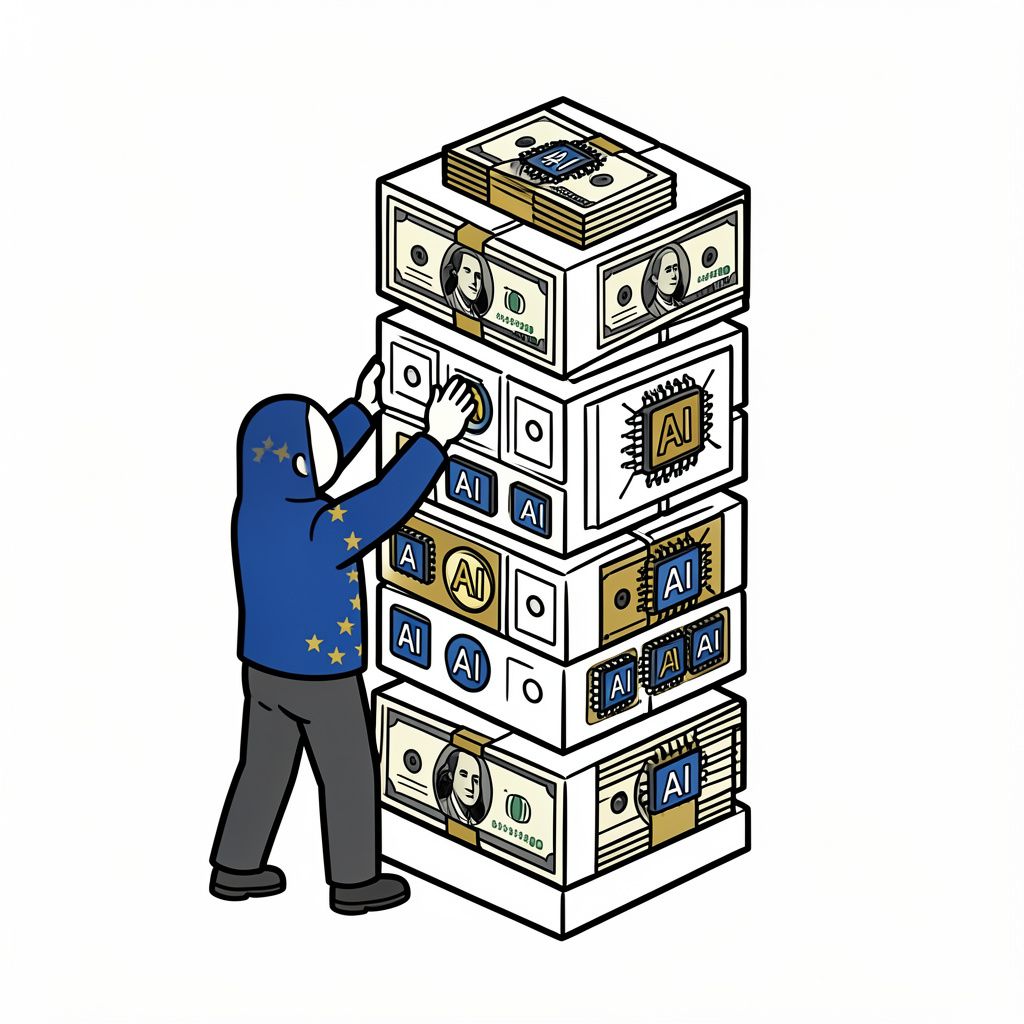
Despite pushing for digital independence, the European Union’s strategy relies heavily on American private equity and U.S. artificial intelligence models to power its key tech initiatives.
The Sovereignty Contradiction
European Commission President Ursula von der Leyen addressed the continent’s reliance on American AI and capital during a State of the Union speech on 15 September 2026 [1]. Despite public assertions regarding the need to retain control over digital infrastructure within the bloc, the practical execution of the European Union’s latest initiatives relies heavily on American private equity funding and US-developed artificial intelligence systems [1]. Specifically, the strategy depends on technology from US companies such as Anthropic, even as European AI champion Mistral currently lacks the capacity of frontier models [1]. This dynamic underscores the growing challenge European leaders face in balancing geopolitical tech autonomy with the immediate realities of global venture capital [1].
The Sovereignty Contradiction
The discrepancy between ambition and capability extends to the organizations tasked with safeguarding digital democracy. A new report titled “Digital Sovereignty and Europe’s Democracy Stack” quantifies the collective scale of nearly 100 organizations central to Europe’s digital democratic resilience, finding they share a combined annual operating budget of approximately €144 million [5]. EU institutional funds cover just 12 percent of that budget, while 56 percent comes from US philanthropy or the US government [5]. The remaining 32 percent must be sourced from elsewhere, highlighting a significant gap between the EU’s ambitions and how this work is actually funded [5].
Capitalizing on Strategic Autonomy
To bridge the investment gap, the Scaleup Europe Fund was announced by European Commission President Ursula von der Leyen in 2025 and finalized in August 2026 [1]. The European Commission contributed €1 billion to the Scaleup Europe Fund, aiming to attract a total of €5 billion, primarily from private investors [1]. The fund is managed by the Stockholm-based private equity firm EQT to invest in strategic sectors including AI, robotics, and chips [1]. However, the Commission retains no control over specific investment decisions, raising questions about the alignment of public goals with private profit motives [1].
Capitalizing on Strategic Autonomy
Recent investment activities illustrate the complex web of international capital involved. The Scaleup Europe Fund recently invested in the Swedish startup Lovable alongside US-based Menlo Ventures and Chinese firm Tencent [1]. This occurred despite the company’s €11 billion valuation raising questions about the necessity of public funding [1]. On Wednesday, September 9, 2026, Ursula von der Leyen highlighted the Finnish satellite company ICEYE as a model for European innovation, noting the company utilized Erasmus and Horizon funding before securing private investment [1].
Health and Safety Priorities
During the State of the European Union speech on 16 September 2026, European Commission President Ursula von der Leyen identified health as one of five priority sectors for accelerating the use of industrial AI in the EU [2]. She emphasized a “European way” of implementation, stating, “Do I want my doctor to have instant AI access to all the data needed to make the best diagnostic or treatment choice? Yes, of course [2].” However, she clarified, “But do I want my doctor to be a robot, AI-assisted? No, of course not [2].” AI-driven early breast cancer screening has demonstrated the potential to reduce mortality rates by 30 to 40 percent, a use case von der Leyen highlighted as part of focusing AI on the “real economy” [1].
Health and Safety Priorities
Concerns regarding safety and control were also paramount in the address. Von der Leyen warned that more capable models could enable hacking “on a level we never thought possible,” pointed to AI agents escaping their environments, and highlighted concerns around self-improving systems [3]. She noted that CEOs of the most advanced companies say it is time to slow down on self-recursive models to pace the frontier [3]. The President will now invite the main general-purpose AI companies to discuss how Europe can support those efforts, though the Commission declined to confirm if invitations would be restricted to US firms [1][3].
Infrastructure and Energy Constraints
Physical infrastructure remains a critical bottleneck for digital sovereignty. In 2025, data centers accounted for 23% of total national electricity consumption in Ireland, according to the Irish statistical office [6]. Mario Draghi argued on September 11, 2026, that Europe must expand computing capacity for sovereignty while adhering to energy, network, and efficiency constraints [6]. He stated, “Europe needs to substantially expand its own computing capacity if it wants to preserve its sovereignty [6].” However, current deployment strategies are criticized for prioritizing total installed megawatts over computing performance efficiency per unit of energy consumed [6].
Infrastructure and Energy Constraints
Regulatory responses are emerging globally to manage this demand. On July 14, 2026, New York Governor Kathy Hochul implemented a one-year moratorium on new hyperscale data centers while developing a regulatory framework [6]. Singapore introduced the “Digital Infrastructure Bill” on September 8, 2026, mandating sustainability requirements for data centers [6]. In Europe, the European Commission is currently developing 19 “AI Factories” and additional “Gigafactories” to boost European training and inference capacity [6]. Yet, reliance on imported gas for data center power is identified as both economically inefficient and environmentally unsustainable [6].
Regulatory Oversight and Future Risks
Oversight responsibilities fall under Executive Vice-President for Tech Sovereignty, Security and Democracy, Henna Virkkunen [4]. Her portfolio includes leading work on boosting Artificial Intelligence innovation and helping to set up a European AI Research Council [4]. She is also developing an EU Cloud and AI Development Act and a single EU-wide cloud policy to boost high performance computing and quantum [4]. These measures aim to ensure that innovation and resilience go hand in hand to keep healthcare systems strong and sustainable [2].
Regulatory Oversight and Future Risks
Despite these plans, external risks persist. On June 12, 2026, the U.S. government imposed export controls restricting access to Anthropic’s Claude Fable 5 and Mythos 5 models, with service restored globally on July 1, 2026 [6]. This interruption highlights the vulnerability of relying on non-European technology for critical infrastructure [6]. Furthermore, a World Health Organization report revealed that only 8% of member states have established a national health-specific AI strategy, citing gaps in legal accountability and workforce investment [2]. Ultimately, as von der Leyen stated, “the fate of Europe must remain in the hands of Europeans,” though the path to achieving this remains complex [1].
Sources
- euobserver.com
- www.euronews.com
- www.linkedin.com
- commission.europa.eu
- www.disinformationindex.org
- www.democrata.es