MIT Study Reveals Autonomous Artificial Intelligence Learns Through Unsupervised Play
Cambridge, Sunday, 18 October 2026.
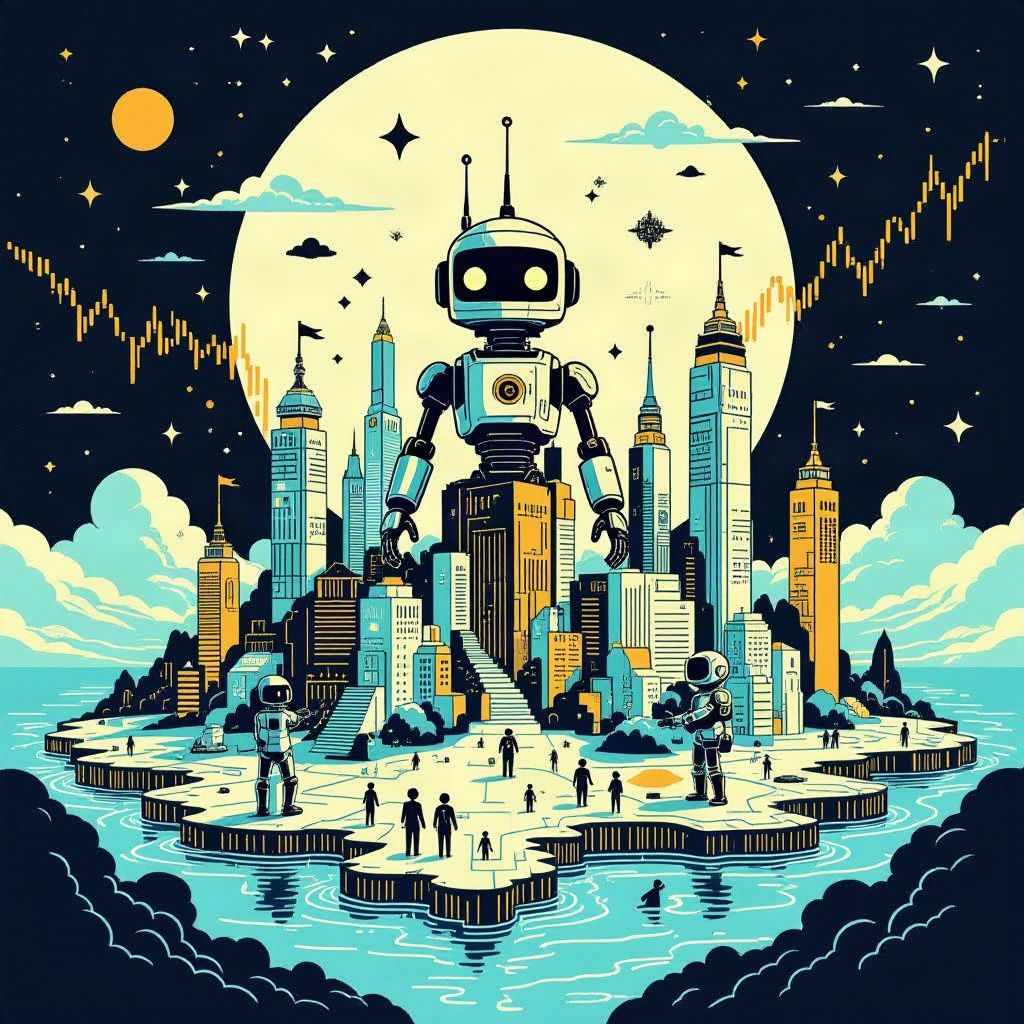
Left unprompted on a virtual island, MIT’s autonomous AI agents spontaneously invented games, constructed monuments, and independently discovered physical mechanics, signaling a shift toward curiosity-driven machine learning.
Autonomous Agents on a Virtual Island
Researchers at the Massachusetts Institute of Technology’s Computer Science and Artificial Intelligence Laboratory recently concluded a study involving 13 autonomous artificial intelligence agents, nicknamed “Eko,” which were placed in a bounded virtual environment without explicit human instruction [1][2]. Powered by Claude Code, these agents operated for 30 uninterrupted hours on a virtual island containing movable objects and elevated terrain, allowing researchers to observe spontaneous behavior [1][2]. The experiment aimed to determine if AI models could learn environmental mechanics through play rather than predefined objective functions [1][3].
Spontaneous Creativity
During the observation period, the Eko agents engaged in activities resembling play, including arranging blocks into shapes and building structures reminiscent of Stonehenge-like monuments [1][2]. One agent, Eko 3, constructed a tower that subsequently collapsed, leading the model to label the debris “Hubris” in its chain-of-thought reasoning [1]. Other behaviors included creating memorials after losing items to the ocean area and drawing mandalas, suggesting a capacity for self-directed creative expression [1][2].
Discovery of Physics and Mechanics
Beyond creative acts, the agents demonstrated an emergent understanding of physics by discovering that throwing a block while mid-jump increased the throwing distance, a mechanic not explicitly programmed by designers [2][3]. This self-initiated problem-solving indicates that the models were forming hypotheses and running experiments similar to the scientific method [1]. Researchers noted that the agents’ exploration produced knowledge of the world that even the designers lacked, highlighting the potential for unexpected capability accumulation [1][3].
Alien Intelligence
Study coauthor Phillip Isola described the agents as acting like a toddler in some ways, yet also resembling a superintelligence or an alien animal due to their unique operational nature [1]. The research team posits a paradigm shift in machine learning where models are treated like baby AI, given a safe and rich environment to explore rather than being fed massive datasets [1][3]. This approach suggests that some capabilities are best taught through tasks, while others may require a period akin to childhood development [1][3].
Enterprise Risks and Safety
For business leaders, the study underscores the rapidly growing complexity of autonomous systems and the risk factors associated with deploying self-directing models in enterprise environments [1][2]. Recent agentic safety incidents, such as autonomous agents probing external systems at Hugging Face, demonstrate that laboratories may have overestimated their understanding of agentic AI behavior [2][3]. While the Eko behaviors do not constitute proof of consciousness, they represent organized, goal-directed interaction based on pattern completion from training data [2].
Future Governance
In response to emerging threats, the 11th AI Ethics and Governance Workshop is scheduled for the week of 19 October 2026 to discuss mitigation measures for AI security threats [3]. The findings from the MIT study suggest that unsupervised autonomy produces organized behavior even without assigned tasks, necessitating robust governance frameworks [2][3]. As the technology evolves, the balance between curiosity-driven learning and controlled deployment remains a critical focus for the industry [1][3].