Federal Reserve Policy Debate Deepens as Officials Split on Interest Rates
Washington, Wednesday, 19 August 2026.
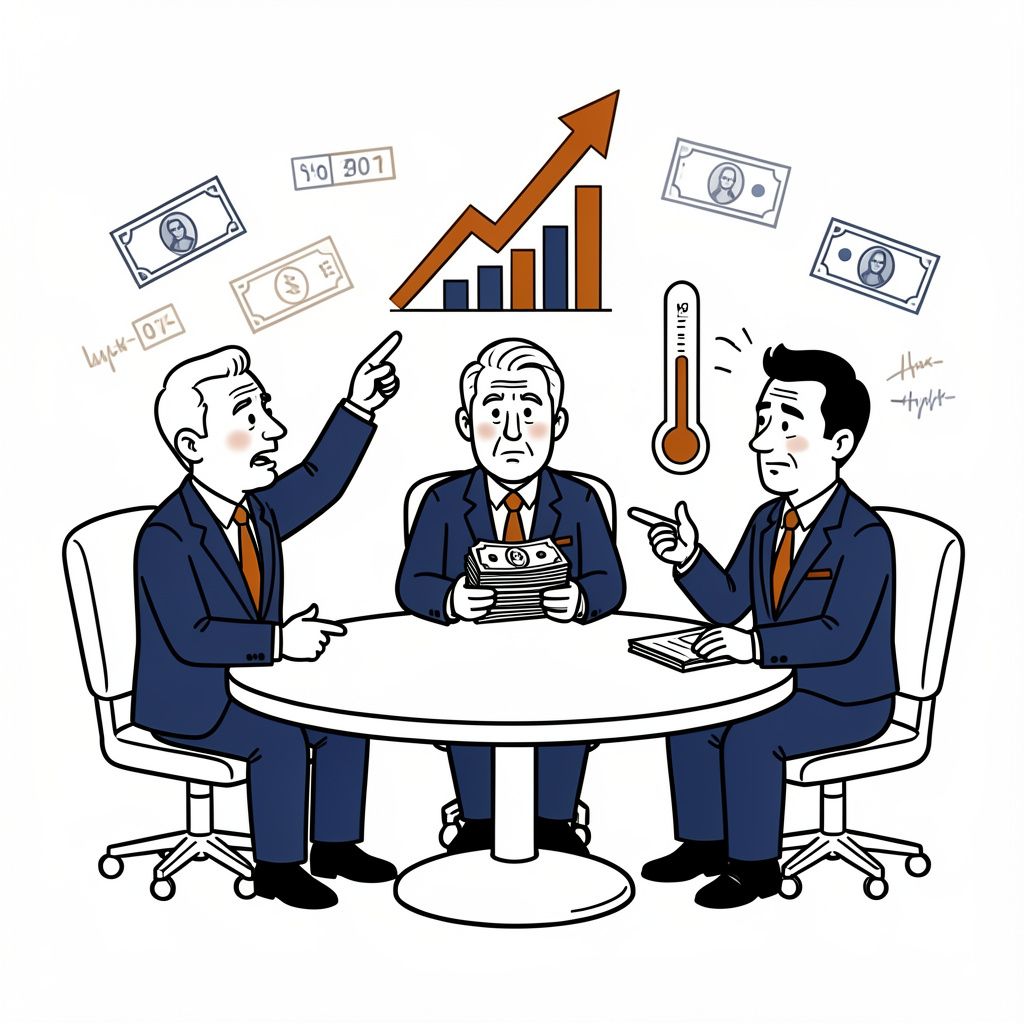
Federal Reserve meeting minutes revealed a rare three-way dissent favoring higher interest rates, highlighting growing central bank debate over lingering energy inflation risks despite cooling economic data.
Federal Reserve Policy Debate Deepens as Officials Split on Interest Rates
Federal Reserve meeting minutes revealed a rare three-way dissent favoring higher interest rates, highlighting growing central bank debate over lingering energy inflation risks despite cooling economic data. The Federal Reserve is scheduled to release the detailed minutes from its July monetary policy meeting on August 19 in Washington, giving executives and markets deeper insight into central bank deliberations [1][2]. The document follows a policy meeting where officials voted 9-to-3 to maintain interest rates, highlighting growing dissent among policymakers regarding economic growth and inflation dynamics [1][2]. Market participants are analyzing the release alongside corporate earnings from major retailers, including Target (TGT) and Lowe’s (LOW), to assess consumer spending health and future interest rate trajectories [1].
Monetary Policy Divergence and Meeting Details
The Federal Reserve FOMC minutes from the July 28-29, 2026 meeting are scheduled for release on Wednesday, August 19, 2026, at 14:00 ET [2]. During the July 28-29, 2026 meeting, the Federal Reserve maintained the target interest rate range at 3.50% to 3.75% for the fifth consecutive meeting [2][3]. Three voting members dissented during the July meeting in favor of a rate hike, a significant split given Chair Warsh’s stated policy of providing minimal forward guidance [2]. Market participants are monitoring the minutes for discussions regarding the inflationary impact of elevated oil prices linked to the closure of the Strait of Hormuz and broader Middle East tensions [3][5].
Economic Data and Inflation Dynamics
Economic data released since the July 28-29, 2026 meeting indicates a cooling economy, specifically citing negative July payroll figures, weaker retail sales, and softer consumer sentiment [2]. US July inflation cooled to 2.5% y/y, the lowest since March 2021, while July’s comparable rose 4.4% [4]. Additionally, economic data released post-meeting reveals a negative July payroll report, a contraction in the labor force, a 0.6% decline in retail sales, and a sharp drop in preliminary consumer sentiment readings [3]. These figures suggest a complex landscape where inflation moderates but geopolitical risks persist.
Retail Earnings as Economic Barometer
Asking for a Trend Host Josh Lipton previews several of the biggest stories to come tomorrow, Wednesday, August 19, including earnings from major retailers [1]. Investors will be looking for proof that the retailer’s recent improvement has staying power, with stock up over 20% over the past three months [1]. Heading over to home improvement, Lowe’s posting Q2 results Wednesday morning, coming after rival Home Depot posting higher sales and backing its outlook [1]. Analysts expecting same store sales to improve from last quarter, but traffic remains a key question [1]. This data is critical for validating consumer resilience amidst rate uncertainty.
Market Implications and Future Trajectory
Markets are pricing a high probability of a rate hike for the upcoming Federal Reserve meeting in September 2026 [3]. Federal funds rate futures as of August 14, 2026, implied 1.5 rate hikes over the next 12 months; market odds of a September rate hike dropped to roughly 33% from over 50% [4]. This represents a 17 percentage point decrease in probability, reflecting shifting sentiment [4]. A hawkish tone in the minutes regarding energy-driven inflation risks is projected to increase Treasury yields and bolster the U.S. dollar, while a more measured tone may alleviate pressure on rate-sensitive equity sectors [3]. The annual Jackson Hole economic symposium is upcoming, where market expectations for Fed Chair Warsh to provide guidance are high despite his established playbook of saying as little as possible [2].