EU Elevates Vietnam Relations to Secure Critical Minerals and Tech Supply Chains
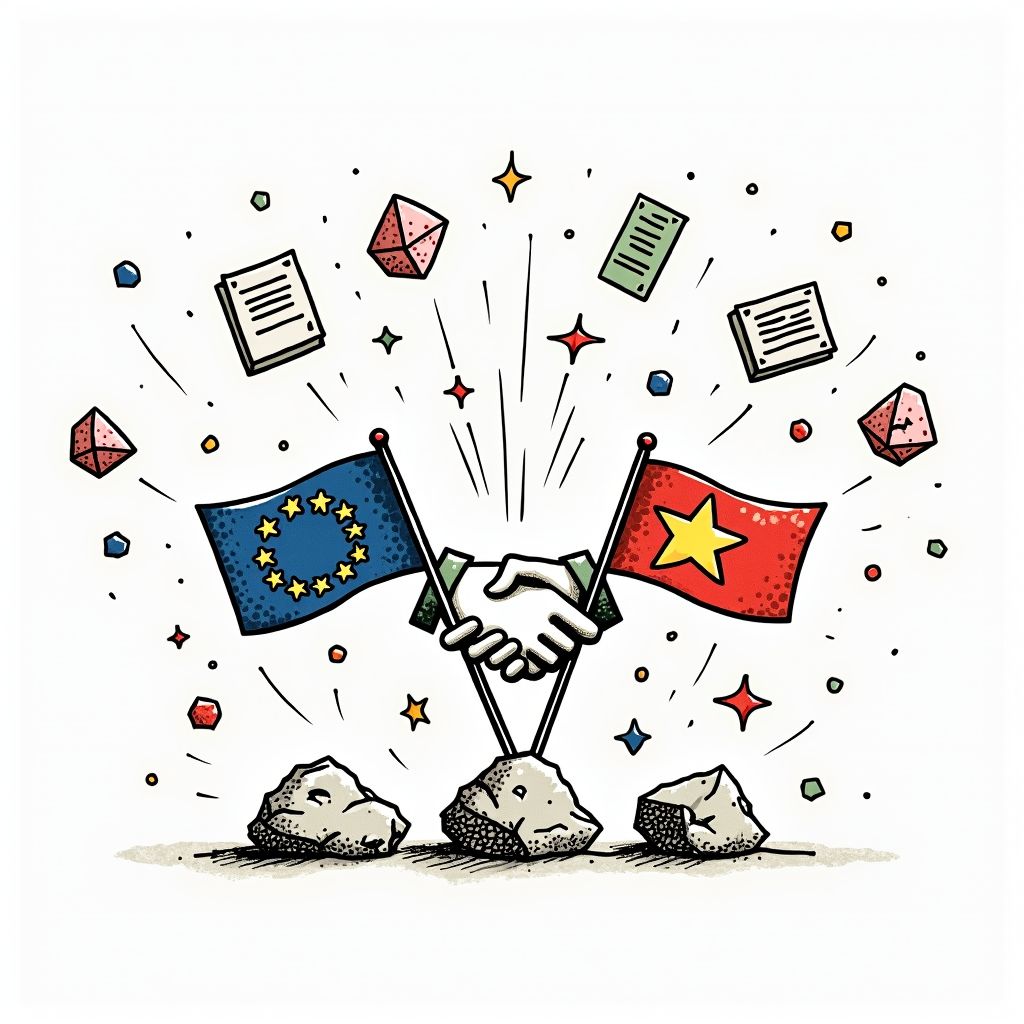
Hanoi, Friday, 30 January 2026.
Matching the diplomatic status of the U.S. and China, this strategic upgrade grants the EU crucial access to Vietnam’s semiconductor and mineral resources, diversifying supply chains against global risks.
A Historic Diplomatic Upgrade
On Thursday, January 29, 2026, the European Union and Vietnam officially elevated their bilateral relationship to a “Comprehensive Strategic Partnership,” the highest diplomatic designation Hanoi offers to foreign nations [2][4]. This significant move, finalized during European Council President António Costa’s visit to Hanoi, places the EU on the same diplomatic tier as the United States, China, and Russia [2][5]. The upgrade is described by Vietnamese President Luong Cuong as a “historical milestone,” reflecting a shared ambition to deepen ties amidst a fracturing global order [3]. While the agreement entails no binding commitments, it carries substantial political weight, signaling Brussels’ intent to solidify its footprint in Southeast Asia’s most dynamic manufacturing hub [3][5].
Economic Resilience Amidst Global Headwinds
The diplomatic elevation comes as both economies seek to recalibrate their trade strategies in response to global disruptions and rising protectionism [2]. Vietnam has firmly established itself as the EU’s largest trading partner in Southeast Asia [2][5]. In the first 11 months of 2025 alone, bilateral trade volume reached $66.8 billion, representing a year-on-year increase of 6.6% [2][5]. This growth underscores Vietnam’s critical role as a beneficiary of supply chain diversification, as multinational firms continue to shift production away from China to mitigate geopolitical risks [2]. However, this export-led success has drawn scrutiny regarding market access and trade surpluses, issues this new partnership framework aims to address through closer cooperation [2].
Strategic Resources and Digital Infrastructure
A central pillar of the upgraded partnership is the security of supply chains for the technology and energy sectors. According to joint statements and draft documents, the EU and Vietnam are prioritizing cooperation on critical minerals, specifically promoting investment in sustainable mining and processing [1]. Vietnam holds deposits of rare earths and gallium and is already a key global supplier of tungsten, resources essential for Europe’s green and digital transitions [1]. Furthermore, the partnership outlines deeper collaboration in semiconductor manufacturing and the development of “trusted” 5G communications infrastructure [1][3]. This focus on “trusted” networks is particularly notable given that Hanoi awarded 5G construction contracts to Chinese companies, including Huawei, in 2025 [1].
Navigating a Polarized Global Order
The agreement also highlights the delicate geopolitical balancing act Vietnam performs, often referred to as “bamboo diplomacy.” The announcement follows the January 23, 2026, re-election of Communist Party General Secretary To Lam, who has championed aggressive economic reforms [2][5]. For the EU, the partnership is a mechanism to defend the “international rules-based order” which President Costa noted is “under threat from multiple sides” [2][3]. Beyond trade, the two sides have committed to exploring cooperation in defense, maritime security, and the potential transfer of “non-sensitive technology” to Hanoi [1][3]. European nations also expressed interest in investing in Vietnam’s infrastructure, including its planned nationwide high-speed railway network [1].