How Space Solar Power Is Fueling a Two Trillion Dollar Industry
New York, Saturday, 12 September 2026.
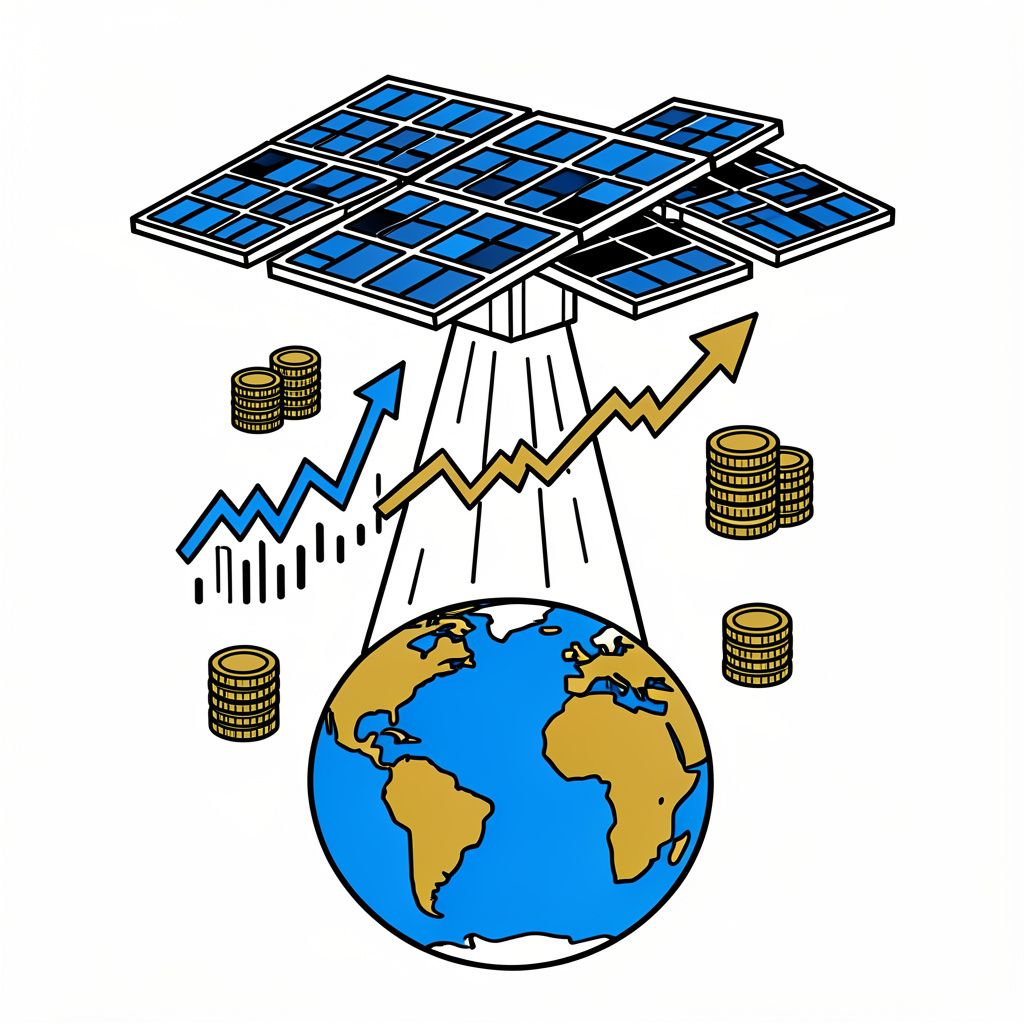
Rapid advancements in orbital solar power are reshaping space operations, positioning the global space economy to reach $2 trillion by 2040 as energy demand accelerates.
Market Valuation and Investment Trends
Professional services firm PwC projects the global space economy could reach a valuation of $2 trillion by 2040, driven largely by renewable energy projects and infrastructure expansion [1][4]. This represents a significant increase from the $686 billion estimated for 2025, implying a growth gap of 1314 billion over the 15-year period [1]. The Space Foundation reported that the sector marked an annual growth rate of 12% leading into this period, signaling robust expansion [1][4]. Private capital is aggressively funding this growth, with $28.7 billion flowing to space enterprises in April 2026 alone [1][4]. Such liquidity indicates strong investor confidence in the commercial viability of orbital operations and energy systems [4].
Investment Momentum and Government Support
Government agencies are complementing private investment with targeted funding opportunities to accelerate development [1]. On August 31, 2026, the U.S. Department of Energy announced a $12 million grant opportunity for the Space Photovoltaic Research and Development Program [1][4]. Applications for this program remain open until October 8, 2026, highlighting the immediate priority placed on energy technology [1]. Established entities involved in space operations, including NASA and the European Space Agency (ESA), are actively scouting commercial partners to support these initiatives [1][4]. This public-private collaboration is essential for mitigating the high initial costs associated with space infrastructure [3].
Technological Breakthroughs and Supply Chain
Technological innovation is critical to reducing costs and improving efficiency in orbit [5]. On September 10, 2026, Rocket Lab Corporation announced the production release of its Inverted Metamorphic (IMM) Apex solar cell, which eliminates reliance on germanium substrates [5]. This new cell delivers a beginning-of-life solar conversion efficiency of 31.5% and achieves a 40% reduction in cell mass compared to legacy products [5]. Supply chain diversification is also evident in corporate maneuvers, such as York Space Systems acquiring space-solar developer Solestial for $67 million in cash and stock on May 20, 2026 [1][4]. These developments aim to lower the barrier to entry for satellite builders and constellation developers [5].
Logistics and Launch Economics
The economic feasibility of deploying heavy materials into orbit is improving due to falling launch costs [1]. Data indicates that launch costs have reached approximately $2,000 per kilogram or less over the last 15 years, making large-scale deployment financially viable [1][4]. Despite these improvements, deploying heavy materials into orbit remains a logistical hurdle that requires continued innovation [1]. Companies are engineering cells as drop-in replacements for heritage germanium-based cells to facilitate easier adoption without major capital investments [5]. This compatibility enables spacecraft integrators to adopt new chemistry without redesigning existing solar array configurations [5].
Lunar Infrastructure and Demand Drivers
The cislunar orbit, the zone between Earth and the Moon, is identified as a particularly promising region for growth [1]. A PwC 2026 lunar market assessment models prospective surface activity from 2026 through 2050, projecting cumulative lunar revenue to range from approximately $93.9 billion to $127.3 billion [3]. This demand is driven by critical infrastructure systems including transportation, energy, communications, and life support [3]. The 2020 study by the Science and Technology Policy Institute at the Institute for Defense Analyses concluded that government expenditures and transportation costs are the dominant economic variables [3]. Current plans from NASA, ESA, and China aim to establish bases and stations between 2030 and 2035, further cementing this trajectory [3].
Strategic Infrastructure and Interoperability
Interoperable infrastructure is prioritized over isolated hardware to drive recurring service demand [3]. DARPA’s LunA-10 study examined whether independently developed commercial systems could form interoperable lunar infrastructure [3]. ESA’s Moonlight program aims to establish a five-satellite lunar communications and navigation system with full operations by 2030 [3]. Additionally, ULA’s vision of a self-sustaining cislunar economy culminates in Space-Based Solar Power Stations and rotating orbital colonies [2]. These strategic plans underscore the shift from government ownership toward government purchase of commercial outcomes [3].
Strategic Outlook and Challenges
Despite the optimism, technical hurdles remain for certain technologies like perovskite photovoltaics, where long-term durability and reliability are key concerns [1]. While conversion efficiencies are approaching 30%, the ultimate scale and significance of space solar are only beginning to come into focus [1][4]. Analysts note that space solar is at the frontier of research, with mission schedules and crew activity subject to technical, financial, and political change [1][3]. However, the Space Foundation describes space solar as a foundational technology for the continued expansion of orbital operations [1].
Long-Term Economic Projections
Forecasts for lunar economic value are explicitly conditional on variables including mission cadence and infrastructure utilization [3]. No published evidence as of September 2, 2026, demonstrates that the diversified stage of the lunar economy is inevitable, though a credible route exists [3]. The transition to a self-supporting lunar economy depends on service markets generating enough activity to attract private customers beyond initial institutional budgets [3]. Projections for this transition currently span 2040 to 2050 or later, requiring sustained commitment from global business leaders [3][4].