Extreme European Drought Forces Nuclear Closures and Detonations Along the Danube
Budapest, Thursday, 6 August 2026.
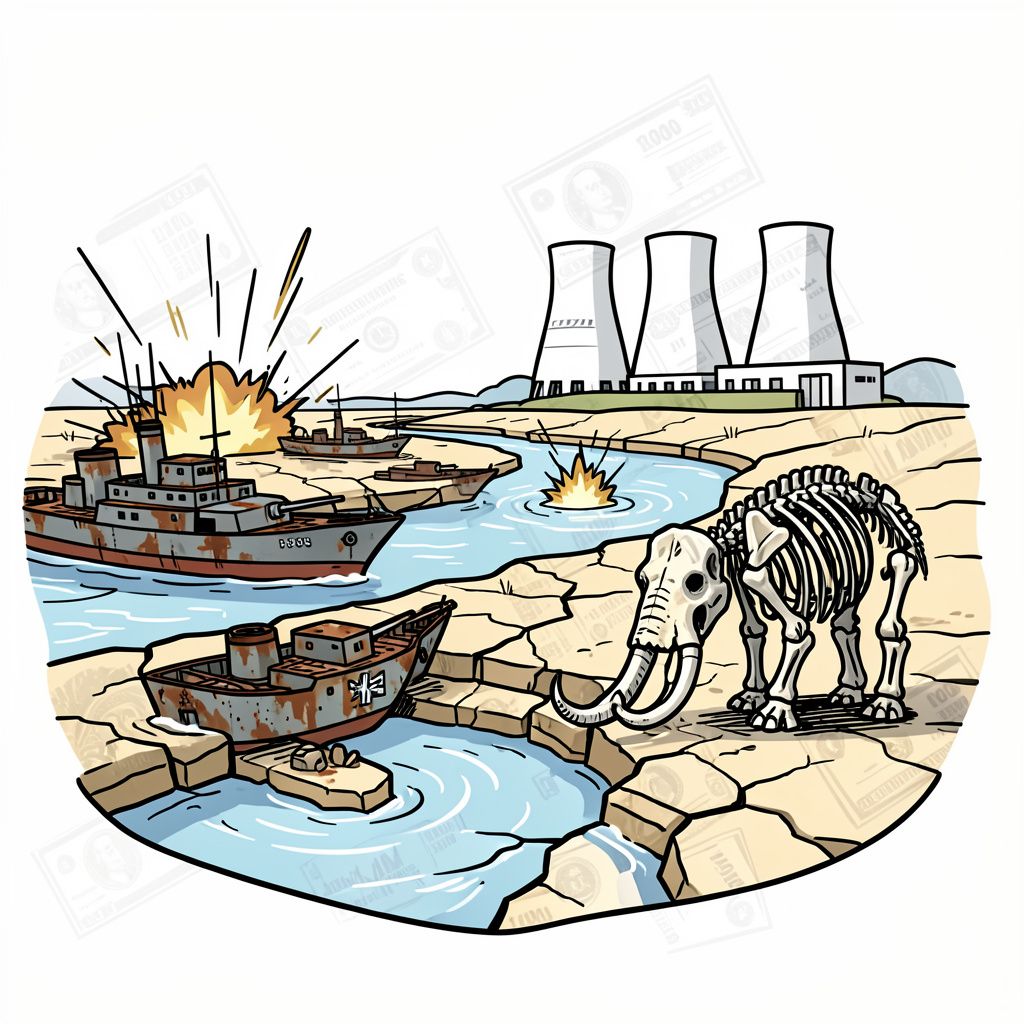
In August 2026, a historic drought severely depleted Europe’s major waterways, causing widespread industrial and energy disruptions across the continent. Water levels dropped so low that nuclear power plants in Hungary and Romania were forced to cut output or shut down entirely, prompting the Romanian Navy to detonate underwater explosives on the Danube to clear channels for reactor cooling water. Beyond threatening electricity grids and straining freight logistics, the drying riverbed exposed extraordinary artifacts, including scuttled World War II German warships and prehistoric woolly mammoth fossils.
Nuclear and Hydroelectric Capacity Compromised
The energy sector faces immediate strain as cooling water shortages force significant output reductions across Central Europe. Hungary’s Paks nuclear power plant, which typically supplies nearly half of the nation’s electricity, reduced its output to 240 megawatts from a standard capacity of 2,000 megawatts due to insufficient water levels in the Danube [1][4]. This reduction represents a capacity loss of 88 percent, prompting government officials to appeal to citizens for voluntary electricity conservation during peak evening hours [1]. Simultaneously, Romania’s Cernavoda nuclear plant, responsible for approximately 20 percent of the country’s power, was forced to shut down one of its reactors entirely [1][4].
Nuclear and Hydroelectric Capacity Compromised
In a desperate bid to maintain operations, Romanian authorities conducted controlled underwater explosions on the Bala channel on 3 August 2026 to redirect cooling water to the Cernavoda facility [3][4]. Serbia has also reported reductions in hydroelectric generation capacity, with some plants operating at merely 20 percent of normal output due to the record-low river levels [1]. These disruptions highlight the vulnerability of thermal and nuclear power infrastructure to hydrological changes, with energy security now directly linked to river flow rates across the region [4].
Inland Shipping Faces Historic Bottlenecks
Logistics networks are experiencing severe congestion as water levels drop below navigational thresholds. At Kaub, Germany, a critical choke point on the Rhine River, water levels fell to 24 centimeters on 3 and 4 August 2026, marking the lowest recorded levels since 1880 [4]. Consequently, cargo vessels are restricted to operating at approximately 20 percent of their normal capacity, forcing barges that typically carry 2,000 to 2,500 metric tons to limit loads to between 400 and 600 metric tons [1]. This bottlenecking effect is compounding delays for manufacturing and agriculture sectors reliant on inland waterway transportation.
Inland Shipping Faces Historic Bottlenecks
The disruption extends beyond freight capacity to passenger safety and scheduling. In Vidin, Bulgaria, nearly 200 tourists required evacuation from a cruise ship that became stranded on a shoal due to the receding waters [1][2]. Additionally, ferry services and grain barges between Vienna and Budapest have been suspended as water levels in Budapest dropped to 41 centimeters, approaching the all-time low of 49 centimeters set in 2018 [3]. Transport experts warn that capacity will remain constrained throughout August 2026 as water levels are unlikely to rise above critical thresholds in the immediate future [4].
Archaeological and Environmental Revelations
As the water recedes, the drought has unveiled historical artifacts previously submerged for decades. Near Prahovo, Serbia, at least 20 World War II-era German warships have emerged from the riverbed, having been scuttled in September 1944 to obstruct Soviet advances [1][5]. Historians estimate that up to 200 German warships were intentionally sunk in this gorge prior to Nazi Germany’s surrender in May 1945 [1]. In Bulgaria, the low water levels also revealed woolly mammoth remains, including a jawbone and tusk fragments, near Ryahovo [1].
Economic Forecasts and Mitigation Strategies
The economic ramifications of the drought are projected to be substantial, with research indicating that one month of low water on the Rhine reduces German industrial production by approximately 1 percent [3]. Professor Stefan Kooths of the Kiel Institute for the World Economy estimates that the current conditions could dampen German GDP by up to 0.2 percent in the third quarter of 2026, translating to a value-added loss between 1 and 2 billion euros [4]. Broader analysis suggests climate-related events caused at least €43 billion in short-term losses across EU regions in the previous summer, with projections reaching €126 billion by 2029 [3].
Economic Forecasts and Mitigation Strategies
Mitigation efforts are underway, but manufacturers are already adjusting operations to cope with the dual pressures of energy shortages and logistics delays. Two Romanian car manufacturing plants, Dacia and Ford, agreed to halt production for over 14 days to lower national electricity consumption [1]. With water levels on the Danube not expected to rise significantly in the coming weeks, industries dependent on river transport and cooling water must reorganize supply chains to mitigate further economic contraction [1][4].