Floating Ships Could Power Homes and Run Artificial Intelligence at Sea
San Francisco, Saturday, 5 September 2026.
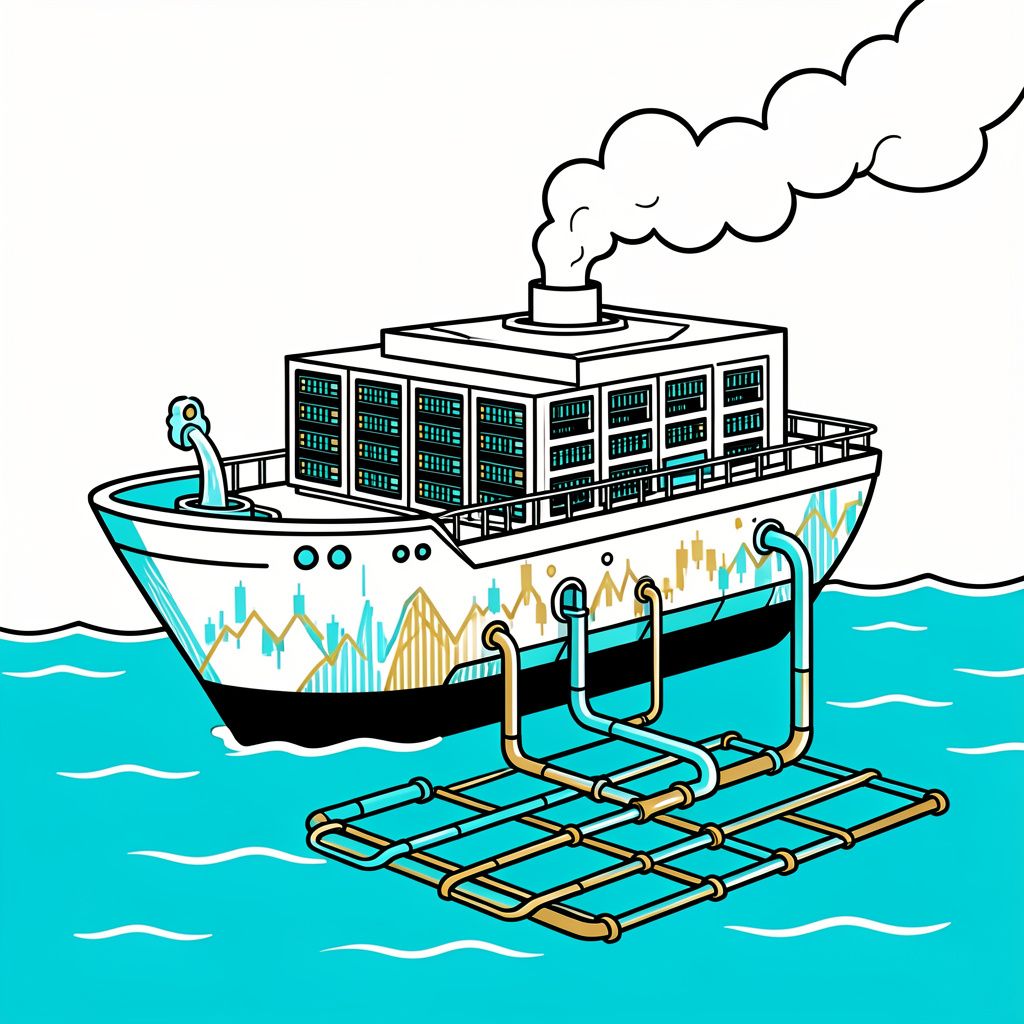
Innovative offshore vessels like the Kraaken project use server heat and seawater to run data centers while supplying coastal regions with power and millions of liters of fresh water daily.
The Kraaken Concept and Operational Specifications
In July 2026, the partnership known as Optimal Transit, comprising InMar Technologies and OptiFuel Systems, unveiled the initial concept for the Blue Economy VITAL 100 MW Kraaken [1]. This floating infrastructure platform is designed to function as a self-powered facility that integrates AI-grade data center capacity with onboard power generation and desalination systems [1]. The vessel is engineered to generate 100 MW of total capacity, retaining 60 MW for high-density computing while exporting 40 MW of electricity to coastal grids [1]. This exported power is sufficient to supply approximately 32,000 homes, addressing regional energy demands without relying on conventional land-based grids [1]. Additionally, the onboard desalination system produces 30 million liters of fresh water daily, supporting an estimated 150,000 people [1].
Thermal Engineering and Efficiency
The core technology driving the Kraaken vessel is a patented Digital Ocean Thermal (DOT) engine, which is a modified Ocean Thermal Energy Conversion (OTEC) system [1]. This system utilizes warm surface seawater at approximately 25 °C to vaporize ammonia, a process that is supercharged by integrating waste heat from liquid-cooled servers operating at around 45 °C via an Ammonia Heat Exchange Bus [1]. By leveraging this thermal differential, the platform requires no land, no grid connection, and no conventional fuel to operate [1]. The vessel utilizes a Small Waterplane Area Twin Hull (SWATH) design, with the 100-MW variant measuring approximately 91 meters in length and weighing 50,000 long tons [1]. In the event of severe weather, the platform can detach from its mooring within hours and move at speeds of up to 16 knots to ensure safety [1].
Economic Viability and Deployment
Optimal Transit estimates an all-in cost of US$587 million per VITAL vessel, claiming this represents a significant reduction compared to equivalent land-based facilities [1]. When compared to the lower-end estimate of US$750 million for land-based equivalents, the cost reduction is calculated as 21.733 percent [1]. The company asserts that this modular approach reduces deployment time to approximately three years, whereas land-based equivalents typically require six to 10 years [1]. While the initial concept was unveiled in July 2026, production plans are contingent on a proposed Series B funding round scheduled for 2027 [1]. No specific launch or deployment date has been provided for the first operational unit [1].
Broader Industry Trends
The Kraaken project emerges amidst a wider industry interest in offshore compute infrastructure, with other major entities exploring similar maritime solutions. For instance, Samsung Heavy Industries is also reported to be working on floating data centers that utilize seawater for cooling to ease power grid stress [3][4]. These parallel developments suggest a growing recognition of the ocean’s potential to mitigate land-use constraints and manage the thermal loads associated with modern AI workloads [3][4]. However, unlike the Kraaken project which aims for full energy independence via OTEC, other industry efforts often focus primarily on cooling and location rather than integrated power generation [3][4].