Mounting AI Building Costs Spark Investor Concerns Over Tech Spending
New York, Monday, 16 November 2026.
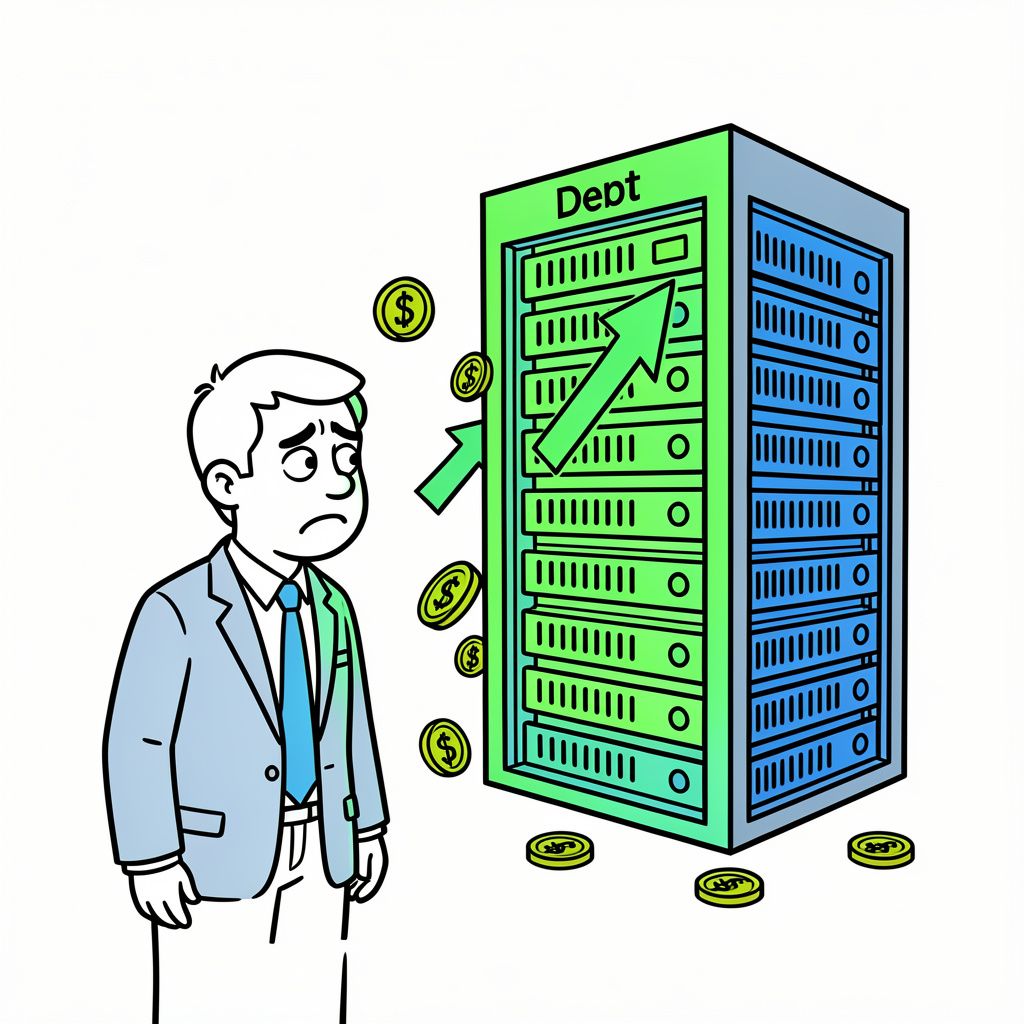
Unprecedented data center investments have outpaced cash flows, turning the tech industry’s massive spending cycle into a broader debt market test with negative free cash flow projected by 2027.
The AI Infrastructure Investment Gap: When Spending Outpaces Cash Flows
As of mid-November 2026, the technology sector is confronting a critical inflection point: unprecedented capital expenditures on AI infrastructure have far outstripped the ability of leading firms to generate corresponding cash flows. Leading mega-cap technology companies—including Alphabet, Amazon, Meta, Microsoft, Oracle, and SpaceX—are projected to see their combined capital expenditure estimates for 2027 rise 131% since December 2025, approaching USD 1.5 trillion [5]. Yet, consensus forecasts indicate that free cash flow across these same companies swung from approximately USD 165 billion in June 2025 to roughly negative USD 237 billion by the end of 2026 [5]. This reversal underscores a widening investment gap: capital outflows are accelerating faster than earnings materialize, raising concerns about long-term sustainability and balance sheet strain. The strain is no longer isolated to a few players; it is becoming a systemic feature of the tech ecosystem as AI monetization timelines stretch into 2028 and beyond.
Anthropic’s IPO and the Valuation Conundrum in an AI-Driven Market
The imminent public debut of Anthropic, the first major pure-play AI developer to go public, has intensified investor scrutiny over whether AI-driven revenue can justify the sector’s colossal investment scale. Anthropic’s prospectus—filed just days ago—highlights transformative potential but also warns investors of strategic decisions that “may run counter to expectations,” including forward investments that “may seem irresponsibly large at first glance” [1]. The document underscores the inherent tension between near-term capital deployment and long-term monetization timelines. With Anthropic projecting nearly USD 16.3 billion in revenue during the first half of 2026—a 14-fold year-over-year increase—its infrastructure costs have surged to nearly USD 9 billion over the same period [2]. Meanwhile, the company has outlined spending commitments of nearly USD 800 billion over the next decade, though these projections remain subject to market and operational conditions [2]. This disconnect between revenue growth and infrastructure spending raises a pivotal question: Can AI monetization scale fast enough to cover the infrastructure bills currently being written?
Debt Markets as the Backbone of AI Expansion
To bridge the cash flow shortfall, technology firms are increasingly turning to debt markets. As of August 2026, Alphabet, Amazon, Meta, and Oracle had issued a combined USD 223 billion in U.S. corporate bonds, more than doubling the USD 108 billion issued in 2025 [4]. This surge reflects a broader shift: AI infrastructure financing now relies on a mix of public and private capital, including credit, equity, and structured financing [2]. Investment-grade technology bond spreads have surpassed the broader investment-grade market for the first time in years, signaling rising perceived risk despite strong revenue bases unrelated to AI [4]. Collin Martin of the Schwab Center for Financial Research cautions that while default risk for hyperscalers remains low due to market dominance, widening spreads could pressure secondary market valuations and investor portfolios [4]. The reliance on debt is not merely tactical—it is structural, as AI capital expenditures now outstrip cash flows generated by mega-cap tech, pushing credit into a central role in the economic cycle [5].
Prepayment Models and the Shift in Capital Deployment Risk
Amidst this debt-fueled expansion, a novel financing model is emerging: customer-funded capital expenditures. Nebius, a global AI infrastructure provider, recently guided for USD 40–45 billion in capital expenditure for 2027, with enterprise customer prepayments covering over 100% of associated costs in Q3 2026 [6]. This model shifts execution risk from demand uncertainty to delivery speed, compressing every link in the supply chain—from GPU fabrication to site readiness [6]. By converting forward-looking demand into committed capital before deployment, Nebius is redefining traditional financing flows in AI [6]. This approach, if successful, could become a blueprint for scalable AI infrastructure financing, but it also amplifies operational risk: a missed timeline could strand billions in prepaid capital while leaving customers waiting. As such, the viability of this model may hinge on whether supply chains can keep pace with hyperscaler-level deployment velocity.
Broader Economic Implications: Rates, Credit, and Real Yields
The AI capital expenditure cycle is no longer just a sectoral phenomenon—it is reshaping broader financial markets. U.S. 10-year real yields rose nearly a full percentage point between April and September 2026, a shift analysts attribute to AI-driven competition for capital and crowding-out effects in credit markets [5]. This tightening in real yields reflects increased demand for financing across the economy, with AI infrastructure competing for scarce resources. Meanwhile, compute-backed credit—including project bonds, chip-backed loans, and data center securitizations—has reached approximately USD 235 billion as of late 2026, with a base case of USD 1.8 trillion to be raised by 2030 [5]. However, resale prices for high-end AI chips (e.g., H100-class) have typically fallen by a third to a half within three years, while financing terms may extend five to seven years against leases of only three—raising concerns about asset-liability mismatches and refinancing risks [5]. These dynamics suggest that the AI capex cycle is not only an economic force but a potential catalyst for broader financial volatility.
Environmental and Regulatory Headwinds Complicate the Investment Thesis
Beyond financial concerns, the sustainability of AI infrastructure expansion is being challenged by regulatory and environmental constraints. In July 2026, New York State imposed a one-year moratorium on new, large data centers due to environmental impact concerns—particularly water and energy consumption [4]. This intervention, though localized, signals growing regulatory risks for hyperscalers and cloud providers planning aggressive build-outs. As data centers multiply—each consuming the equivalent of tens of thousands of homes in electricity—the sector faces increasing scrutiny over its climate footprint and resource allocation. These external pressures compound the financial strain, raising questions about whether the AI infrastructure boom can proceed at the projected scale without triggering regulatory pushback or public opposition.
Conclusion: A High-Stakes Test of Capital Allocation Discipline
As institutional investors and corporate leaders gather in late 2026, the tech sector stands at a crossroads. The AI infrastructure boom has unlocked transformative possibilities but also exposed critical vulnerabilities: unsustainable capital intensity, reliance on debt, and uncertain monetization timelines. While Anthropic’s impending IPO and Nebius’s prepayment model offer glimpses of innovation in financing, they also highlight the fragility of assumptions underpinning the entire cycle [1][2][6]. The broader economic impact—from rising real yields to tightening credit spreads—demonstrates that AI’s capital demands are no longer confined to technology balance sheets but are reverberating across global financial markets [4][5]. The central challenge for investors and policymakers alike will be distinguishing between durable growth and speculative excess in an era where the future of AI hinges not on technological possibility, but on financial sustainability.
Sources
- www.afr.com
- russellinvestments.com
- www.facebook.com
- www.schwab.com
- www.troweprice.com
- www.linkedin.com