Wall Street Exchanges Lose Billions as Continuous Perpetual Futures Trading Gains Traction
New York, Saturday, 22 August 2026.
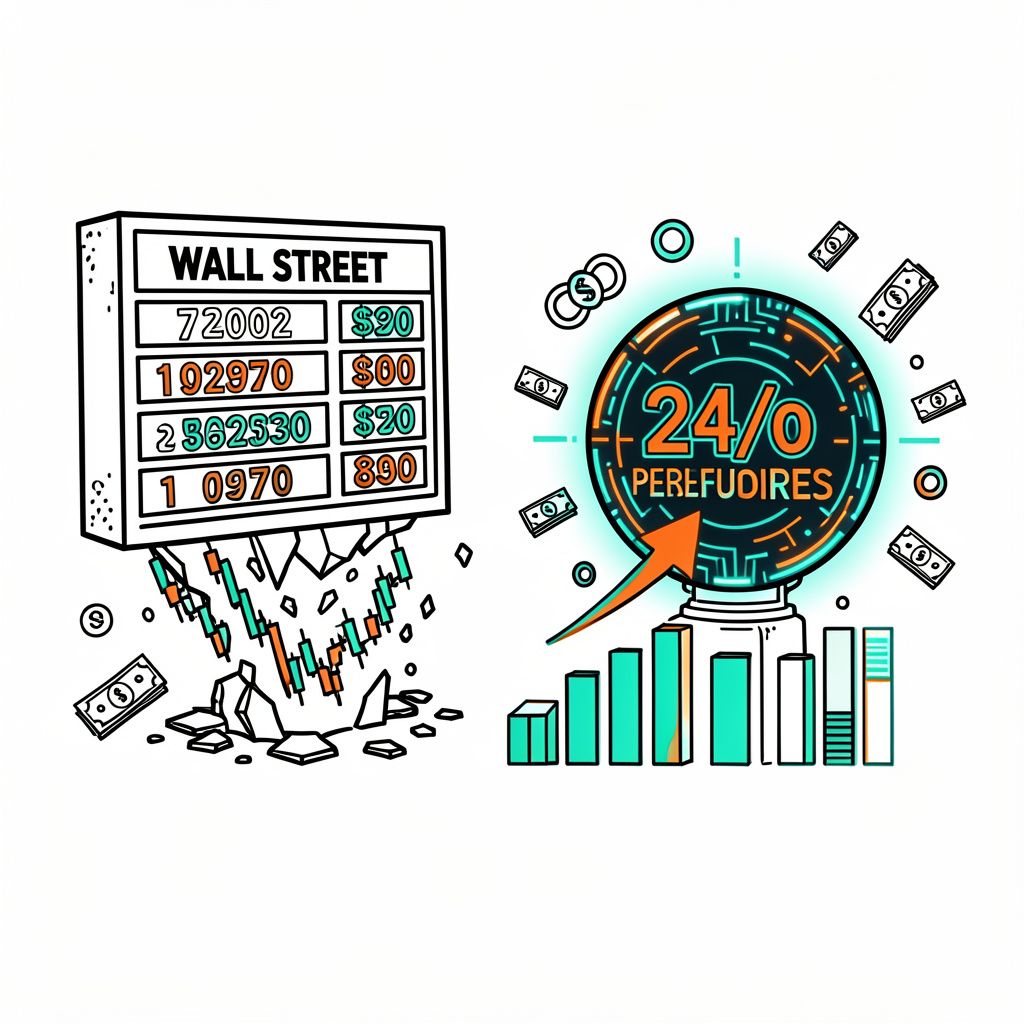
Traditional exchanges lost $18 billion in market value after potential regulatory pathways emerged for 24/7 perpetual futures, threatening traditional trading models that rely on expiring contracts.
Market Valuation Shock and Revenue Models
The financial impact on traditional exchanges has been immediate and severe, with major entities including CME Group, Cboe Global Markets, Intercontinental Exchange, and Miami International Holdings losing a combined $18 billion in market value over the two-day period ending 2026-08-19 [1]. This depreciation reflects investor anxiety over the potential erosion of revenue streams traditionally reliant on expiring derivatives contracts, which perpetual futures negate by eliminating expiration dates [1]. While perpetual futures trading in the U.S. has historically been restricted to cryptocurrencies, current trends indicate a potential expansion into traditional asset classes like stocks and commodities, threatening the core economics of established exchanges [1]. An anonymous board member of a publicly-traded exchange noted that traditional exchange economics could be in question as investors expect continuing access in an increasingly competitive market [1].
Regulatory Shifts and Presidential Commentary
Regulatory clarity began to emerge on 2026-08-19, when President Trump held a press conference discussing a potential path for the Commodity Futures Trading Commission (CFTC) to regulate Hyperliquid, a decentralized perpetual futures trading venue [1]. This development signals a potential pathway for decentralized venues to enter the U.S. market under a structured regulatory framework, a sentiment echoed in media coverage featuring Hyperliquid Strategies CEO David Schamis [2]. The pressure on regulators to adapt risk management protocols and liquidity frameworks is now immediate, as round-the-clock trading volumes surge beyond traditional market hours [1]. Institutional responses have varied, with some entities like ICE investing $200 million into OKX for a joint venture in March 2026, acknowledging the shift in landscape [1].
Institutional Defense and Legal Challenges
Incumbent exchanges are actively litigating to protect their market position, exemplified by CME CEO Terrence Duffy filing a lawsuit against the CFTC on 2026-06-17 regarding the approval of bitcoin perpetual futures on Kalshi [1]. The lawsuit argues that these products should be classified as swaps rather than futures to impose stricter capital, risk, and tax requirements [1]. Conversely, proponents argue that the characterization is driven by competition fears, with Kalshi communications head Diana Elisabeth stating that perpetual futures offer a cheaper, simpler product for the end consumer [1]. Despite the legal friction, institutional investments continue, such as Deutsche Borse Group’s $200 million stake in Kraken’s operator, Payward, in 2025 [1].
Trading Volumes and Revenue Trends
Total notional perpetual volume across centralized and decentralized exchanges averaged approximately $150 billion per day in 2026, a decline from the 2025 peak of near $200 billion per day [1]. Revenue metrics show divergent trends; Hyperliquid protocol revenue peaked at $357 million in 2025, dropping to $200 million in Q2 2026, representing a calculated decrease of -43.978 percent [1]. In contrast, Cboe recorded over $700 million in revenue in Q2 2026, a 25% year-over-year increase, suggesting traditional venues remain resilient despite the competitive pressure [1]. Trading in stock perpetuals like SpaceX and SK Hynix exploded this year, with TradeXYZ volume growing to just under $500 billion thanks to the popularity of real-world assets [1].