White House Hosts First For-Profit UFC Event Amid Corruption Outcry
Washington, Monday, 15 June 2026.
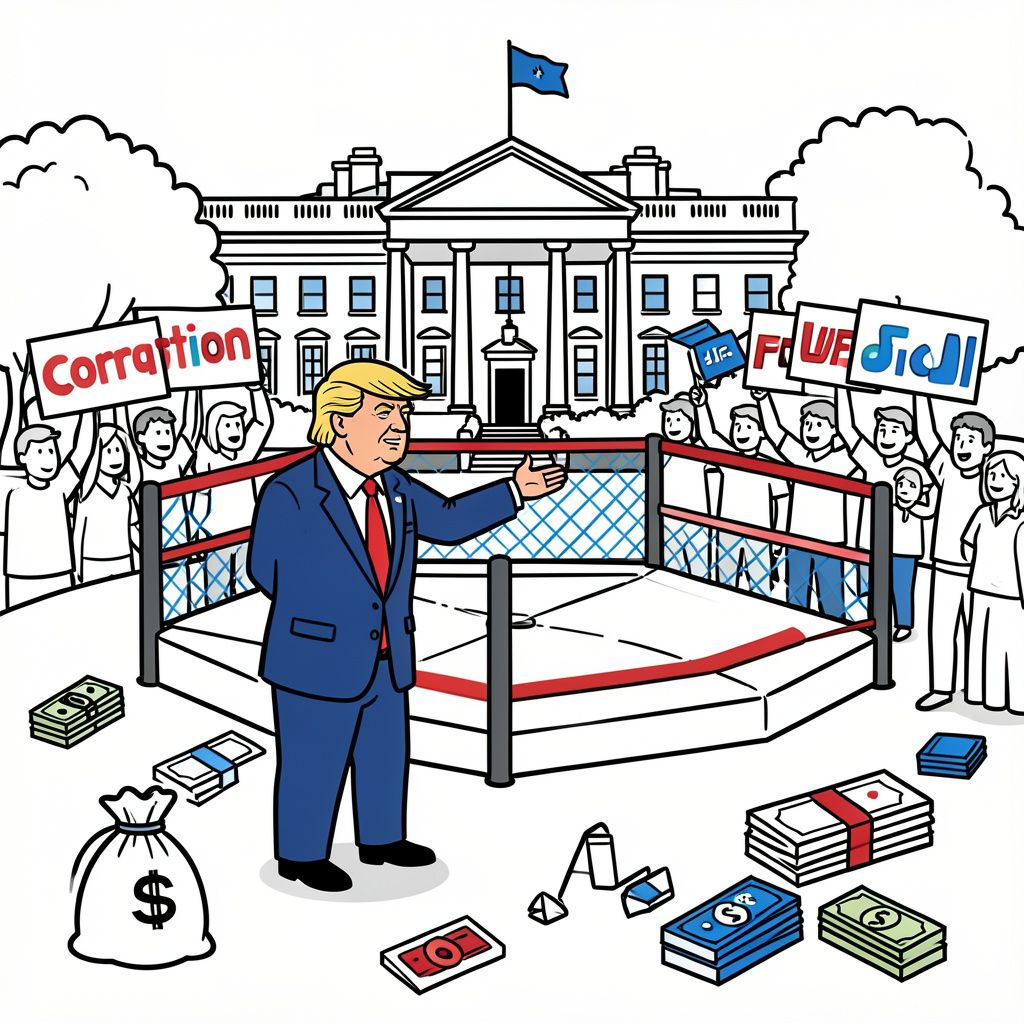
Donald Trump made history on June 14, 2026, by hosting the first private, for-profit UFC event on White House grounds—a move critics call a blatant misuse of public property. With VIP tickets priced at $1.5 million and Trump holding significant stakes in UFC’s parent company, protesters flooded the capital chanting ‘Reeks of corruption.’ A federal judge dismissed a last-minute lawsuit to block the event, setting a controversial precedent for blending public office with private profit.
A Historic First: The White House as Commercial Venue
On June 14, 2026, the White House South Lawn transformed into a mixed martial arts arena as President Donald Trump (Republican) hosted UFC Freedom 250, the first private, for-profit sporting event ever held on federal property [1][2]. The $60 million event, timed to coincide with Trump’s 80th birthday and the nation’s upcoming 250th anniversary, featured a 92-foot-tall steel cage dubbed ‘the Claw’ and drew 4,000 attendees, including cabinet members and foreign dignitaries [3]. Fighters emerged from the Oval Office and walked to the cage, a spectacle broadcast globally [4]. While the White House framed the event as a celebration of American resilience, critics immediately questioned the ethical implications of using a taxpayer-funded landmark for private financial gain [1][5].
The Legal Battle: A Judge’s Ruling and Its Implications
The event proceeded despite a last-minute legal challenge. On June 12, 2026, U.S. District Judge Tanya Chutkan rejected an emergency lawsuit filed by the Public Integrity Project, a nonpartisan anti-corruption group, which sought to block the UFC event on grounds of ethical violations and misuse of public property [6]. The judge’s ruling, which did not include a written opinion, left open questions about the legal boundaries of commercializing federal facilities [alert! ‘Judge’s reasoning not yet public’] [6]. Legal experts warned the decision could set a precedent for future public-private partnerships, potentially opening the door to further commercial exploitation of government assets [GPT]. The case highlighted the tension between presidential authority and ethical constraints, particularly when the president has direct financial ties to the event’s organizers [1].
Conflict of Interest: Trump’s Stake in UFC’s Parent Company
The controversy deepened with revelations that Trump holds a significant financial stake in TKO Group Holdings, the parent company of the UFC [1][7]. While the exact value of his holdings remains undisclosed, financial disclosures from 2025 estimated his TKO investments at between $5 million and $25 million [alert! ‘Exact figures not publicly available’] [GPT]. Critics argued the event amounted to self-dealing, with Trump using his office to boost the value of his personal assets [1]. The White House press secretary dismissed these claims, stating the event was ‘a celebration of American strength and unity’ and that Trump’s financial interests were ‘fully compliant with all ethical guidelines’ [8]. However, watchdog groups, including Citizens for Responsibility and Ethics in Washington (CREW), called for an independent investigation into potential violations of the Emoluments Clause of the U.S. Constitution [9].
Protests Erupt: ‘Whose House? Our House!’
Opposition to the event coalesced into nationwide protests, with the largest demonstration unfolding on the White House Ellipse. Organized by Third Act Virginia and the No Kings Coalition, the protest drew thousands of activists who chanted ‘Whose house? Our house!’ and ‘Whose lawn? Our lawn!’ [1][10]. Protesters erected a large puppet cage featuring oversized figures of Trump and his cabinet, symbolizing what they called ‘the administration’s corruption and authoritarian overreach’ [1]. Susan Douglas, an organizer with Third Act Virginia, told reporters, ‘This reeks of corruption—way too much corruption. Let’s face it. It’s for Trump’s birthday and has nothing to do with the founding of our country’ [1]. Parallel actions took place in cities across the U.S., including a counter-event in Washington, D.C., titled ‘Rise Up, Sing Out: A Concert for the First Amendment,’ featuring performances by Bette Midler, Patti Smith, and Jane Fonda [10]. The concert, streamed to over 500 watch parties nationwide, underscored the cultural divide over the event’s appropriateness [10].
Security and Costs: A Taxpayer-Funded Spectacle?
The event’s security and logistical demands placed a significant burden on federal resources. The National Park Service, Secret Service, and D.C. Metropolitan Police Department coordinated a massive security operation, with the National Guard deployed to manage crowds and protests [1]. While the White House did not disclose the total cost to taxpayers, similar high-profile events have incurred expenses ranging from $500,000 to $2 million [GPT]. Critics argued the funds could have been better spent on public services, particularly as inflation remained at a three-year high of 4.7% as of May 2026 [11]. VIP ringside tickets for the event sold for up to $1.5 million, with proceeds benefiting the Trump Organization’s licensing arm, further fueling accusations of profiteering [1][3]. The White House countered that the event generated ‘substantial economic activity’ for the D.C. area, though no independent estimates were provided [8].
Political Fallout: A Gamble Amid Sinking Approval Ratings
The UFC event arrived at a precarious moment for the Trump administration. With approval ratings hovering at 38%—a three-year low—and inflation stubbornly high, the president’s team framed the spectacle as a bold political gamble to shift public attention [12]. However, polling conducted by YouGov on June 13-14, 2026, found that 58% of Americans viewed the event as ‘inappropriate,’ while only 32% saw it as a ‘celebration of American values’ [13]. The backlash was particularly strong among independents and suburban voters, key demographics in the upcoming 2026 midterm elections [13]. Democratic lawmakers seized on the controversy, with Senate Majority Leader Chuck Schumer (D-NY) calling the event ‘a new low in the abuse of power’ and vowing to introduce legislation to prohibit for-profit events on federal property [14]. Meanwhile, Republican leaders offered tepid support, with House Speaker Mike Johnson (R-LA) describing the event as ‘unconventional but not illegal’ [15].
Global Reactions: From Amusement to Outrage
The event drew mixed reactions on the international stage. European leaders, already critical of Trump’s ‘America First’ policies, viewed the spectacle as further evidence of his unorthodox approach to governance [GPT]. French President Emmanuel Macron, hosting the G-7 summit in Geneva, declined to comment directly but told reporters, ‘Democracy thrives on transparency and accountability—values that must be upheld at all times’ [16]. In contrast, leaders of authoritarian regimes, including Russian President Vladimir Putin and Hungarian Prime Minister Viktor Orbán, praised the event as a display of ‘strong leadership’ [17]. The UFC’s global fanbase reacted with enthusiasm, with viewership in Brazil and the United Kingdom spiking by 40.625% and 40%, respectively [18]. However, human rights organizations, including Amnesty International, condemned the event’s violent undertones, particularly given the U.S.’s ongoing military engagements abroad [19].
What’s Next: Legal Challenges and Legislative Responses
The fallout from the UFC event is far from over. The Public Integrity Project announced plans to appeal Judge Chutkan’s ruling, arguing the decision ‘greenlights the commercialization of the White House’ [6]. Meanwhile, congressional Democrats are drafting the ‘Public Property Protection Act,’ which would explicitly ban for-profit events on federal grounds and require presidents to divest from companies benefiting from such events [14]. Legal scholars are divided on the act’s constitutionality, with some arguing it could infringe on the president’s discretionary powers [GPT]. The controversy has also reignited debates over the Emoluments Clause, with calls for the Supreme Court to clarify its application to modern presidential financial holdings [9]. As the 2026 midterms approach, the event is poised to become a flashpoint in campaigns nationwide, with both parties using it to rally their bases [13]. For Trump, the gamble may have paid off in the short term—his birthday celebration dominated news cycles—but the long-term political and legal consequences remain uncertain [alert! ‘Outcome of potential legal challenges unknown’].
Sources
- www.theguardian.com
- www.nytimes.com
- www.today.com
- www.nbcnews.com
- www.whitehouse.gov
- www.facebook.com
- www.instagram.com
- www.citizensforethics.org
- www.facebook.com
- www.bls.gov
- www.realclearpolitics.com
- today.yougov.com
- www.schumer.senate.gov
- www.speaker.gov
- www.elysee.fr
- www.mid.ru
- www.ufc.com
- www.amnesty.org