United States Accuses Forty Countries of Helping China Bypass Import Duties
Washington, Friday, 14 August 2026.
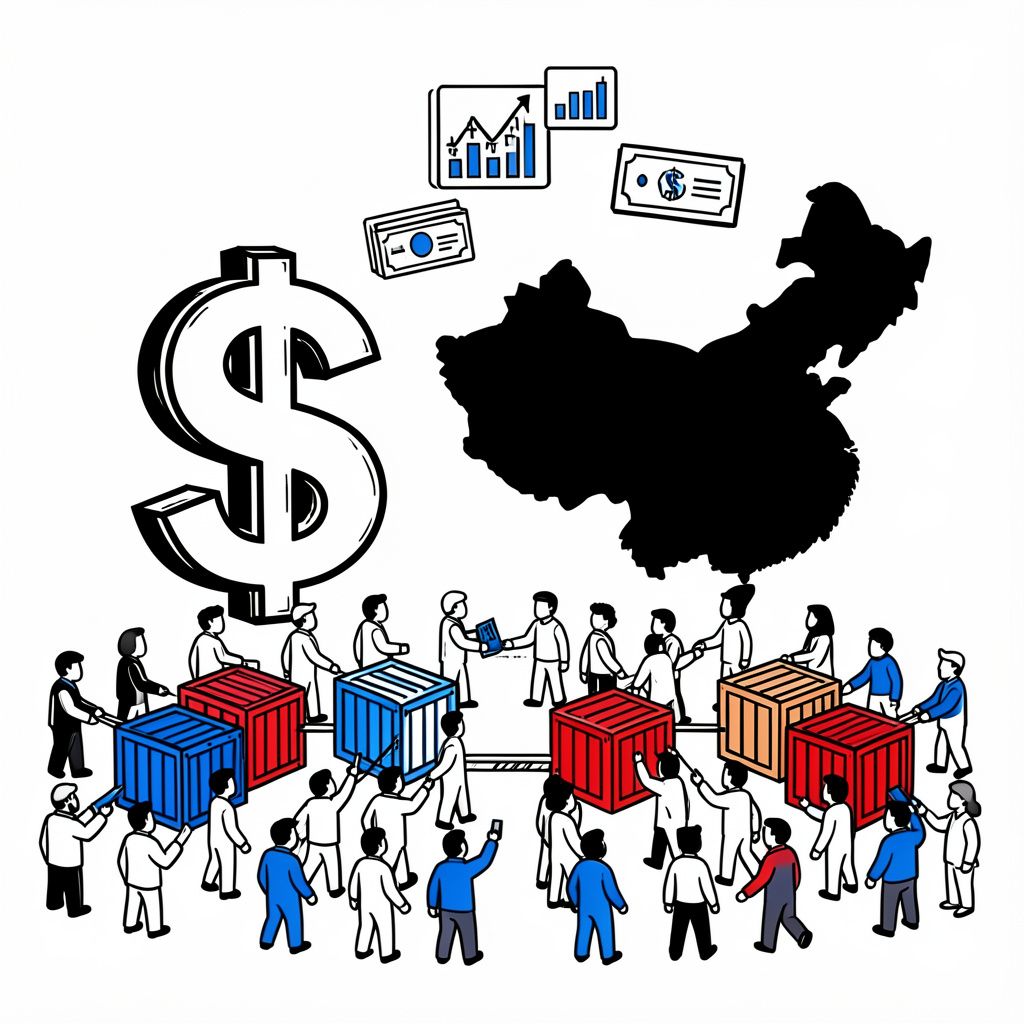
The White House accused over 40 nations of enabling a 60-billion-dollar trade scheme that routes Chinese goods through third-party countries to illegally bypass United States import tariffs.
Report Details Transshipment Mechanisms
On Thursday, 6 August 2026, the White House released a report titled ‘The Great Transshipment Scam,’ alleging that Chinese exporters systematically route goods through third-party nations to evade U.S. import levies [2][4]. Peter Navarro, Senior Counselor for Trade and Manufacturing, stated that this practice has allowed China to launder exports through more than 40 countries, robbing the U.S. treasury of tens of billions of dollars [2][4]. The Council of Economic Advisers estimates the scale of this trade at approximately $60 billion annually, though other organizations place the figure as high as $303 billion [3][4]. Accused nations include key economic allies such as Canada, Japan, and European Union member states, alongside emerging markets like Vietnam and Mexico [1][4].
Report Details Transshipment Mechanisms
The report outlines how exporters utilize limited assembly, relabeling, repackaging, and false country-of-origin declarations to disguise Chinese-origin products [2]. These goods often pass through production-side nodes for minor processing or logistics-side nodes for documentation alteration before entering the United States [3]. The White House categorizes the involved jurisdictions into three tiers, with Tier 1 including diversified scale leaders like Canada and the EU, where transshipment risk is embedded in broad legitimate trade [3]. Tier 2 and Tier 3 nations, such as Vietnam and Cambodia, are identified as utilizing deep supply chain integration or limited customs enforcement to facilitate rerouting [3].
Enforcement Measures and Economic Impact
To counter these tactics, President Trump signed Executive Order 14411 on 3 June 2026, enhancing importer accountability and trade transparency [3][4]. This order empowers U.S. Customs and Border Protection (CBP) with an AI-driven ‘Detective Border’ system designed to identify high-risk shipments and distinguish between legitimate nearshoring and illegal origin shifting [3]. Treasury Secretary Scott Bessent emphasized that illegal transshipment is a deliberate attempt to evade tariffs and undercut American workers [4]. The administration intends to utilize this framework to evaluate future trade data and determine if transshipment volumes decline following implementation [3].
Enforcement Measures and Economic Impact
Economic modeling within the report suggests significant costs to the U.S. economy, estimating that every $1 billion increase in the trade deficit from illegal transshipment displaces 6,000 U.S. jobs [3]. Based on a central case analysis of $75 billion in annual illegal transshipment flow, the report calculates a displacement of approximately 450,000 jobs using the formula 450000 [3]. Additionally, the central case projects between $113 billion to $150 billion in reduced annual GDP and $19 billion to $26 billion in lost federal revenue [3]. Revenue loss estimates vary by source, with the Department of Commerce estimating $27 billion to $49 billion in losses annually [3].
Long-term Trade Dynamics
The current enforcement push builds upon Section 301 tariffs initially imposed on 6 July 2018, which covered approximately 70% of Chinese exports to the U.S. [3]. While direct U.S.-China trade deficits reduced in 2019 and 2020, exporters subsequently shifted to routing goods through third-party jurisdictions [3]. The administration notes that comparing 526-day periods before and after the current inauguration, shipments with post-release discrepancies increased by 245% [3]. Ongoing assessments of trade and customs data from implicated countries will determine the efficacy of these anti-transshipment measures [3][4].